Battle of New Orleans: St. Louis Cathedral
Text
Facing Jackson Square and the Mississippi River, the Cathedral-Basilica of St. Louis, King of France, is the oldest Catholic cathedral in continual use in the United States. With its three steeples, St. Louis Cathedral, as it is commonly known, is one of New Orleans’ oldest and most recognizable landmarks. The Cabildo flanks the left (upriver) side of the Cathedral, while the Presbytere appears on the right. St. Louis Cathedral occupies the site of the first church in the area included in the 1803 Louisiana Purchase.
Bienville planned the church when he laid out the City of New Orleans in 1718, naming it St. Louis after the patron saint of the then reigning monarch of France. Established as a parish in 1720, the first church building on the site opened in 1727. The eighteenth-century church was destroyed by fire in 1788; the present church was dedicated as a cathedral on Christmas Eve, 1794. At his own expense, Don Andres Almonester y Roxas, a wealthy Spanish nobleman and father of Baroness Pontalba, built the Cathedral at a cost of $50,000, “on condition that a mass would be said in perpetuity every Sunday for the repose of his soul.” After his death in 1798, Almonester was buried in the cathedral.
The design reflected the usual Spanish style, with three round towers in front. The building was remodeled several times over the next few decades and steeples were raised on the towers.
"The side chapel on the north side is dedicated to the Sacred Heart of Jesus. Don Andres Almonester sleeps beneath a large slab on which is inscribed in Spanish his many deeds," according to a cathedral guidebook.
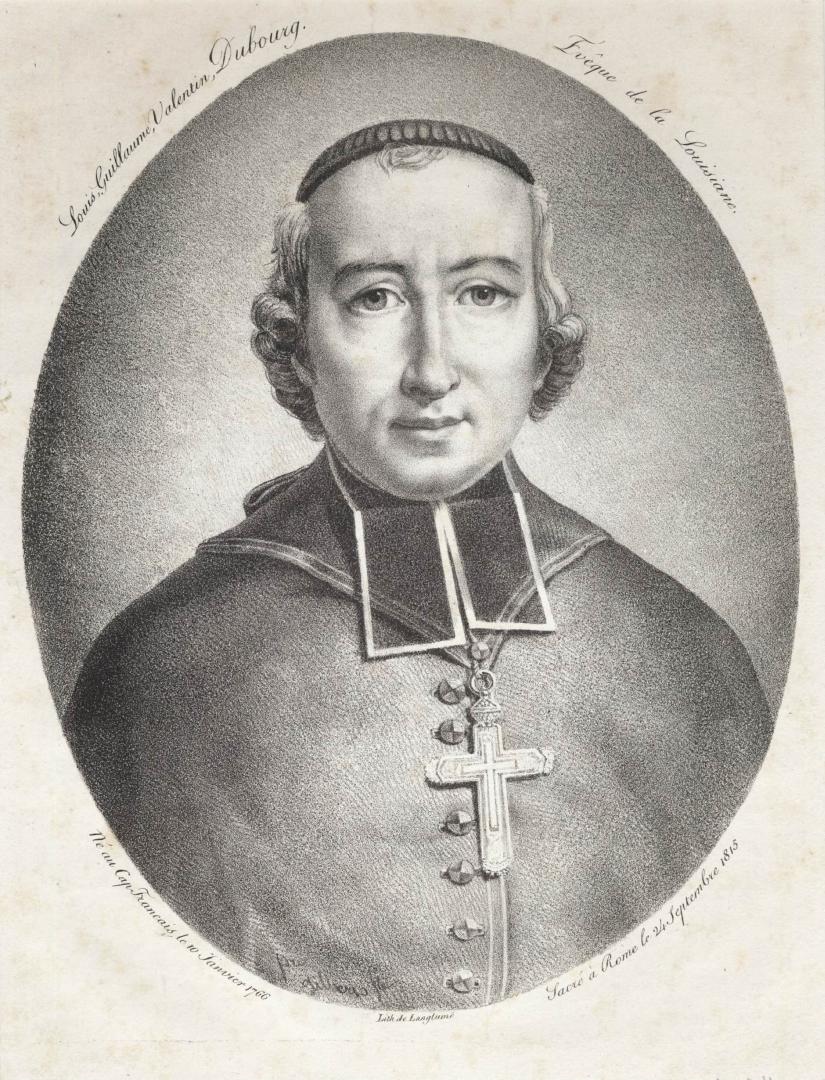
After the victory over British troops on January 8, 1815, General Jackson requested a thanksgiving service, an “external manifestation” of thanks to “the Ruler of all events.” Abbe Dubourg offered a solemn high Mass at St. Louis Cathedral on January 23, 1815. General Jackson and members of his troops attended the Mass and a solemn "Te Deum" of Thanksgiving was sung. On January 8, 1840, the twenty-fifth anniversary of the Battle of New Orleans, Andrew Jackson returned to New Orleans and attended a service at St. Louis Cathedral. Afterward, Jackson conducted a military review in Jackson Square. Mass is still celebrated daily at St. Louis Cathedral. Pope Paul VI designated the cathedral as a minor basilica on December 9, 1964.
Files
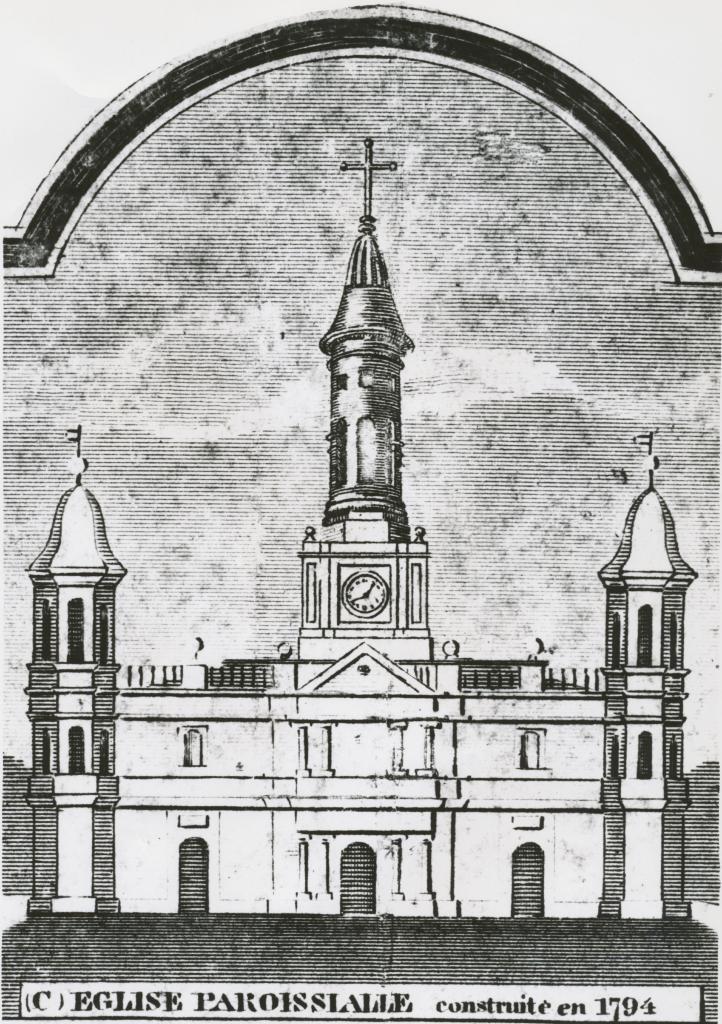
St. Louis Cathedral, 1815
Constructed in 1794, this version of the cathedral appeared roughly in this manner at the time of the Battle of New Orleans. Courtesy of the Collections of the Louisiana State Museum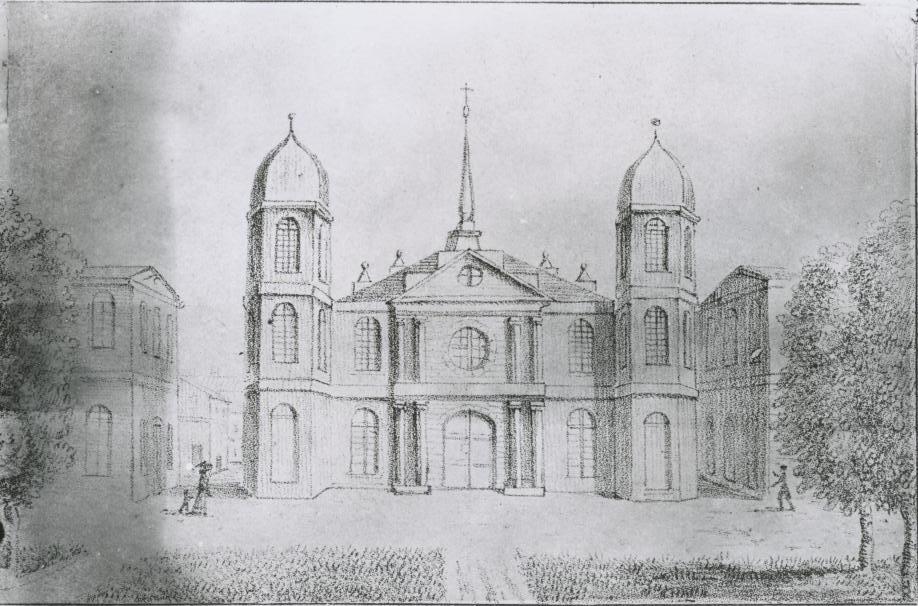
St. Louis Cathedral, circa 1820
Pirate's Alley, formerly Orleans Alley, appears on the left and ran between the Cathedral and the Cabildo. Pere Antoine's Alley, also known as St. Anthony Alley, appears on the right side; it ran between the cathedral and the Presbytere. Courtesy of the Collections of the Louisiana State Museum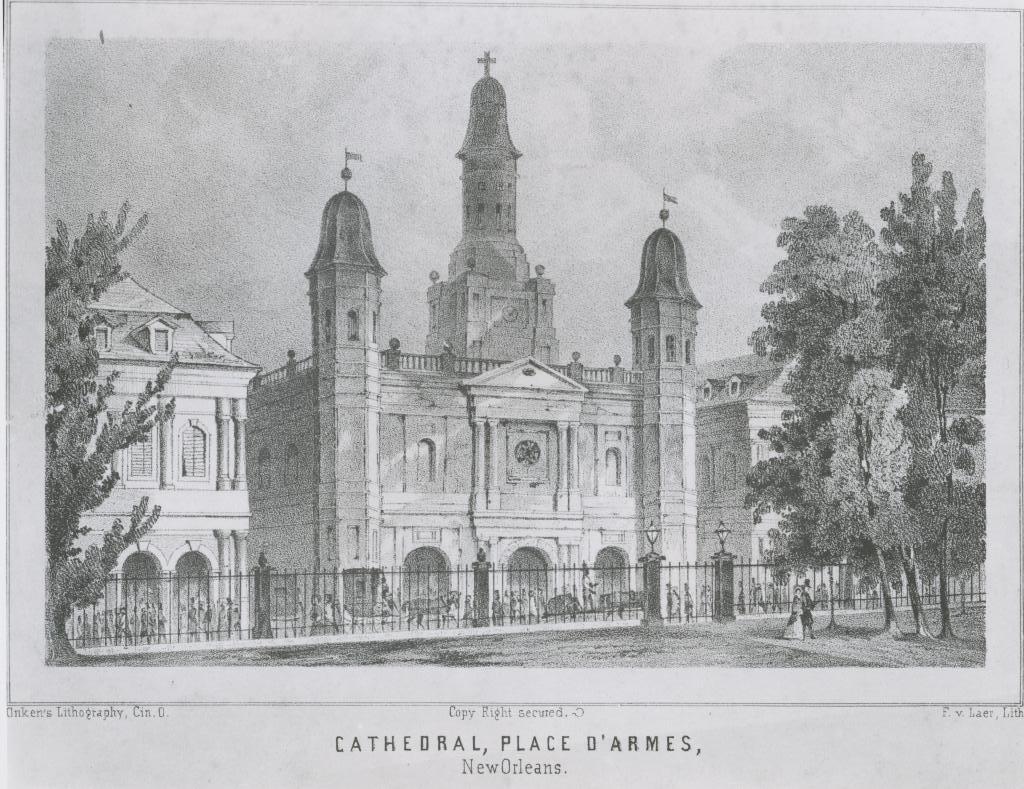
St. Louis Cathedral and Place D'Armes, 1847
St. Louis Cathedral as it appeared in 1847 flanked by the Cabildo on the left and the Presbytere on the right. | Source: Courtesy of the Collections of the Louisiana State Museum.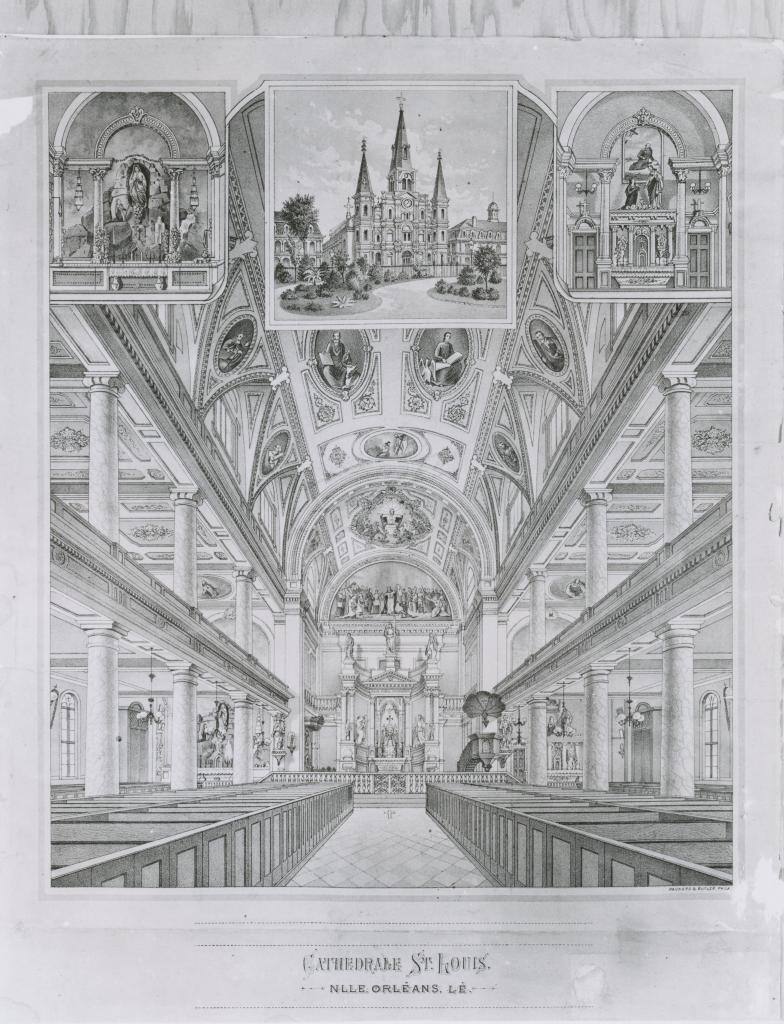
Interior view of St. Louis Cathedral around 1850
Source: Courtesy of the Collections of the Louisiana State Museum.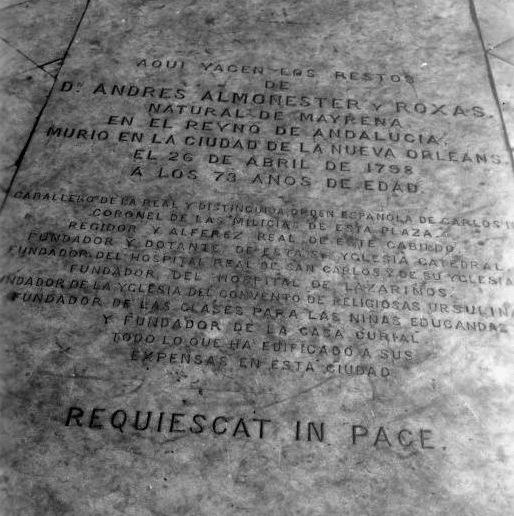
Burial Slab
This engraved slab in St. Louis Cathedral marks the burial site of Don Andres Almonester y Roxas, the father of the Baroness de Pontalba, who died in April 1798. After a fire destroyed the original church in 1788, Don Andres Almonester donated $50,000 of his own fortune to build the second St. Louis Cathedral, which was completed in 1794. State Library of Louisiana.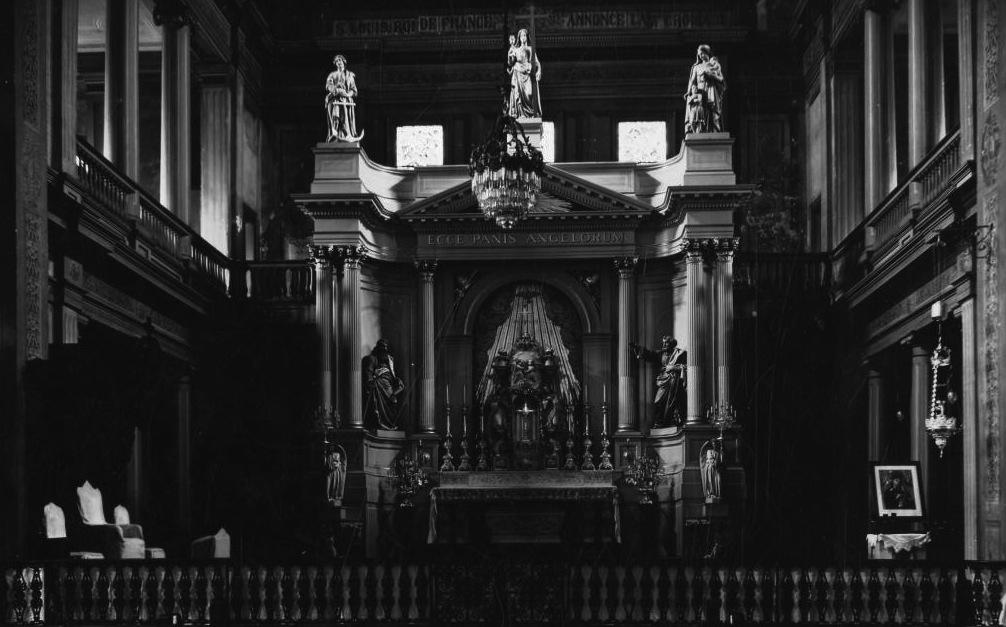
Main Altar in St. Louis Cathedral, circa 1930s
State Library of Louisiana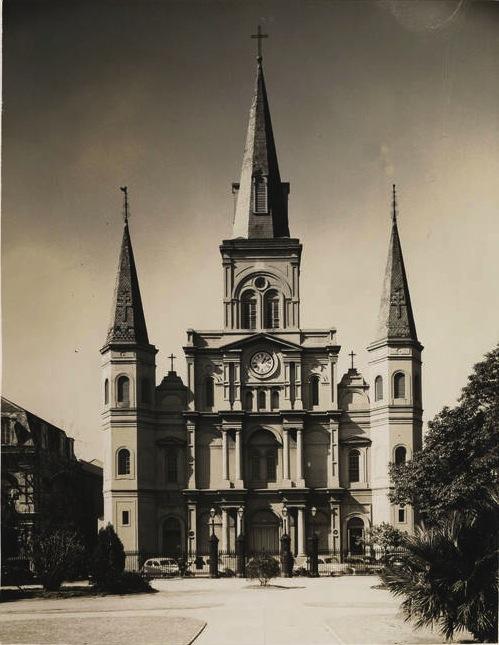
A 1940 image of St. Louis Cathedral with its three steeples viewed from Jackson Square.
Source: Courtesy of the Collections of the Louisiana State Museum.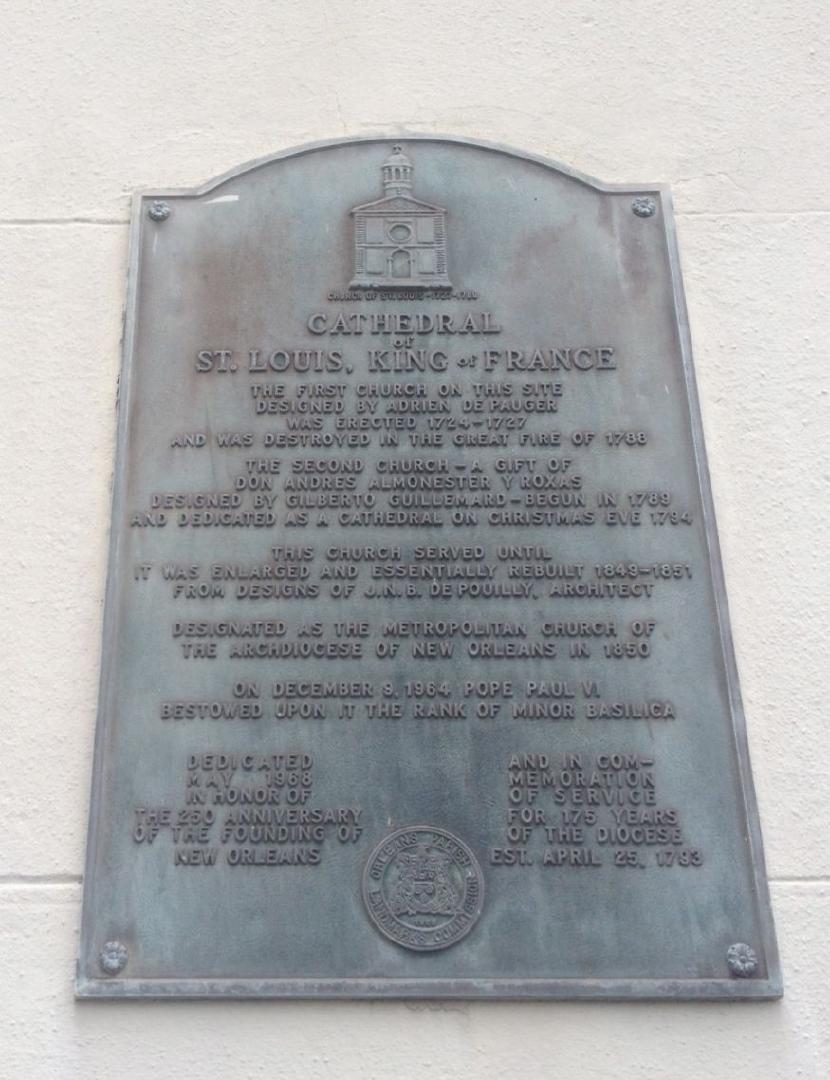
St. Louis Cathedral Plaque
This plaque summarizes the building's various incarnations. Photograph by Mary Ann Wegmann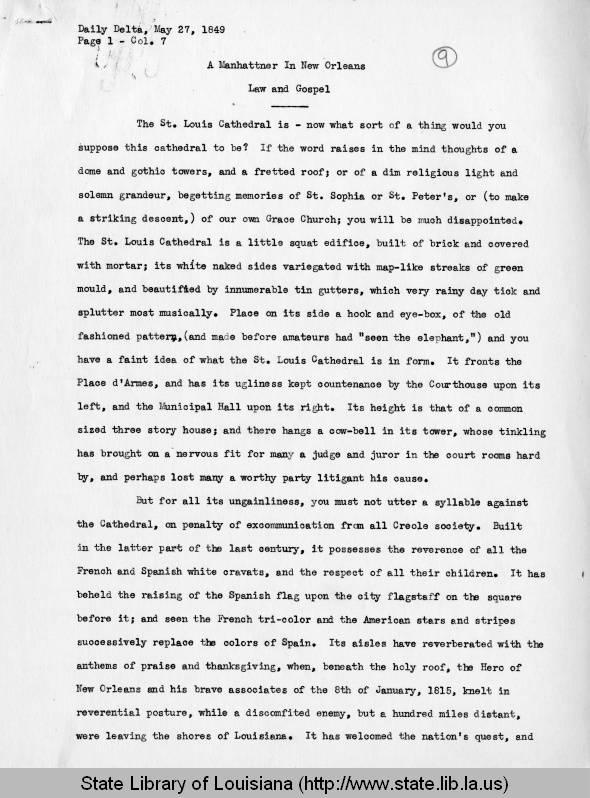
Account of New Orleans
A New Yorker described St. Louis Cathedral in 1849 as a “little squat edifice” with “a cow-bell in its tower,” where Jackson and his troops “knelt in reverential posture” after their victory at the Battle of New Orleans. State Library of Louisiana.