Archaeology of the St. Peter Street Cemetery
Text
The St. Peter Street Cemetery served as the City of New Orleans’ primary burial ground through most of the Colonial era, from 1724 (and possibly earlier) until 1789, when it was officially replaced by St. Louis Cemetery No. 1. It still appears to have occasionally been used into the 1790s, particularly when flooding made it difficult to access the new cemetery. The St. Peter Street burial ground was utilized by all segments of New Orleans society in the Colonial era, or at least by anyone who was baptized as Catholic, including early European settlers, native-born ‘whites’, Native Americans, and free people of color. Those who were enslaved were also buried at the St. Peter site, including those of both African and Native American descent.
A disproportionate number of the people whose remains have been recovered archaeologically during the two efforts to date appear to be of African descent, and at least some also show signs of mixed Native American ancestry. At this point, there is no way of knowing if this is because the cemetery was spatially segregated or if it is due to some other factor. It is also likely that at least some of the individuals were enslaved in life, something that may be indicated by pathologies suggestive of shackling on one individual’s ankle, healed parry fractures (produced when the forearm is used to ward off blows), and osteological signs of heavy physical labor and dietary stress. While we will likely never be able to link specific sets of human remains to individuals in the records, there are interesting stories that emerge from both sources.
Files
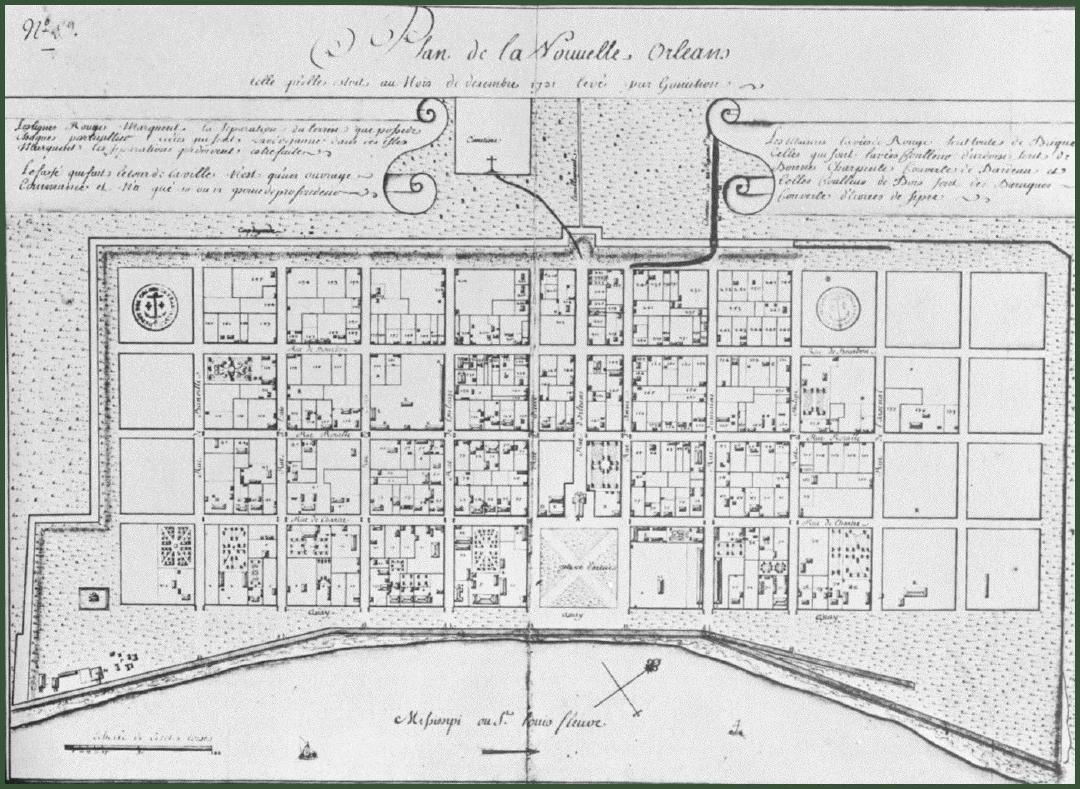
Plan de la Nouvelle Orléans telle qu'elle estoit au mois de dexembre 1731 levé par Gonichon. Décembre 1731. Souvenir reproduction.
This reproduction of the 1731 Gonichon map shows the St. Peter Street Cemetery area still outside of the developed portion of the city. | Source: Image courtesy of The Historic New Orleans Collection.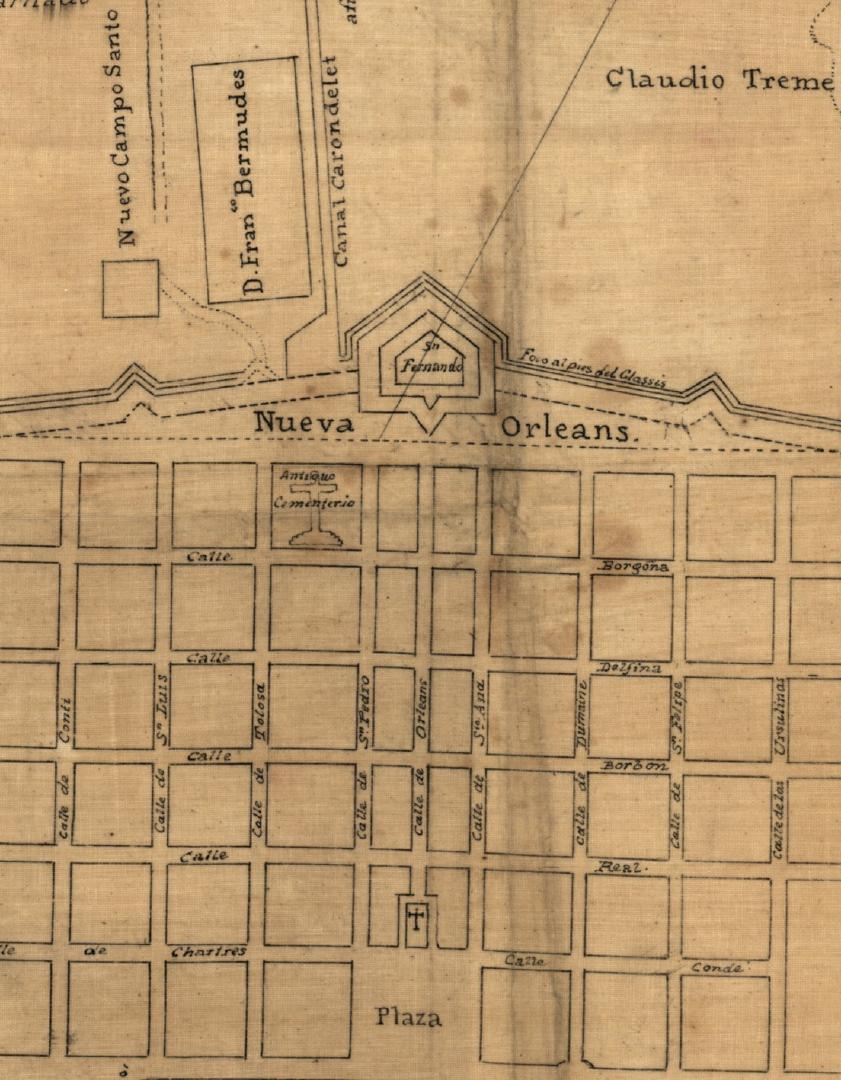
Excerpt from Map of New Orleans and Vicinity by Vicente Sebastián Pintado.
The 1804 Pintado map of New Orleans shows both the St. Peter Street site, referred to as the old cemetery, inside the city walls, and the new one, just to the outside of them. | Source: Library of Congress, Map Division, G4014.N5G46 1819.P5 Vault. | Date: The map is an 1873 copy of an 1804 map copied by Pintado in Havana in 1819.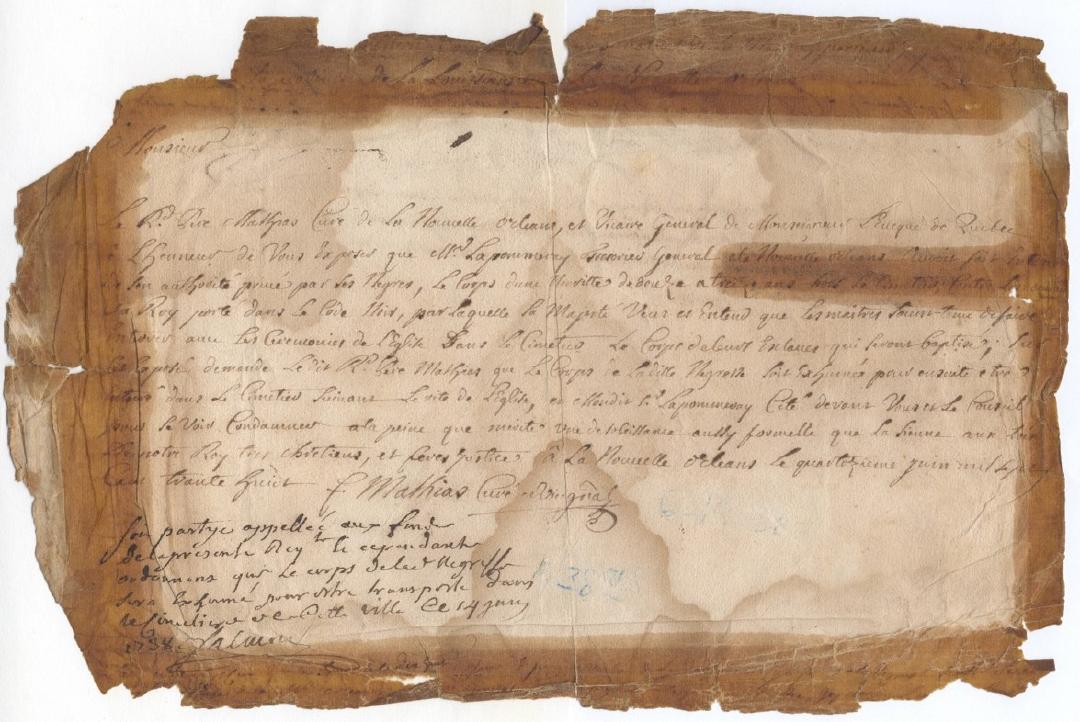
1738 06-14 French Superior Council Record. (Petition for cemetery burial of baptized female slave, age 13 years, body to be exhumed from grave outside cemetery.)
The importance with which burial within the consecrated ground of the cemetery was held is seen in a 1738 case involving a petition to the Superior Council, in which an enslaved girl was to have her body exhumed and reburied at the site. In it, Father Mathias reported that Monsieur Loquet de la Pommeraye, the Treasurer General, had his slaves bury “the body of a negress of twelve or thirteen years, out of the cemetery, contrary to the ordinance of the King in the Code Noir, by which His Majesty wills and intends that the masters be obliged to inter the bodies of their baptized slaves in the cemetery, with the ceremonies of the Church.” The girl was exhumed and reburied in the cemetery, and Loquet de la Pommeraye was fined of thirty livres to be applied to fencing the cemetery (Cabildo Archives 293; transcription of documents available at http://www.mylhcv.com/colonial-treasurer-general-of-new-orleans-sued-by-vicar-general from Louisiana Historical Quarterly, October 1920). | Source: Image courtesy of the Louisiana State Museum. https://louisianadigitallibrary.org/islandora/object/lsm-p15140coll60%3A1391 | Date: June 14, 1738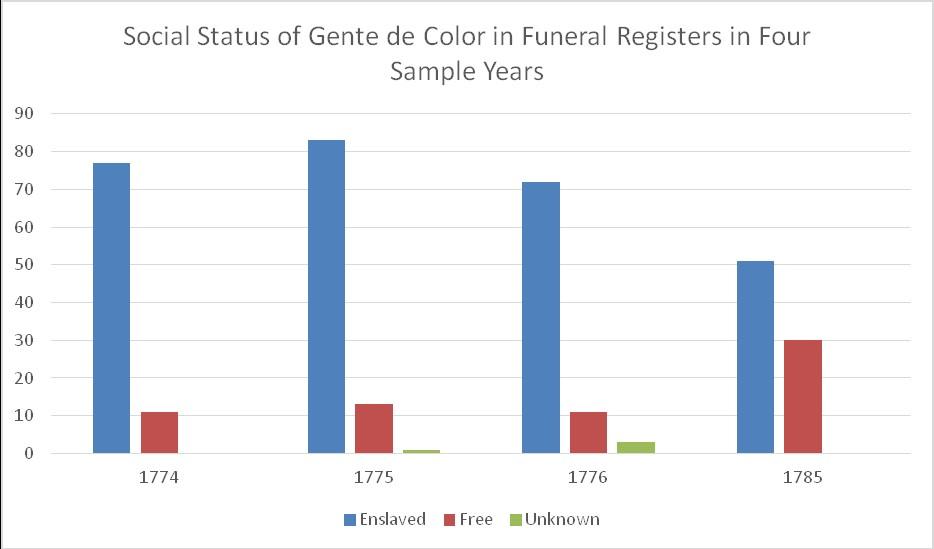
Social status of ‘Gente de Color’ buried in St. Peter Street Cemetery in selected years.
Some of the Colonial-era Sacramental Records for New Orleans were destroyed in the 1788 fire, but some funeral records have been preserved in the Archives of the Archdiocese of New Orleans. Beginning in 1772, during the Spanish era, burials of whites (or ‘blancos’) were enumerated in separate registers from people of color (“gente de color”), who are broken down into a number of different categories, including “negro”, “mulato”, “grifo”, “quateron”, and “Yndio”. Those of both ‘slave’ (“esclavo”) and free (“libre”) status are enumerated in the registers for people of color. The sacramental records are well-known as a source of genealogical information, but, because so many of the people of color in them are listed without clear surnames, they have often received somewhat less attention from researchers. | Date: 2013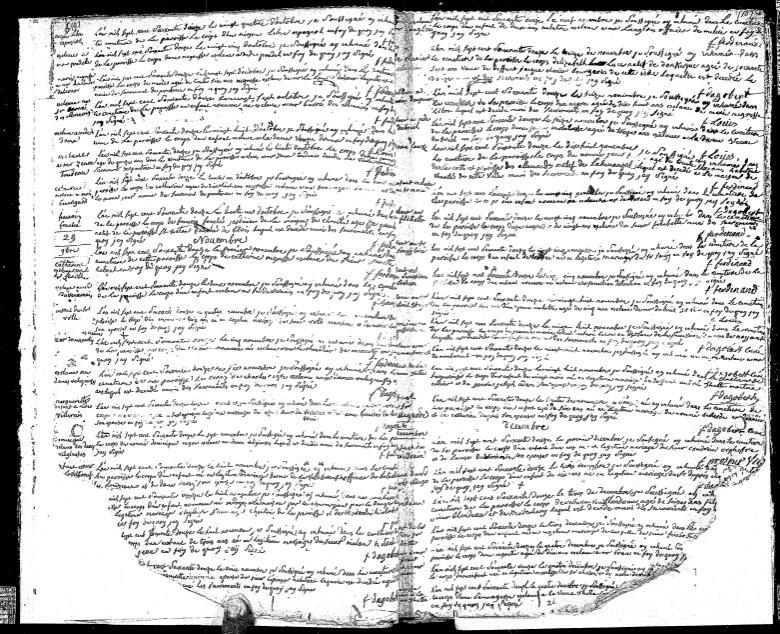
Sample page from “Gente de Color” funeral registers from St. Louis Cathedral.
A number of ‘Yndios/Indios’ appear in Spanish period records, including both free individuals, like a man recorded as “Mingo Houppas”, an apparent chief of the Choctaw (identified in the burial record as the “Gran Hefe o Cacique de los Salvages Chactas”), who died at Charity Hospital on 30 August, 1775 after receiving the rites of baptism, and ones enslaved. The enslavement of Native Americans had ostensibly been outlawed in Spanish colonies, but the practice continued in Louisiana long after it became a Spanish colony. | Source: Credit as per source (Archdiocese). [Seek Permission] | Date: Original copy created between 1772-1793.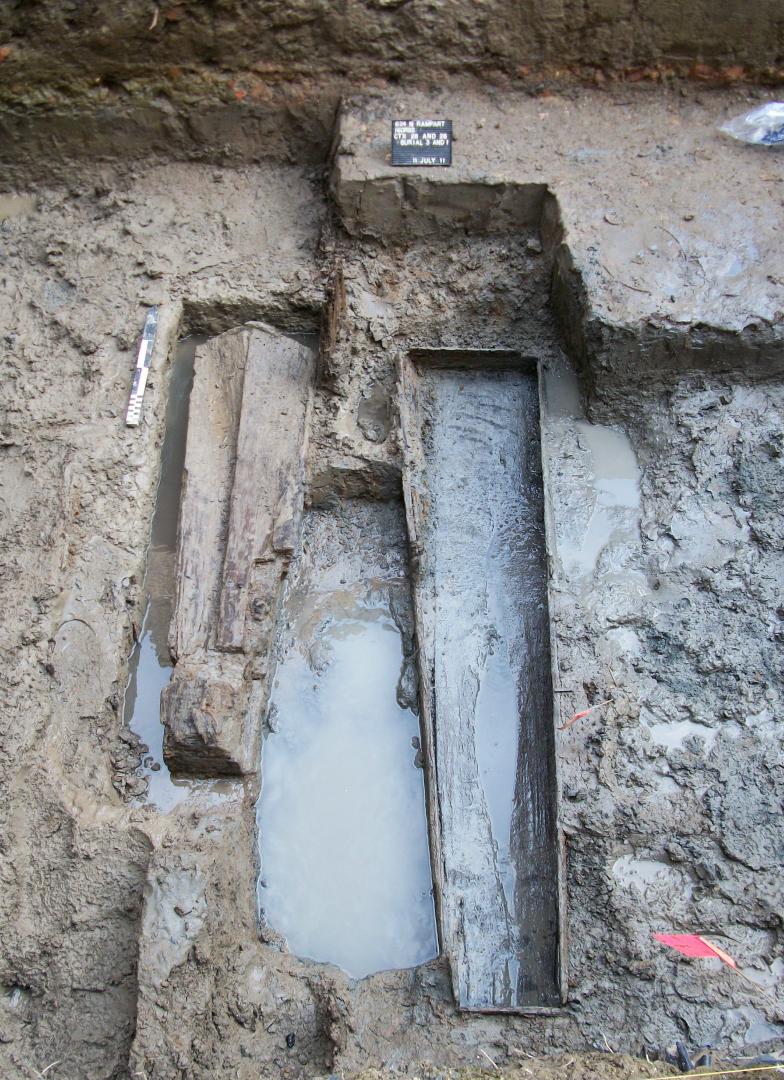
Closely Spaced Coffins at St. Peter Street Cemetery During 2011 Excavations
Archaeological excavations in both 1984 and 2011 confirmed just how full the cemetery had been: coffins were closely packed, with shafts from new graves often intersecting or located on top of earlier ones. In many cases, skeletal materials from disturbed earlier graves were thrown back into new graves on top of coffins by eighteenth-century grave diggers. | Source: Collections of UNO Archaeology Lab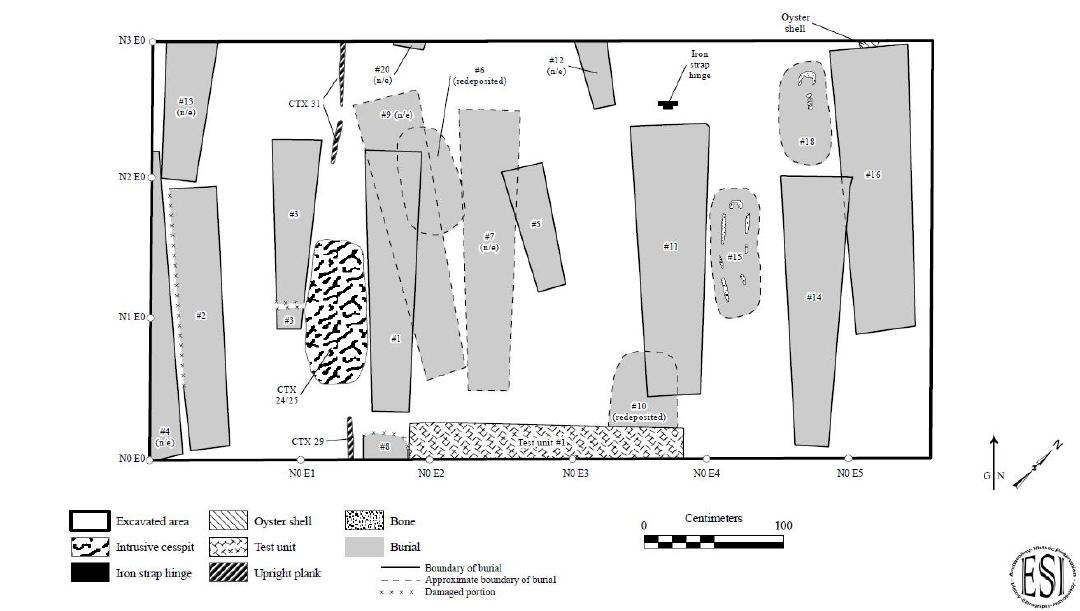
Plan of Excavated Area in 2011
Excavations in an area of about 3 m by 6 m in 2011 identified no less than 20 burials, and archaeologists recovered remains of at least 15 individuals. Many identified burials were left interred because they were not going to be disturbed by the planned development. | Source: Courtesy of UNO Department of Anthropology and Sociology. | Date: August 2011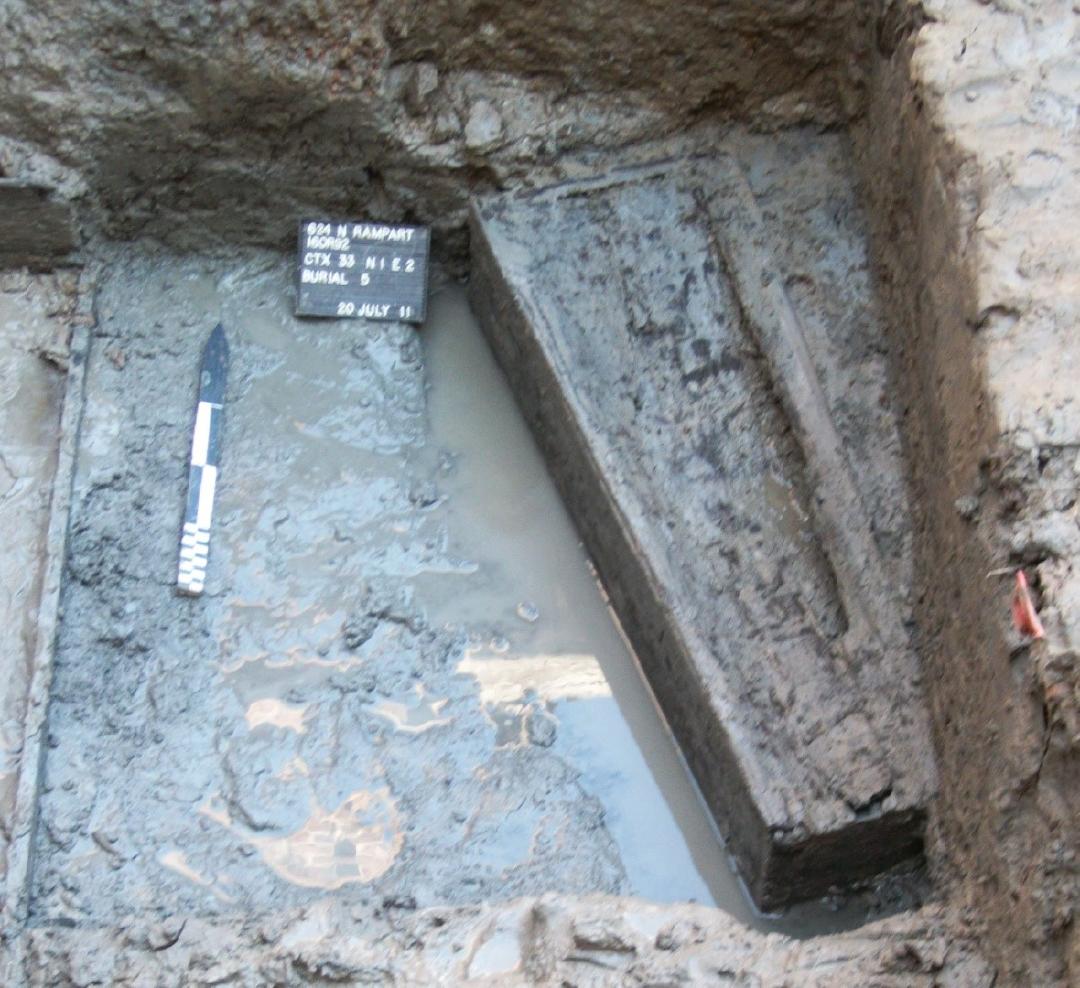
Burial 5
Recovered burials were identified at the LSU FACES lab to sex, ethnicity/ancestry, age at death, pathologies, and so on, through standard forensic methods. This individual, a child of African descent only 2-4 years old at time of death, probably was interred in the 1760s. Based on the demographics of the Louisiana colony at the time, he or she likely would have been enslaved in life. | Source: Courtesy of UNO Department of Anthropology and Sociology. | Date: 20 July 2011.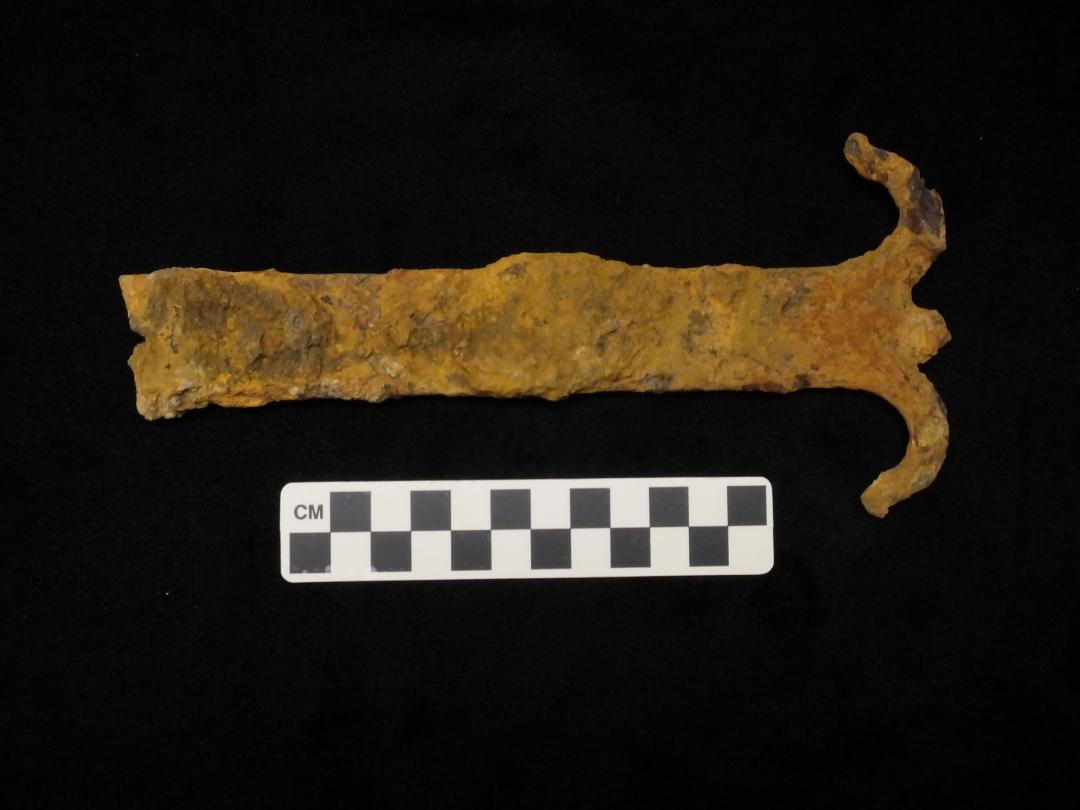
Strap hinge used to mark head of grave.
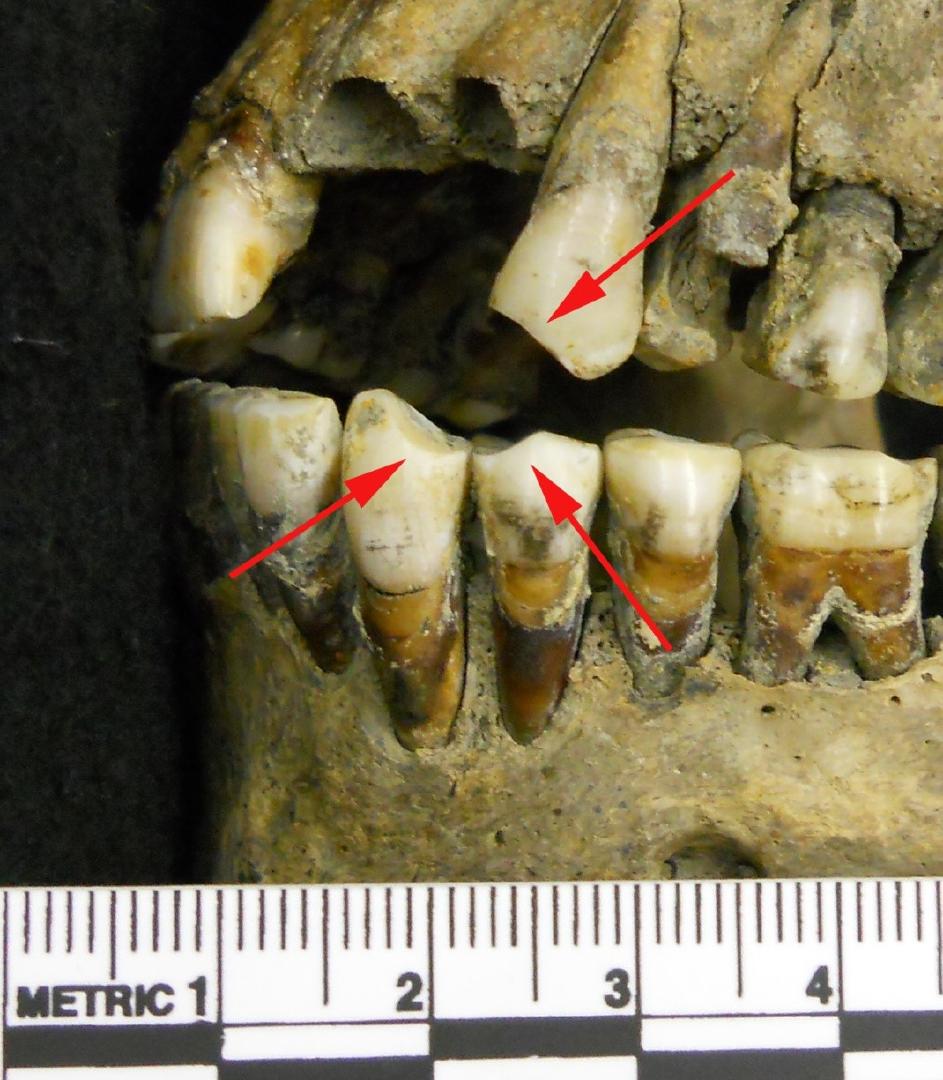
Few graves still had markers associated with them, and it was assumed that these had been cleared prior to development of the lot. There were some exceptions; this iron strap hinge, for instance, had been inserted vertically at the head of the grave of an adult man, perhaps to mimic a Christian cross. The man himself was apparently of mixed African and Native American descent, as indicated by shoveling of the incisors, a genetic trait associated with Asian and Native American populations; this trait occurred in at least 4 of the 15 individuals recovered in 2011, a surprisingly high number speaking to the intensity of African-Native American interactions in the early part of the Colonial era. | Source: Courtesy of UNO Department of Anthropology and Sociology. | Date: 14 April 2015.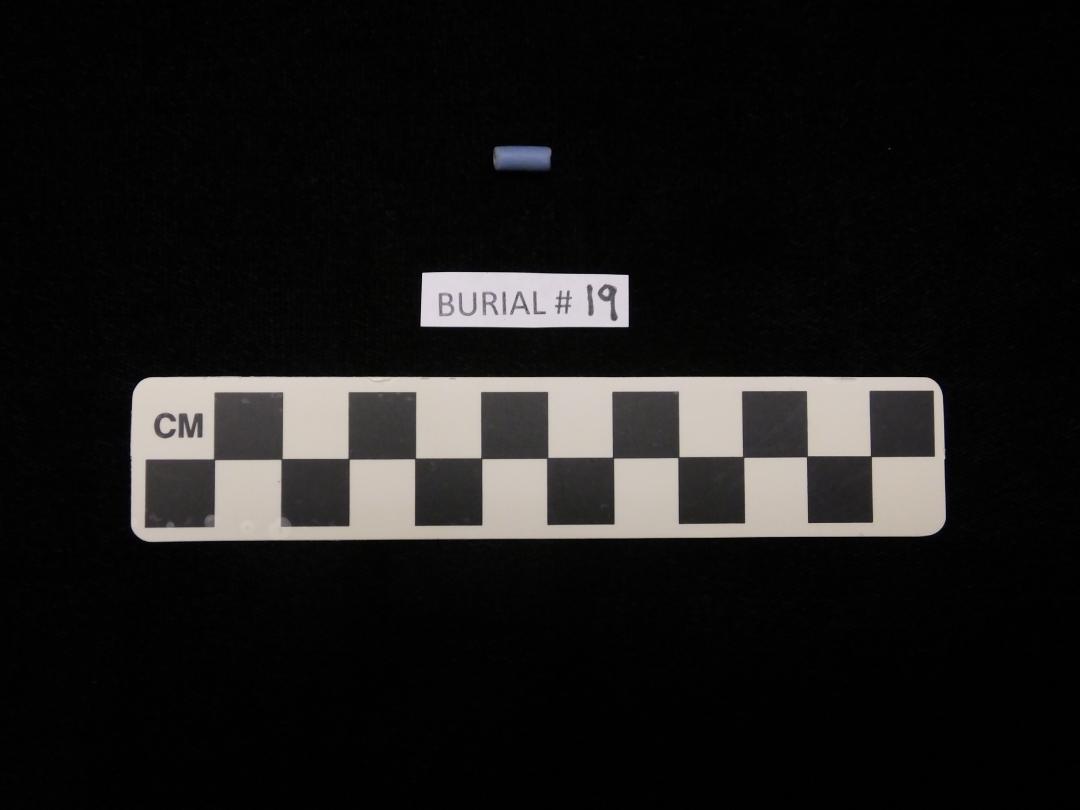
Blue bead associated with Burial #19
This single tubular blue glass bead was recovered from the vicinity of the neck of Burial #19, a non-coffin burial likely that of a woman of mixed African and Native ancestry. She was buried close by a child, also without a coffin, and it is possible that they were interred as part of a single interment. Blue glass beads have been the source of considerable speculation in the archaeology of African America, with their prevalence suggested as deriving from use as protective charms in West Africa. | Source: Courtesy of UNO Department of Anthropology and Sociology. | Date: 13 April 2015