<?xml version="1.0" encoding="UTF-8"?>
<feed xmlns="http://www.w3.org/2005/Atom">
  <title type="text">New Orleans Historical</title>
  <updated>2026-08-24T16:58:09+00:00</updated>
  <generator uri="http://framework.zend.com" version="1.12.20">Zend_Feed_Writer</generator>
  <link rel="alternate" type="text/html" href="https://mail.neworleanshistorical.org/"/>
  <link rel="self" type="application/atom+xml" href="https://mail.neworleanshistorical.org/items/browse?output=rss2"/>
  <id>https://mail.neworleanshistorical.org/</id>
  <author>
    <name>New Orleans Historical</name>
    <uri>https://mail.neworleanshistorical.org</uri>
  </author>
  <link rel="hub" href="https://pubsubhubbub.appspot.com/"/>
  <entry>
    <title type="html"><![CDATA[ Benjamin Franklin Senior High School: Dedication Ceremony ]]></title>
    <summary type="html"><![CDATA[<img src="https://mail.neworleanshistorical.org/files/fullsize/a1672565cc6fc567600a189f4f7ec7e2.jpg" alt="Dedication Ceremony Pamphlet, 1958" /><br/><p>Benjamin Franklin Senior High School was dedicated on November 10, 1957. The dedication was sponsored by the Orleans Parish School Board, and it included the formal presentation of the building by a school board member to William Kutz, President of the Student Council.</p><p>If not for the efforts of the late Charles Meynier, the building may not have survived as a public school. Owner of a hardware store on Maple Street and a leader of the Maple Street merchants, Meynier had attended McDonogh 23 School. He questioned the School Board's plans for the property in the 1950s as the building sat empty. Many believed that the building might give way to an A&P grocery store.</p><p>Meynier circulated a petition in Carrollton and generated 2200 signatures in support of the Carrollton Courthouse. The School Board had declared that the building was unfit for a school but eventually decided to locate Ben Franklin School there. </p><p><em><strong><a href="https://mail.neworleanshistorical.org/items/show/431">For more (including 2 images) view the original article</a></strong></em></p>]]></summary>
    <published>2012-11-13T02:41:38+00:00</published>
    <updated>2026-07-15T16:20:34+00:00</updated>
    <link rel="alternate" type="text/html" href="https://mail.neworleanshistorical.org/items/show/431"/>
    <id>https://mail.neworleanshistorical.org/items/show/431</id>
    <author>
      <name>Adrienne Luck&amp;#32;&amp;amp;&amp;#32;Mary Wegmann</name>
    </author>
  </entry>
  <entry>
    <title type="html"><![CDATA[ Benjamin Franklin Senior High School: Student Life ]]></title>
    <summary type="html"><![CDATA[<img src="https://mail.neworleanshistorical.org/files/fullsize/63c5d8bdea87133f2a71f9d95e1ddd3c.jpg" alt="Latin Club performing in front of the school " /><br/><p>The school opened in September 1957 with 103 students at the Sophomore level.  Junior and Senior levels were added in subsequent years. The high school was created to provide college preparatory training for students with exceptional ability in academic fields. Its origins are also tied to Cold War politics and the "space race" with the Soviet Union.  Franklin integrated in 1963 with scarcely any problems, unlike several other Orleans Parish Public Schools. Students throughout the city were able to apply for admission, as long as they scored well on an intelligence exam and had a good school record. Once admitted, students were required to maintain a B average or better.  </p><p>In order to house the students appropriately, the building was renovated and refurbished to provide relatively modern facilities. The main building was never air conditioned. However, care was taken to preserve its historic architecture. Franklin relocated to its present location on the University of New Orleans campus during the 1989-90 academic year. The courthouse has continued to serve as a school building, first for Lusher Middle School and more recently for Audubon Montessori.</p><p><em><strong><a href="https://mail.neworleanshistorical.org/items/show/432">For more (including 11 images&#32;&amp;&#32;4 audio files) view the original article</a></strong></em></p>]]></summary>
    <published>2012-11-13T02:55:07+00:00</published>
    <updated>2026-07-15T16:20:34+00:00</updated>
    <link rel="alternate" type="text/html" href="https://mail.neworleanshistorical.org/items/show/432"/>
    <id>https://mail.neworleanshistorical.org/items/show/432</id>
    <author>
      <name>Adrienne Luck </name>
    </author>
  </entry>
  <entry>
    <title type="html"><![CDATA[ McDonogh No. 23]]></title>
    <summary type="html"><![CDATA[<img src="https://mail.neworleanshistorical.org/files/fullsize/9bf8fe82c91f339b23fd30d696d310c3.jpg" alt="McDonogh Number 23" /><br/><p>Several years after New Orleans annexed the Town of Carrollton in 1874, the former Carrollton Courthouse began to be used as a public school. The city was able to make the purchase because of the donations of John McDonogh. In 1889, after renovations were complete, the school opened as John McDonogh No. 23. Until 1952, it remained one of the many McDonogh schools throughout New Orleans.  </p><p><em><strong><a href="https://mail.neworleanshistorical.org/items/show/424">For more (including 2 images&#32;&amp;&#32;1 video) view the original article</a></strong></em></p>]]></summary>
    <published>2012-11-12T01:29:05+00:00</published>
    <updated>2026-07-15T16:20:34+00:00</updated>
    <link rel="alternate" type="text/html" href="https://mail.neworleanshistorical.org/items/show/424"/>
    <id>https://mail.neworleanshistorical.org/items/show/424</id>
    <author>
      <name>Adrienne Luck</name>
    </author>
  </entry>
  <entry>
    <title type="html"><![CDATA[&quot;Bonnie Blue Flag:&quot; The Most Dangerous Song of the Civil War ]]></title>
    <summary type="html"><![CDATA[<img src="https://mail.neworleanshistorical.org/files/fullsize/0982691ca4aba61b7e307d810b78d0b7.jpg" alt="&quot;The Bonnie Blue Flag&quot;" /><br/><p>The popularity of sheet music in the United States had reached its peak by the start of the Civil War. Well before the development of recording and broadcasting technology, the commercial music industry centered upon the circulation of sheet music played by both amateur and professional musicians. To enjoy popular music, consumers either had to perform the songs themselves, attend public concerts, or participate in informal gatherings. This made music a more interactive and socially engaging experience than the passive role today’s recording industry creates for listeners. </p><p>The nationalization of the sheet music industry in the late nineteenth century stifled the production of songs created by local musicians and composers. In the mid-1800s, however, music created by local and regional musicians readily found its way to audiences via the many music publishers found in various US cities. These conditions allowed a song popularized through performance in New Orleans to become a controversial anthem of the Confederacy. Historian E. Lawrence Abel speculates that A.E. Blackmar and Bro. ran the South’s most successful sheet music publishing house. Among other tunes, such as "Missouri, or a voice from the South," and "Dixie," Blackmar published one of the earliest imprints of Harry Macarthy’s popular song “Bonnie Blue Flag.” </p><p>In May 1862, Union forces entered New Orleans and the city became one of the first occupied territories in the South during the Civil War. From May to December 1862, General Benjamin Butler ruled over the city. His legacy is marked by his severe social policies. General Order No. 40 states that "Any person who has in his possession...any property of any kind or description whatever, of the so-called Confederate States...shall be liable to imprisonment and to have his property confiscated." With this order, owning or singing one of the most popular songs of the period became an act of treason. Arrest records from New Orleans papers reveal that men and women were regularly arrested for singing "Bonnie Blue Flag," and were charged with a range of penalties, from a fine to time in the workhouse to a full pardon. </p><p>A few months before Butler took over the city, advertisements for A.E. Blackmar and Bro. disappeared from the newspapers. Henry, the oldest Blackmar brother, relocated his publishing operation to Atlanta, where it remained successful for the duration of the war. Armand Blackmar stayed to run the shop in New Orleans, but was not quite as lucky. Butler, acting on General Order No. 40, is said to have arrested Blackmar and ransacked his shop, destroying all Confederate materials inside. By the time we see Blackmar in New Orleans again, Butler had been removed from the city and replaced by General Nathaniel Prentiss Banks, who is known to have pursued a more socially lenient approach to running New Orleans than his predecessor. </p><p>In November 1863, advertisements for Blackmar reappeared in the newspapers of New Orleans, but no longer promoted "The Bonnie Blue Flag." These advertisements also reported a change of address from 74 Camp Street to 167 Canal Street, where Blackmar continued to publish music for the duration of the war. Paper and ink were in scarce supply by this point in the war, forcing some publishers to print on recycled materials such as wallpaper and develop new ways to make ink for printing. However, despite material shortages and Union presence, Blackmar's success in the final years of the war suggests that the demand for sheet music remained strong in occupied New Orleans. </p><p>After the Civil War and the collapse of the Confederacy, "The Bonnie Blue Flag" developed a life of its own. In the second decade of the twentieth century, the song was revived as a symbol of Lost Cause mentality in the midst of fifty-year commemorations of the War. During the Civil Rights era, "The Bonnie Blue Flag" once again became a song of protest, this time against the integration of public spaces. It even found its way back into the classroom, as one New Orleans resident remembers learning it at his elementary school in the 1950s. It can even be heard in current movies such as <em>Gods and Generals</em> and, more perplexingly, the video game <em>Bioshock</em>. The long afterlives of this song have sometime divorced it from its original meaning, but its memory also reveals how music played a role in the city's experience of the Civil War.</p><p><em><strong><a href="https://mail.neworleanshistorical.org/items/show/806">For more (including 8 images&#32;&amp;&#32;1 video) view the original article</a></strong></em></p>]]></summary>
    <published>2014-03-23T22:25:22+00:00</published>
    <updated>2026-08-24T00:37:32+00:00</updated>
    <link rel="alternate" type="text/html" href="https://mail.neworleanshistorical.org/items/show/806"/>
    <id>https://mail.neworleanshistorical.org/items/show/806</id>
    <author>
      <name>Jessica Anne Dauterive</name>
    </author>
  </entry>
  <entry>
    <title type="html"><![CDATA[&quot;House Sold to Out-of-Towner&quot; Tennessee Williams Moves In]]></title>
    <summary type="html"><![CDATA[<img src="https://mail.neworleanshistorical.org/files/fullsize/137200b3266c965de65b6c3966588748.jpg" alt="1014 Dumaine Street, 1964" /><br/><p>Tennessee Williams was no stranger to New Orleans. Some of his most famous works, including <em>A Streetcar Named Desire</em>, are set in the city. Although Williams spent decades living on and off in rental spaces, 1014 Dumaine Street is the first home he owned in New Orleans. Purchased in 1962, the building was not always what one would imagine as the home of a world-renowned writer.
Articles in the <em>Times-Picayune</em> ranging from 1927 through 1959 painted the address as less than desirable. One 1952 <em>Times-Picayune</em> article even detailed the filing of a petition in Civic District Court by the city to get the Dumaine building either repaired or demolished, calling it “dangerously deteriorated.” Many of the newspaper’s other mentions of the site prior to the 1960s portrayed it as the home for various criminals. These residents’ reported crimes varied in severity. While some infractions were as minor as a truck driver not having a chauffeur’s license and a woman possessing “lottery paraphernalia,” others were as severe as gun theft, auto theft, and assault. A 1958 <em>Times-Picayune</em> article even mentioned the shooting of an 18-year-old man in front of the building.
However, the immediate neighborhood’s condition appeared to change as the 1950s became the 1960s. In July 1960, a <em>Times-Picayune</em> apartment listing at 1014 Dumaine Street boasted “luxury apartments” in a “magnificent building just recently restored.” A 1961 <em>Times-Picayune</em> article also featured 1014 Dumaine Street among properties in the French Quarter that underwent notable restorations and renovations. The article’s mention of rising property values, related to restoration projects throughout the French Quarter, implied a decline in affordability for renters in the Vieux Carre.
In 1962, just four years after the shooting on Dumaine Street, Tennessee Williams purchased the property at 1014 Dumaine, which likely retained little of its former dilapidation. However, Williams did not move into the building’s front, second floor apartment until 1972, when Don Lee Keith claims that some “bothersome” tenants moved out. Once moved in, Williams used the space as his base of operations in New Orleans for the remainder of his life.
Friends, locals, and tourists can recall instances when they stumbled into Williams at numerous French Quarter bars and restaurants. Recalling Williams’ New Orleans visits during this time, one of Williams’ former Dumaine Street tenants, Dr. Lawrence Hill, recalled a moment of excitement he shared with the writer: “One morning he came down and knocked on my door, all excited … <em>Esquire</em> magazine had agreed to buy a short story from him. Here he was, the most famous playwright in the country, and he was acting like he’d made his first sale. It was the most down-to-earth I’d seen him.” "He left $10 million when he died," Cynthia Ratcliffe, co-owner of Heritage Tours, said. "But [shortly before] his death, he could still be seen washing and folding his own socks in there,” she added, referring to a laundromat at the corner of Burgundy and Dumaine. </p><p>W. Kenneth Holditch’s recollection of a January 1979 encounter with Williams described the author’s frustrations with the changing nature of the French Quarter: “He commented on what he saw as the unpleasant changes to the Quarter that had been occurring over the past decade or more, including the increasing sleaziness of Bourbon Street, the loss of permanent residences to businesses, and the influx of tourists that made walking through the streets of some areas increasingly difficult. However, changing conditions in the neighborhood did not deter Williams from staying in his French Quarter home. In fact, a newspaper article published a few years after he died claimed Williams was seen on the Dumaine Street’s second floor balcony just a few weeks prior to his death in New York City in 1983."</p><p><em><strong><a href="https://mail.neworleanshistorical.org/items/show/962">For more (including 7 images) view the original article</a></strong></em></p>]]></summary>
    <published>2015-12-08T01:27:59+00:00</published>
    <updated>2026-07-15T16:20:31+00:00</updated>
    <link rel="alternate" type="text/html" href="https://mail.neworleanshistorical.org/items/show/962"/>
    <id>https://mail.neworleanshistorical.org/items/show/962</id>
    <author>
      <name>William Archambeault</name>
    </author>
  </entry>
  <entry>
    <title type="html"><![CDATA[&quot;On The Road&quot; in Algiers: The William Burroughs House]]></title>
    <summary type="html"><![CDATA[<img src="https://mail.neworleanshistorical.org/files/fullsize/212baf256ba2a260cb80e236dec61017.jpg" alt="509 Wagner Street, Algiers, Louisiana" /><br/><p>In January of 1949, a maroon Hudson sedan pulled up to the house at 509 Wagner Street in Algiers, Louisiana. The driver was Neal Cassady, and the passengers included Jack Kerouac, Al Hinkle, and LuAnne Henderson. They drove nonstop from New York to visit William S. Burroughs, who had bought the house in August 1948 for $3500 and lived with his common-law wife Joan Vollmer, her six-year old daughter Julie, and the couple’s two-year old son Billy. Hinkle’s newlywed wife Helen was also staying there. The visit, which lasted a few days, would become renowned as an episode in Kerouac’s iconic Beat Generation novel On The Road (1957). </p><p>Part of the fictionalized, autobiographical second journey chronicled in the novel, the arrival at Wagner Street to visit Burroughs (who is called Old Bull Lee) is narrated by Kerouac’s alter ego, Sal Paradise: “We went to Old Bull Lee’s house outside town near the river levee. It was on a road that ran across a swampy field. The house was a dilapidated old heap with sagging porches running around and weeping willows in the yard; the grass was a yard high, old fences leaned, old barns collapsed.” Burroughs was addicted to heroin and not particularly engaged in the local scene, other than, as Sal explains: “slipping along the streets with shady characters and haunting connection bars.” The travelers are excited to check out the New Orleans jazz scene, but Burroughs tells them they cannot because the city is segregated. They spend a day across the river on Canal Street, and Burroughs drives Kerouac to “go play the horses over to the bookie parlor in Graetna” [sic]. Most of the time, however, they hang out at Wagner Street, where Burroughs reads, philosophizes, shoots his air pistol, sets up a knife-throwing target, and encourages Kerouac to try out the “orgone accumulator,” a layered wood and metal box based on the theories of Wilhelm Reich that a man can sit inside to absorb “atmospheric atoms of the life-principle,” which he had constructed in the back yard. Burroughs tries to persuade Kerouac to remain in New Orleans and abandon what he sees as Cassady’s pointless cross-country traveling, but Kerouac, Cassady, and Henderson head back on the road. 509 Wagner Street was sold by the end of July 1949, but Burroughs’ time there also figured in his first novel, Junkie: Confessions of an Unredeemed Drug Addict (1953), published under the pseudonym William Lee and aimed at the pulp fiction market.</p><p><em><strong><a href="https://mail.neworleanshistorical.org/items/show/1453">For more (including 7 images) view the original article</a></strong></em></p>]]></summary>
    <published>2019-02-04T23:50:41+00:00</published>
    <updated>2026-07-15T16:20:27+00:00</updated>
    <link rel="alternate" type="text/html" href="https://mail.neworleanshistorical.org/items/show/1453"/>
    <id>https://mail.neworleanshistorical.org/items/show/1453</id>
    <author>
      <name>Robert H. Cataliotti </name>
    </author>
  </entry>
  <entry>
    <title type="html"><![CDATA[&quot;Tolerating&quot; Gambling]]></title>
    <summary type="html"><![CDATA[<img src="https://mail.neworleanshistorical.org/files/fullsize/2c96ecc5af534c91c7b959ce7b97cfd1.jpg" alt="Louisiana State Sheriffs Literally Turning Their Backs on Slot Machines at Brunie&#039;s Restaurant." /><br/><p>The state of illicit gambling in New Orleans was summed up well in the 1938 WPA New Orleans City Guide, "although gambling is, strictly speaking, illegal, these places are usually open for business from dusk to dawn." Gambling had a strong presence throughout the Greater New Orleans Area. </p><p>According to Hank Staples, part owner of the Maple Leaf Bar, "there was a lot of gambling; it was tolerated. I guess more than tolerated because it was so wide open, so blatant." Al Kleindienst, a lifetime resident of the Greater New Orleans Area, shared some of his memories of the prevalence of gambling as well. "They had a sheriff out that way [Arabi], who had his own place," Al said in a 2012 interview. "He had chips that had his initials on it." </p><p>Below you will find an excerpt from a video interview with New Orleans resident Buddy Adams discussing the past prevalence of gambling houses. </p><p><em><strong><a href="https://mail.neworleanshistorical.org/items/show/441">For more (including 2 images&#32;&amp;&#32;1 video) view the original article</a></strong></em></p>]]></summary>
    <published>2012-11-15T04:53:37+00:00</published>
    <updated>2026-07-15T16:20:34+00:00</updated>
    <link rel="alternate" type="text/html" href="https://mail.neworleanshistorical.org/items/show/441"/>
    <id>https://mail.neworleanshistorical.org/items/show/441</id>
    <author>
      <name>Christina Lawrence&amp;#32;&amp;amp;&amp;#32;Kathryn O&amp;#039;Dwyer, editor</name>
    </author>
  </entry>
  <entry>
    <title type="html"><![CDATA[“Confined in the Dungeons”: Orleans Parish Prison and Self-Emancipated People]]></title>
    <summary type="html"><![CDATA[<img src="https://mail.neworleanshistorical.org/files/fullsize/95154524bad7e7e953ccdd44603e09e2.jpg" alt="Old Parish Prison" /><br/><p>Located in Treme, the original Orleans Parish Prison stood where the Municipal Auditorium and Louis Armstrong Park stand today. From the 1830s to 1895, the prison housed individuals accused of crimes, including enslaved people who attempted to free themselves from bondage. [1] </p><p>The nineteenth-century newspaper advertisements in the images below come from <a href="https://freedomonthemove.org/">Freedom on the Move</a>, a database of fugitive slave advertisements including those placed by jailors appealing to enslavers to claim ownership of runaways. If someone accused a Black person in New Orleans of running away from slavery, jailors imprisoned them until their enslaver paid the bond. Black people, enslaved or free, lived under the constant threat of incarceration. Laws required free people of color to carry court-issued documents proving free status, known as freedom papers. The failure to show freedom papers at the request of any white person could result in imprisonment or enslavement. [2] </p><p>In 1895, The Times-Picayune described Orleans Parish Prison as “the place where refractory slaves were sent to receive a dose of cat o’nine tails, or to be confined in the dungeons… in extreme cases the rebellious blacks were kept immured in the dark cells on a diet of bread and water until reduced to the proper degree of submission.” [3] Jailors subjected enslaved people to degrading and torturous prison conditions as a punishment for running away. </p><p>It is not known exactly how many enslaved people spent time locked away behind these now forsaken walls. Nonetheless, the Orleans Parish Prison jailors’ advertisements reveal a lot of information about self-emancipated people and their experiences of physical escape to resist punishment, violence, and the other brutal conditions of slavery. [4] Names, physical descriptions, skills, family connections, and many more personal and individual characteristics surface in the advertisements. We can also learn how long a self-emancipated person lived outside of the confinements of slavery. During this time, self-emancipated people fostered a greater sense of privacy, autonomy, and freedom. </p><p>Even though many self-emancipated people ended up in bondage once again in the Orleans Parish Prison, their efforts show how enslaved people resisted enslavement and created their own freedom.</p><p><em><strong><a href="https://mail.neworleanshistorical.org/items/show/929">For more (including 10 images) view the original article</a></strong></em></p>]]></summary>
    <published>2015-04-23T19:19:59+00:00</published>
    <updated>2026-07-15T16:20:32+00:00</updated>
    <link rel="alternate" type="text/html" href="https://mail.neworleanshistorical.org/items/show/929"/>
    <id>https://mail.neworleanshistorical.org/items/show/929</id>
    <author>
      <name>Lauren Smith, Kathryn O&amp;#039;Dwyer, Editor,&amp;#32;&amp;amp;&amp;#32;Brett Todd. Contributor</name>
    </author>
  </entry>
  <entry>
    <title type="html"><![CDATA[“Don’t Wear Your Good Shoes Up Here”: The Arcadia and Alamo Dance Halls of Prohibition Era New Orleans ]]></title>
    <summary type="html"><![CDATA[<img src="https://mail.neworleanshistorical.org/files/fullsize/bbf320d7821a4b47bb8efbd8cd2f1b6e.jpg" alt="Cartoon advertisement for The Fischbein-Williams Syncopators jazz group posted at the Arcadia Dance Hall." /><br/><p>In the 1920s and 1930s, the second floor of 1001 Canal Street was home to the Arcadia and Alamo Dance Halls. These dance halls served as a space for thirsty men in New Orleans to cut loose at the height of Prohibition. Prohibition, enacted in January 1920 by the 18th Amendment, made the manufacture and sale of alcohol federally illegal throughout the United States, but nowhere housed more scofflaws than New Orleans. When Izzy Einstein, a famous 1920s customs agent, traveled to New Orleans to enforce Prohibition, he remarked that it took only thirty-five seconds to find alcohol. The driver of a taxi that Einstein hailed at the train station offered a swig of liquor from a bottle stashed beneath a seat. [2] </p><p>One of sixty-three dance halls in New Orleans, the Arcadia was known as a ‘closed,’ or ‘nickel-a-dance’ hall, primarily catering to single men without dates who would pay for dances from the women employed by the establishment. [3] The women working in these closed halls were known as ‘hostesses’ and club owners encouraged them to dance, drink, and converse with the male clientele. [4] In 1924, New Orleans Item journalist <a href="https://neworleanshistorical.org/items/show/1602">Dorothy Day</a> went undercover as a hostess in the Arcadia dance hall. Day's first-hand account of dance hall goings-on gives us an in-depth glimpse into New Orleans nightlife in the 1920s. Day describes the diverse clientele of the Arcadia as “transients, salesmen, sailors and boys from the army and navy, [and] high school boys out seeing life.” [5] Alcohol consumption was everywhere, especially in the practice of ‘B-drinking’, a scheme wherein women wokring at the dance hall would convince gullible male suitors to buy them the most expensive drinks. Police officers frequented the dance hall and often overlooked the sale of alcohol - for a fee. [6] Like most music venues in the city, jazz was the music of choice for the dance halls at 1001 Canal. The dance halls hosted a variety of jazz acts, including The Fischbein-Williams Syncopators and the world-famous banjoist/guitarist, Danny Barker. [7, 8]</p><p><em><strong><a href="https://mail.neworleanshistorical.org/items/show/1601">For more (including 3 images) view the original article</a></strong></em></p>]]></summary>
    <published>2020-06-30T22:59:31+00:00</published>
    <updated>2026-07-15T16:20:25+00:00</updated>
    <link rel="alternate" type="text/html" href="https://mail.neworleanshistorical.org/items/show/1601"/>
    <id>https://mail.neworleanshistorical.org/items/show/1601</id>
    <author>
      <name>Joseph LeDesma</name>
    </author>
  </entry>
  <entry>
    <title type="html"><![CDATA[“They Would Not Let Me Quit”: Black Greek Life in The University Center at UNO]]></title>
    <summary type="html"><![CDATA[<img src="https://mail.neworleanshistorical.org/files/fullsize/7d60656f0a9359a353a61accedf80179.jpg" alt=" Phi Beta Sigma and Zeta Phi Beta Step Performance in the UC.
" /><br/><p>Located near the geographic center of the university, the University Center, or UC for short, host various offices such as the cafeteria, bookstore, ballroom, and staff offices for Student Involvement and Leadership. In the past, the UC also hosted the Admissions and Financial Aid offices. This meant that nearly every student, including members of Black Greek organizations, were required to pass through the UC. The UC was a place for socializing and a place for business. </p><p>Marie, an African American student who first began classes at UNO in 1967, once made the long walk from the Liberal Arts building to the UC while attending school. As an African American woman, there were many spaces where Marie felt unwelcomed. Marie did not feel that way when she was around her sorority sisters. Marie pledged the Sigma Gamma Rho Sorority in 1969, when the sorority was the only Black Greek organization on campus. </p><p>During her tenure at UNO, Marie studied French. Marie grew up in New Orleans, a segregated city where she was always surrounded by African Americans, just like her. Yet when she arrived at UNO, a predominantly White campus, Marie felt like a foreigner. She was the only African American in all her classes and all her professors were White.  After simply walking into class, she felt disadvantaged due to her skin color. One day, Marie received an essay back from her professor extensively marked with corrections and a poor grade. Marie felt discouraged, as if she couldn’t go on. In an oral history interview conducted in 2018, Marie reflected on what happened next:</p><p>“I was on my way to drop out of school. I was devastated, so I was, I’m crying walking across to the UC. Because at first, we didn’t have all the buildings that they have now. But they did have the UC. And I remember, a couple of my Sorors saw me, and they pulled me on the side. We looked out after each other, they looked out after you, we looked out after each other, they pulled me on the side you know, what’s the matter, why you crying. They talk, they literally kept me from dropping out of school. Because I was determined I would quit. They would not let me quit.”</p><p>The support Marie received from her sorority sisters prevented her from dropping out of the University. Marie went on to graduate with a degree in French. The support provided by the sorority not only benefited her, but all of her sisters, as she stated, “Everybody that pledged Sigma Gamma Rho, along the time I was there, graduated from UNO. Everybody.”</p><p>Marie’s story demonstrates the strong communal bonds Black Greek letter organizations fostered among members, and how those bonds supported the academic success of African American students. </p><p>As the central location on the campus of UNO, the University Center would host events for generations of UNO student organizations. This would be no different for Black Greek letter organizations. In 1990-1991, Alpha Phi Alpha celebrated its chapter anniversary, and both Phi Beta Sigma and Zeta Phi Beta won the Greek Week talent show doing a step performance. Performing these functions in this central location ensured Black Greek organizations would be highly visible to the student body. Having and maintaining this high level of visibility would prove to be an act of resistance. It was important to show that Black students were not only attending UNO, where they continued to be in the minority and unwelcomed but were showcasing their talents and resistance to the entire student body. </p><p><em><strong><a href="https://mail.neworleanshistorical.org/items/show/1517">For more (including 2 images) view the original article</a></strong></em></p>]]></summary>
    <published>2019-07-12T16:41:12+00:00</published>
    <updated>2026-08-24T00:33:30+00:00</updated>
    <link rel="alternate" type="text/html" href="https://mail.neworleanshistorical.org/items/show/1517"/>
    <id>https://mail.neworleanshistorical.org/items/show/1517</id>
    <author>
      <name>August Darbonne&amp;#32;&amp;amp;&amp;#32;Kathryn O&amp;#039;Dwyer, Editor</name>
    </author>
  </entry>
  <entry>
    <title type="html"><![CDATA[17th Street Canal Levee Breach in 2005]]></title>
    <summary type="html"><![CDATA[<img src="https://mail.neworleanshistorical.org/files/fullsize/6da126c13fe9a8ac2bb95732a92df94a.jpg" alt="Before the Flood " /><br/><p>In 1965, Hurricane Betsy demonstrated that a major hurricane could overtop the earthen levees of the 17th Street Canal. So the Army Corps of Engineers recommended two cost-effective plans which were 1) raising the height of the canal walls or 2) installing floodgates at the canal's mouth at the lakefront.  The Corps felt both could provide reliable hurricane surge protection. </p><p>Since the cost for both approaches was about the same, the Corps ultimately elected to raise the canal walls using I-walls (concrete capped steel sheet pilings). The Corps did this partly because the local sponsors (Orleans Levee Board and the Sewage and Water Board) preferred it.  The OLB and SWB viewed the floodgates plan as incompatible with their interior drainage responsibilities. (Note the gates plan did not include auxiliary pumps like those in place today.) </p><p>On August 29, 2005 at about 9:45 a.m, a monolith (30-foot long section of the concrete floodwall) failed sending torrents of water into New Orleans's Lakeview neighborhood.  The water level in the Canal at the time of failure was about 5 feet lower than the top of the wall.  The breach quickly expanded into a 450 foot wide gap through which storm surge water poured, killing hundreds (directly and indirectly), destroying hundreds of residences, and causing millions of dollars in property damage.  Thirty-one (31) bodies were recovered from areas directly flooded.</p><p>Today, the adjacent land is vacant of homes, buildings and trees.  Many foundations or slabs where homes once stood are all that remain.  The repaired breach site now consists of a different sturdier design called a T-wall.  Three times more expensive to build, the new wall is easily differentiated because of its different texture and different color.  It is also two feet thicker.</p><p>Post-disaster studies conclude that the breach was due to steel sheet pilings driven to depths that were too shallow. Sadly, in recommending the I-walls with such short sheet pilings, the Corps had relied upon a poorly executed and misinterpreted study it had conducted near Morgan City in 1988.  At a savings of $100,000,000, the Corps wrongly concluded it could short-sheet the steel pilings of the 17th Street Canal driving them to depths of not more than 17 feet instead of between 31 and 46.   </p><p>In January of 2008, Federal Judge Stanwood Duval, of the US District Court for Eastern Louisiana, held the US Army Corps of Engineers responsible for defects in the design of the concrete floodwalls constructed in the levees of the 17th Street Canal; however, the agency could not be held financially liable due to sovereign immunity provided in the Flood Control Act of 1928.</p><p><em><strong><a href="https://mail.neworleanshistorical.org/items/show/275">For more (including 10 images&#32;&amp;&#32;1 video) view the original article</a></strong></em></p>]]></summary>
    <published>2012-06-03T19:24:15+00:00</published>
    <updated>2026-07-15T16:20:35+00:00</updated>
    <link rel="alternate" type="text/html" href="https://mail.neworleanshistorical.org/items/show/275"/>
    <id>https://mail.neworleanshistorical.org/items/show/275</id>
    <author>
      <name>Levees.org</name>
    </author>
  </entry>
  <entry>
    <title type="html"><![CDATA[1886 Cycling Tour: New Orleans to Boston]]></title>
    <summary type="html"><![CDATA[<img src="https://mail.neworleanshistorical.org/files/fullsize/6371ef0fba3b4397ea3f6019207e5c85.jpg" alt="Thomas Stevens" /><br/><p>Early on Easter morning 1886, around a hundred people gathered at the Henry Clay Statue outside A. M. Hill Jewelers at St. Charles and Canal. Hill, captain of the New Orleans Bicycle Club, stood dressed in a riding outfit of brown corduroy and knee britches. Charlie Fairchild, Hill’s 23-year-old employee, arrived wearing his riding blue costume, including a flannel shirt, knee britches, and woolen stockings. He carried a pocketbook, a toothbrush, and a bottle of cologne, and from his shirt pocket dangled a watch and chain. Just before 6 o'clock, the appointed time of departure, Harry Fairfax, a nineteen-year-old reporter for his father's paper, The Daily Item, appeared, rolling his high wheel bicycle up Canal Street in the company of his parents and a party of young ladies.</p><p>These three members of the New Orleans Bicycle Club planned to ride from New Orleans to Boston, 1500 miles, in 30 days. Their destination was the national meet of the League of American Wheelmen. Other cyclists at that time were making long-distance tours across the United States and around the world. Thomas Stevens was simultaneously making his way through Asia that spring after having already cycled across North America and Europe. The three cyclists from New Orleans were the first to attempt a long-distance ride across the South. Roads were lacking and maps were non-existent, so the crew was forced to find its way as they went, often riding on railroad tracks. </p><p>The bicycles they rode were “penny farthings,” the high wheel bicycles of the 1880s. They had outfitted their machines, two Rudge Light Roadsters and a Columbia Roadster with the latest equipment. Strapped to the handlebars of each was a bundle of oiled cloth containing all they hoped they'd need for the next month: an extra suit of underwear, a pair of short pants, silk stockings and light shoes for the evenings, a rubber raincoat, an old bed sheet to be torn up for bandages and handkerchiefs, needles and thread, and toiletries including a toothbrush, a comb, a bottle of Pond’s Extract, and plenty of bandaging plaster.</p><p>Their tour proved arduous, as they met with record rainfall, boggy roads, flooded streams, and repeated injury. On the evening of May 24, 1886, they arrived in Boston with one day to spare.</p><p><em><strong><a href="https://mail.neworleanshistorical.org/items/show/502">For more (including 2 images) view the original article</a></strong></em></p>]]></summary>
    <published>2012-12-10T17:40:22+00:00</published>
    <updated>2026-07-15T16:20:34+00:00</updated>
    <link rel="alternate" type="text/html" href="https://mail.neworleanshistorical.org/items/show/502"/>
    <id>https://mail.neworleanshistorical.org/items/show/502</id>
    <author>
      <name>Lacar Musgrove</name>
    </author>
  </entry>
  <entry>
    <title type="html"><![CDATA[1887 Thanksgiving Day Bicycle Road Race]]></title>
    <summary type="html"><![CDATA[<img src="https://mail.neworleanshistorical.org/files/fullsize/1d9208f6713b8a3ca4488a548b0b5cf2.jpg" alt="West End Train" /><br/><p>On a crisp Thanksgiving Day in 1887, a crowd gathered beneath the bare branches of the sycamore trees in the center of Canal Street. Bisected by multiple street railway beds and flanked by the lace-ironwork balconies of multi-story buildings, the broad boulevard's offices and shops were closed, and the street, usually choked with traffic on a Thursday, was traveled by only a few mule-drawn streetcars and omnibuses, the animals’ hooves clopping steadily on the blocks of pavement. </p><p>The chatter among the crowd gathered at the rail stop rang with words like “flyer,” “header,” and “scortch,” and with the names “Captain Hill” and “Guillotte.” Wagers were likely passed between them, the men for money and cigars, and the women for gloves and handkerchiefs. Soon their conversations were drowned out by the hiss and rumble of a steam engine, and the throngs streamed into the seven cars of the special train of the West End line of the New Orleans City Railroad.  </p><p>All were going to the same place, the West End, one of the lakeside resorts to which the denizens of the city flocked on Sundays and holidays to find respite from the noise and filth of the city. The seven cars were packed with excited New Orleanians. The train pulled forward and a few blocks later, reaching Claiborne Avenue, stopped again at the “neutral ground,” the oak-shaded grass median that divided the avenue.  A crowd had gathered there, too. Men, women, and children jostled elbow to elbow, standing on tip toes and craning necks to get a look at the road. The train passengers pressed against the windows at one side of the car, jockeying for view. </p><p>Assembled at the large intersection were fifteen gentlemen dressed in short pants and riding caps, each wearing a distinctly-colored arm band and standing beside his high-wheel bicycle.  The train, functioning as a moving grand stand, would follow the cyclists as they dashed the five and a half miles up Canal Street and then along the New Basin Canal to Lake Pontchartrain. This was the Thanksgiving Day bicycle road race of 1887, and no one on the train had seen anything like it before.</p><p><em><strong><a href="https://mail.neworleanshistorical.org/items/show/503">For more (including 2 images) view the original article</a></strong></em></p>]]></summary>
    <published>2012-12-10T18:03:44+00:00</published>
    <updated>2026-07-15T16:20:34+00:00</updated>
    <link rel="alternate" type="text/html" href="https://mail.neworleanshistorical.org/items/show/503"/>
    <id>https://mail.neworleanshistorical.org/items/show/503</id>
    <author>
      <name>Lacar Musgrove</name>
    </author>
  </entry>
  <entry>
    <title type="html"><![CDATA[1892 General Strike]]></title>
    <summary type="html"><![CDATA[<img src="https://mail.neworleanshistorical.org/files/fullsize/23b65d5ae1e7da20bc63b52f35d4c811.jpg" alt="Strike Headquarters: Three Brothers&#039; Saloon" /><br/><p>Shortly before the arrest of Homer Plessy in June 1892, a successful streetcar strike initiated a wave of union organizing that culminated in what has been called the first biracial general strike in US history. Between 20,000 and 25,000 union workers, who together with their families represented a great deal of the city’s population, stopped work on November 8 and remained on strike until November 11.  The workers organized a city-wide united front called the Workingmen’s Amalgamated Council, located on Exchange Alley. The strikers abandoned the main goal of the action—securing the right to bargain collectively within a union shop in all workplaces—under the threat of martial law.  The strike itself, however, represented labor's temporary rejection of the race-baiting and fear-mongering practiced by white workers as well as businessmen.  Significantly, one black union representative served on the negotiating committee. </p><p>The 1880s had been marked by several integrated labor strikes and demonstrations, but stirrings of the general strike originated in May 1892, when the streetcar operators’ successful walkout won recognition for a closed shop and shorter hours, from 16 to 12 hours per day.  Local labor unity was enhanced throughout the year, as the American Federation of Labor's (AFL) organizing campaign added 30 new unions to the previous 65.  African-American labor organizer George Norton was mostly responsible for the AFL's success in chartering biracial unions.</p><p>The Board of Trade proclaimed that it would sign an agreement with the Scalesmen and Packers' unions, but not with the third group in the Triple Alliance—the Teamsters' Union—because the Board refused to “‘enter into any agreement with n— —rs.’”  To do so would mean placing the employers under the command of blacks, they argued.  Following two postponements, the general strike went into effect on November 8.  About half of the city’s unions joined in the strike, and all of them demanded the closed shop.  The streetcar and printers’ unions broke contracts to join the strike.  The powerful cotton trade unions remained at work, and their employer, the Cotton Exchange, refrained from appearing to cooperate with the Board of Trade.  Without precedent, workers from lower-middle-class occupations with no previous attempts to organize, such as musicians, clothing and shoe store clerks, and workers from the utility companies such as the gas and waterworks also participated in the strike. One of the humblest groups of toilers imaginable, those largely black and immigrant street railway workers who built and maintained the rail systems, did not seem to join in the general strike.  Shortly after the carmen’s successful May strike, tracklayers for one of the railway companies also tried to strike.  The company fired the track crews and quickly replaced them.</p><p>Pro-labor Mayor John Fitzpatrick refused the business community’s calls to intervene to end the strike, so Governor Murphy Foster prepared to send state militia into New Orleans. The threat of violence caused the organizers of the General Strike to bring it to an end and accept labor agreements written on terms set by business. Wage increases were provided, but the settlement did not include recognition of unions. The streetcar union and its contract had been dissolved once they had decided to participate in the General Strike.</p><p>Though unsuccessful, the strike’s broad reach throughout the working class and middle-class community likely owed much to the earlier success of the carmen in securing their union shop contract. Still, organized labor in New Orleans lost much, especially the streetcar workers, whose union recognition ended. The day the strike ended, the Item’s “Labor Department” offered the following review of the strike: “Both to the working and employing classes this demonstration must prove of great value.  It should convince even the hardest task masters—and it is by this class that the strike was caused—that even the humblest toilers have rights deserving of consideration.”</p><p><em><strong><a href="https://mail.neworleanshistorical.org/items/show/489">For more (including 8 images&#32;&amp;&#32;1 audio file) view the original article</a></strong></em></p>]]></summary>
    <published>2012-12-07T00:31:52+00:00</published>
    <updated>2026-08-24T00:40:33+00:00</updated>
    <link rel="alternate" type="text/html" href="https://mail.neworleanshistorical.org/items/show/489"/>
    <id>https://mail.neworleanshistorical.org/items/show/489</id>
    <author>
      <name>Michael Mizell-Nelson </name>
    </author>
  </entry>
  <entry>
    <title type="html"><![CDATA[1929 Streetcar Strike]]></title>
    <summary type="html"><![CDATA[<img src="https://mail.neworleanshistorical.org/files/fullsize/f6a3d6620e358da7062fae4673859292.jpg" alt="Strike supporters at Canal Streetcar Barn" /><br/><p>Following increasingly heated contract negotiations, New Orleans streetcar motormen and conductors struck beginning July 1, 1929. The survival of the carmen's union and 1,100 jobs was in question. Transit strikes throughout the nation provoked emotional displays of public support, and the 1929 strike ranks among the nation's most violent.</p><p>The strike was the culmination of years spent fighting over control of the workplace. Transit managers with New Orleans Public Service, Inc. (NOPSI) had worked to develop a company union whose leaders had once been officers of the AFL union. The former president of the  Amalgamated Association of Street and Electric Railway Employees of America Division No. 194 now headed a rival, company union known as the Progressive Benevolent Association.</p><p>For the first few days, no streetcars operated. When the company attempted to run the cars on July 5 using "strike breakers" (career criminals brought in from New York), brickbats and jeering crowds stopped all but one. More than 10,000 New Orleanians gathered downtown and watched strike supporters disable and then burn the first car operated by a strike breaker. These excerpts from the video documentary Streetcar Stories feature eyewitness accounts about the most violent day of the strike.</p><p>To learn more about how this strike created one of New Orleans' most iconic foods, check out our tour stop about the <a href="https://neworleanshistorical.org/items/show/480" target="_blank" rel="noreferrer noopener">Po-Boy Sandwich</a>.</p><p><em><strong><a href="https://mail.neworleanshistorical.org/items/show/514">For more (including 4 images, 1 audio file,&#32;&amp;&#32;4 videos) view the original article</a></strong></em></p>]]></summary>
    <published>2012-12-31T04:29:46+00:00</published>
    <updated>2026-08-24T00:39:51+00:00</updated>
    <link rel="alternate" type="text/html" href="https://mail.neworleanshistorical.org/items/show/514"/>
    <id>https://mail.neworleanshistorical.org/items/show/514</id>
    <author>
      <name>Michael Mizell-Nelson</name>
    </author>
  </entry>
  <entry>
    <title type="html"><![CDATA[1946 Flambeaux Strike]]></title>
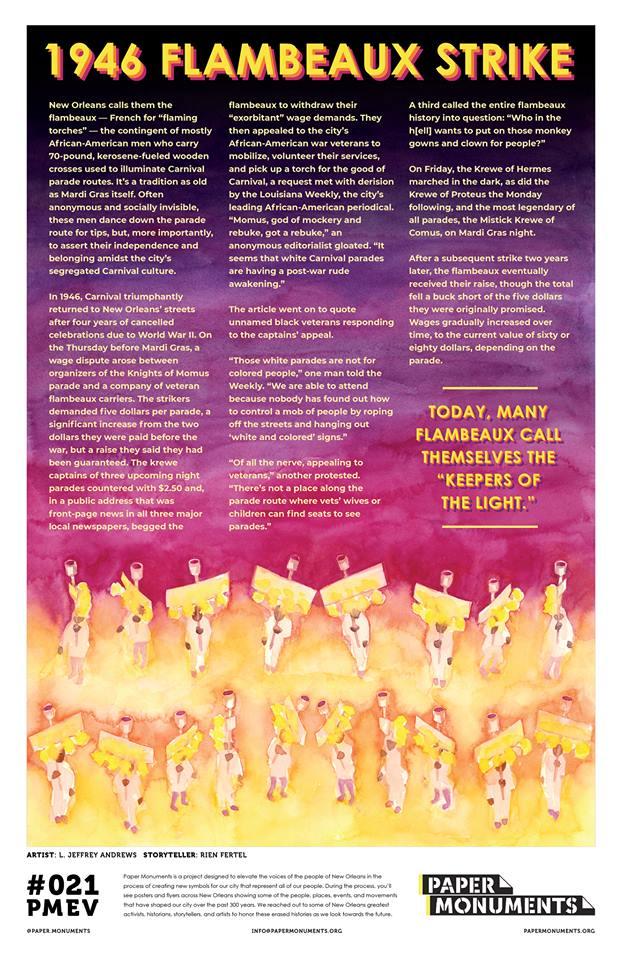
    <summary type="html"><![CDATA[<p><strong><em>Paper Monuments Project #021: In 1946, Carnival triumphantly returned to New Orleans’ streets after four years of canceled celebrations due to World War II. On the Thursday before Mardi Gras, a wage dispute arose between organizers of the Knights of Momus parade and a company of veteran flambeaux carriers.</em></strong></p><img src="https://mail.neworleanshistorical.org/files/fullsize/0093f811c5d46dc95578d33299467727.jpg" alt="&quot;Paper Monuments Poster #021: 1946 Flambeaux Strike.&quot;" /><br/><p>New Orleans calls them the flambeaux — French for “flaming torches” — the contingent of mostly African-American men who carry 70-pound, kerosene-fueled wooden crosses used to illuminate Carnival parade routes. It’s a tradition as old as Mardi Gras itself. Often anonymous and socially invisible, these men dance down the parade route for tips, but, more importantly, to assert their independence and belonging amidst the city’s segregated Carnival culture. </p><p>In 1946, Carnival triumphantly returned to New Orleans’ streets after four years of canceled celebrations due to World War II. On the Thursday before Mardi Gras, a wage dispute arose between organizers of the Knights of Momus parade and a company of veteran flambeaux carriers. The strikers demanded five dollars per parade, a significant increase from the two dollars they were paid before the war, but a raise they said they had been guaranteed. The krewe captains of three upcoming night parades countered with $2.50 and, in a public address that was front-page news in all three major local newspapers, begged the flambeaux to withdraw their “exorbitant” wage demands. They then appealed to the city’s African-American war veterans to mobilize, volunteer their services, and pick up a torch for the good of Carnival, a request met with derision by the Louisiana Weekly, the city’s leading African-American periodical. “Momus, god of mockery and rebuke, got a rebuke,” an anonymous editorialist gloated. “It seems that white Carnival parades are having a post-war rude awakening.” </p><p>The article went on to quote unnamed black veterans responding to the captains’ appeal.</p><p>“Those white parades are not for colored people,” one man told the Weekly. “We are able to attend because nobody has found out how to control a mob of people by roping off the streets and hanging out ‘white and colored’ signs.” </p><p>“Of all the nerve, appealing to veterans,” another protested. “There’s not a place along the parade route where vets’ wives or children can find seats to see parades.”</p><p>A third called the entire flambeaux history into question: “Who in the h[ell] wants to put on those monkey gowns and clown for people?”</p><p>On Friday the Krewe of Hermes marched in the dark, as did the Krewe of Proteus the Monday following, and the most legendary of all parades, the Mistick Krewe of Comus, on Mardi Gras night.</p><p>After a subsequent strike two years later, the flambeaux eventually received their raise, though the total fell a buck short of the five dollars they were originally promised. Wages gradually increased over time, to the current value of sixty or eighty dollars, depending on the parade. Today, many flambeaux call themselves the “Keepers of the Light.”</p><p><em><strong><a href="https://mail.neworleanshistorical.org/items/show/1436">For more view the original article</a></strong></em></p>]]></summary>
    <published>2018-07-23T14:35:23+00:00</published>
    <updated>2026-07-15T16:20:27+00:00</updated>
    <link rel="alternate" type="text/html" href="https://mail.neworleanshistorical.org/items/show/1436"/>
    <id>https://mail.neworleanshistorical.org/items/show/1436</id>
    <author>
      <name>Paper Monuments, Rien Fertel, narrative,&amp;#32;&amp;amp;&amp;#32;Jeffrey Andrews, artwork</name>
    </author>
  </entry>
  <entry>
    <title type="html"><![CDATA[1961 Construction of the William J. Guste, Sr. Homes]]></title>
    <summary type="html"><![CDATA[<img src="https://mail.neworleanshistorical.org/files/fullsize/e9e1a98b36f99d8f03717b3ceda356ae.jpg" alt="“Going, going, gone!”

" /><br/><p>In 1961, the Housing Authority of New Orleans (HANO) announced plans to construct the William J. Guste, Sr. Homes, named for the Housing Authority’s long-time general counsel. The 1961 Report of the Housing Authority of New Orleans declared:</p><p>“The project will consist of 993 dwelling units replacing ten squares of rock bottom slums where 500 negro families have been living in substandard housing. The Housing Authority is dedicated to the eradication of slums in New Orleans. Slums are a breeding place for crime and disease. To remove this slum is a great step forward for our City… it will not only remove this cancer from the heart of our City, but will improve the entire area.”</p><p>The proposed new construction included housing for elderly people, a first in the city, comprising a 12-story high rise building in a cruciform pattern containing 528 apartments. HANO presented the design for the Guste Homes as innovative, addressing some of the issues experienced by residents at other housing projects in the city. HANO was particularly proud of the attention given to plans for the exterior areas of the Guste Homes: </p><p>“Ten once-shabby squares in the congested heart of this old Creole Metropolis –before 1962 is over—will prove, in a test-tube of better living, that in this New Orleans area Nature, with her trees and vines and shrubs and bulbs, makes by far the most beautiful, the most versatile and useful of structural materials at the command of imaginative architects.” [Wilson Callender, “Horticultural Aspects of the William J. Guste Sr. Homes,” 1961 HANO Report, pg. 44]</p><p>The language used to describe the placement of Guste Homes was typical of the era. Since the 1930s, “slum clearance” served as a central feature of efforts to alter housing in American cities, often as a part of what would soon be termed “urban renewal” projects. Local and federal governments often targeted Black working class neighborhoods for clearance.  </p><p><em><strong><a href="https://mail.neworleanshistorical.org/items/show/1660">For more (including 4 images) view the original article</a></strong></em></p>]]></summary>
    <published>2022-03-23T22:34:37+00:00</published>
    <updated>2026-07-15T16:20:25+00:00</updated>
    <link rel="alternate" type="text/html" href="https://mail.neworleanshistorical.org/items/show/1660"/>
    <id>https://mail.neworleanshistorical.org/items/show/1660</id>
    <author>
      <name>D. Ryan Gray, Lauren Smith,&amp;#32;&amp;amp;&amp;#32;Kathryn O&amp;#039;Dwyer, Editor</name>
    </author>
  </entry>
  <entry>
    <title type="html"><![CDATA[1984 World&#039;s Fair Gondola (MART) ]]></title>
    <summary type="html"><![CDATA[<img src="https://mail.neworleanshistorical.org/files/fullsize/1d65930c122fbb1eb46ec19175a64be8.jpg" alt="&quot;West Bank Vista&quot;" /><br/><p>The signature attraction of the 1984 Louisiana World Exposition held in New Orleans was MART (Mississippi Aerial River Transit), a $12 million aerial gondola transport system that connected the fair site on the East Bank of the Mississippi River with the West Bank (Old Algiers). For the price of a $3.50 round-trip ticket, fair riders were shuttled 2,500 feet across the Mississippi River in one of 53 six-passenger, teapot-shaped cars strung from cables suspended 320 feet above the river. After the fair, the gondolas briefly became part of the city's mass transit system.</p><p>The gondola project was the long-time dream of Mardi Gras float designer and native Algerian Blaine Kern, who envisioned a "combination thrill ride and practical commuter vehicle" to connect both banks of the river, according to a May 6, 1984, Times-Picayune article. During the 1960s, Kern partnered with architect August Perez III to organize MART, Inc. </p><p>Two decades later, the concept reemerged during plans for the 1984 Louisiana World Exposition (LWE). The system's initial price tag of $8 million was too steep for area banks. Kern pulled his financial backing from the project, but Perez continued with a consortium of investors to form MART/Perez Inc. The World's Fair and the system's projected $10 million in ticket sales during the first six months of operation gave impetus to the lagging endeavor. Perez found a French bank, Banque de L'Union Européenne of Paris, willing to underwrite the project. Though new to the Louisiana market, the bank was quite familiar with gondola systems. Upon the approval of a 60-year city franchise, the gondolas became a reality.</p><p>Construction of the custom-built aerial gondola system began on September 29, 1983, after a host of clearances from sixty-four state, city, and river agencies that shared jurisdiction over the project. Pomagalski S.A., of Grenoble, France supplied the equipment while MART/Perez Inc. constructed the gondola system. </p><p>To operate in a generally flat city, two 360 foot steel cable towers spaced 2169 feet apart were built to anchor the aerial gondola system. They were designed at a 20-degree tilt toward the river in order to protect the integrity of the Mississippi River levees. The gondola system included eight safety switches and a unique rescue vehicle known as a Pomabus; this was a self-propelled cart that could traverse a stopped cable and enclose a gondola so passengers could be removed and brought back to the terminal. Evidence suggests that the Pomabus never had to be used.</p><p>MART ranked with Disney's Space Mountain ride as the two best thrill rides in America during the six months of the exposition.  Despite its popularity, the gondola struggled to attract the anticipated 3 million riders -- mainly because of the fair's low attendance. The fate of the gondolas was tied closely to the fair's success -- or lack of success. Riders either had to buy a fair ticket or possess a season passport before they could purchase a gondola ticket.</p><p>After the fair closed, the gondola system was promoted as a unique commuter system.  MART officials hoped that West Bankers would ride the gondola daily to and from the east bank, especially to the Central Business District.  A commuter could purchase a $25 unlimited (per month) ride ticket or a $50 ticket; the latter included daily parking at the lot adjacent to the West Bank terminal. West Bankers did not embrace the concept nor did the residents of old Algiers welcome the additional automobile traffic during the fair. Four months after the bankrupt LWE closed, its signature attraction ceased operation permanently.</p><p>While legal battles concerning loan payments, property rights, and ownership ensued, the last remaining structure of the fair remained idle. The New Orleans Dock Board began the process of having the entire system dismantled. In 1992, the passenger cars were sold, and in 1994 the US Coast Guard ordered the removal of the 360 foot steel towers and their cables. MART did not become a legendary landmark of the 1984 World's Fair, but for thousands of fairgoers it provided a lifelong memory.</p><p><em><strong><a href="https://mail.neworleanshistorical.org/items/show/563">For more (including 5 images) view the original article</a></strong></em></p>]]></summary>
    <published>2013-03-09T01:55:52+00:00</published>
    <updated>2026-08-24T00:39:15+00:00</updated>
    <link rel="alternate" type="text/html" href="https://mail.neworleanshistorical.org/items/show/563"/>
    <id>https://mail.neworleanshistorical.org/items/show/563</id>
    <author>
      <name>Frank Straughan</name>
    </author>
  </entry>
  <entry>
    <title type="html"><![CDATA[1984 World&#039;s Fair Monorail]]></title>
    <summary type="html"><![CDATA[<img src="https://mail.neworleanshistorical.org/files/fullsize/9d11a206e6b9648d0c7f1a4d69eb519b.jpg" alt="LWE monorail passes over the space shuttle Enterprise" /><br/><p>When planning the 1984 Louisiana World Exposition (LWE), fair and city officials decided to build a monorail system. This project had two objectives. First, it was intended to move many visitors so as to limit traffic congestion in the Warehouse and Downtown districts directly adjacent to the fair. Second, this advanced transportation infrastructure was supposed to stay in New Orleans as a tribute to modernity. Mayor Ernest “Dutch” Morial had hoped to build a line down the middle of Poydras Street to connect the new Convention Center to the Superdome. The city wanted to repeat the successful conversion of the Seattle World’s Fair monorail into permanent transit infrastructure.</p><p>When the Reagan administration refused to fund the monorail, the city decided to build it on the 80-acre riverfront site of the fair. Six companies bid, and the contract was awarded to Universal Mobility Inc., a Salt-Lake City company which had built 8 other monorail systems in North America. New Orleans’ system was a $15 million, 1.4 mile rubber-tired monorail based on the Straddle - Steel Box Beam technology. Introduced in the 1960s, this technology is still used. </p><p>Three elevated stations were designed by Charles Sanders of Perez and Associates Architecture Company. The New York Times advised that “the silent, elegant monorail will loop everywhere, diving at points into buildings.” The ten car, 146 passenger monorail circled the Exposition counterclockwise. It reached speeds of 10 miles per hour and took 12 minutes to complete the trip. One of the transit stations hosted a local television news broadcast center, which allowed live coverage of the fair. </p><p>Several plans were considered for the subsequent use of the monorail system. Allan Eskew, the main architect of the fair, proposed to give it to Audubon Park or City Park to move the public within their grounds. Later, the Regional Transit Authority (RTA) announced that that they were interested in purchasing the monorail to install it in the center of Poydras Street, as previously envisioned by the Mayor Morial administration. The federal money that RTA had traditionally used to buy transit equipment could not be used to buy monorail systems, and the RTA failed to raise private money to fund the project.</p><p>Unfortunately, the fair did not attract the 11 million visitors that the LWE officials had expected, so the fair left a $102 million debt. The LWE had to file for bankruptcy and could not pay its contractors. Universal Mobility sued Petr Spurney and Floyd Lewis, respectively president and chairman of the Louisiana World Exposition. In a 1985 hearing, the US District Judge ruled that LWE officials were not personally responsible for the debts. The assets of the LWE were auctioned in 1985, including the monorail and its three elevated stations.</p><p><em><strong><a href="https://mail.neworleanshistorical.org/items/show/541">For more (including 4 images) view the original article</a></strong></em></p>]]></summary>
    <published>2013-02-28T00:49:27+00:00</published>
    <updated>2026-07-15T16:20:34+00:00</updated>
    <link rel="alternate" type="text/html" href="https://mail.neworleanshistorical.org/items/show/541"/>
    <id>https://mail.neworleanshistorical.org/items/show/541</id>
    <author>
      <name>Romain Cheynet</name>
    </author>
  </entry>
  <entry>
    <title type="html"><![CDATA[1997 Excavation at Madame John&#039;s Legacy by Shannon Dawdy and GNOAP/UNO]]></title>
    <summary type="html"><![CDATA[<img src="https://mail.neworleanshistorical.org/files/fullsize/d608034d085b5ed73ab837879dda30a9.jpg" alt="Plan showing locations of previous excavations at Madame John’s relative to floorplan, with Dawdy’s excavations in green.  " /><br/><p>In 1997, Dr. Shannon Dawdy directed the second series of excavations at Madame John’s Legacy under the auspices of the Greater New Orleans Archaeological Program, a state program then based at the University of New Orleans.  These investigations focused entirely upon areas e exterior of the primary structure and planned to mitigate impacts to archaeological resources in the rear courtyard associated with the installation of a new air conditioning system. This project was planned in part to comply with Louisiana’s Archaeological Resources Act (R.S. 41:1606), which mandates that significant archaeological remains on a state-owned property be considered during work that might negatively impact them.   </p><p>Most of the images here are scanned from 35 mm slides taken for use in public presentations.  In a very short period of time, digital photography has revolutionized the way that archaeologists can document objects recovered on excavations, in that now thousands of photographs of finds can be taken very quickly.  However, at the same time, these innovations in photography generate new issues, as digital formats change rapidly, and the space to archive large bodies of data and guarantee that it is available in perpetuity itself can become a problem. </p><p><em><strong><a href="https://mail.neworleanshistorical.org/items/show/1614">For more (including 9 images) view the original article</a></strong></em></p>]]></summary>
    <published>2020-07-22T21:14:30+00:00</published>
    <updated>2026-07-15T16:20:25+00:00</updated>
    <link rel="alternate" type="text/html" href="https://mail.neworleanshistorical.org/items/show/1614"/>
    <id>https://mail.neworleanshistorical.org/items/show/1614</id>
    <author>
      <name>D. Ryan Gray</name>
    </author>
  </entry>
  <entry>
    <title type="html"><![CDATA[30/90, Cafe Negril, Spotted Cat: Hannah’s Three-Venue Runaround]]></title>
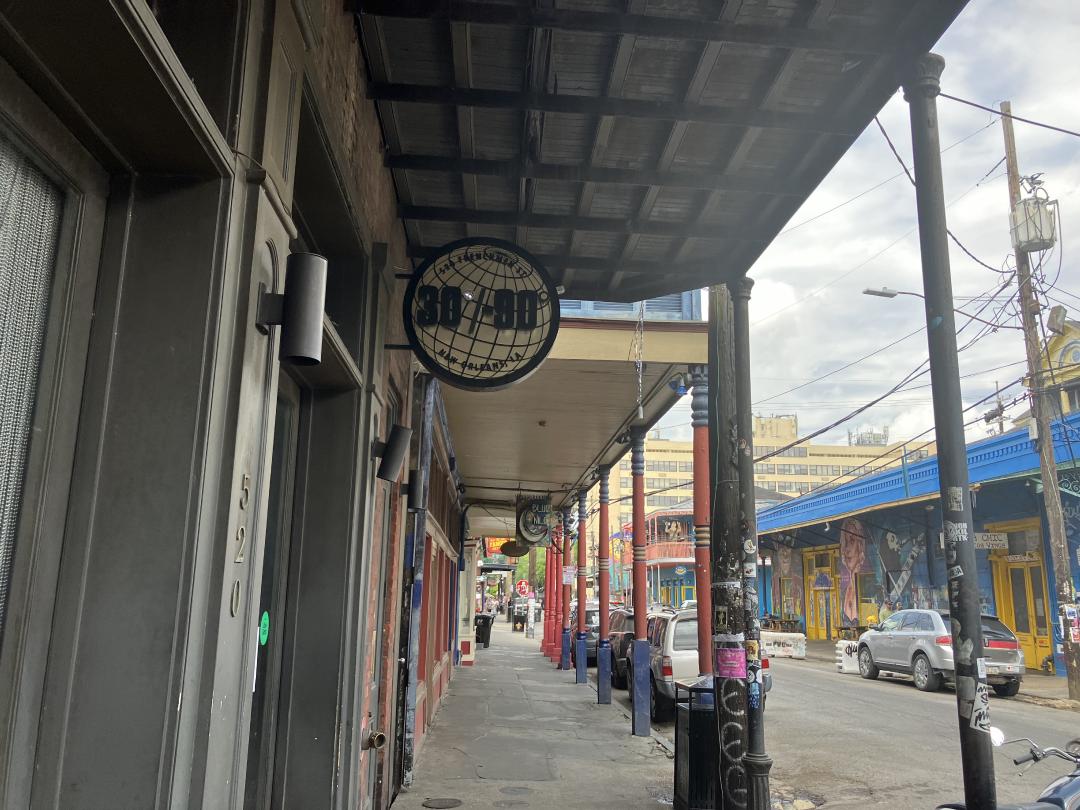
    <summary type="html"><![CDATA[<p><strong><em>In many places where the music industry thrives, bands and businesses are competitive, proprietary, or just plain isolated from one another. Frenchmen Street, on the other hand, has traditionally subscribed to the “borrow a cup of sugar” model… </em></strong></p><img src="https://mail.neworleanshistorical.org/files/fullsize/7f89b8fd27e1a01df93e22b06f35e672.jpg" alt="The sign to 30/90 looking onto Frenchmen Street." /><br/><p><p class="p1">Curtis Casados, a longtime bartender who’s worked at various Frenchmen locations over the years (<a href="https://frenchmennotes.com/?p=2021">read his Spotted Cat storm story here</a>), has always been struck by the camaraderie he’s felt on the street. <i>“Frenchmen itself was just a big large family,”</i> he says. <i>“We all intermingled and drank together. We’d borrow bottles of liquor across the street, or towels, or whatever. It was like, ‘Hey, can I borrow a cup of sugar?’”</i> <p class="p1">The principle applies to musicians as well. One thing that even a new-to-town tourist can observe after a couple days of hanging out on Frenchmen is the way all the same people show up playing in various combinations under various names up and down the street. <p class="p1">Hannah Kreiger-Benson, a local piano player and one of the authors of this tour, describes an ‘only-on-Frenchmen’ experience she had one night that illustrates this point perfectly.  <p class="p1"><i>“So, I was playing with a band at 30*90, and our gig was 5-8, I think, yeah. This was in…2017? 2018? In the middle of our gig, a guy comes running in, says he works at Cafe Negril, [next block, same side of the street], and that their booking from 7-10, the band they’d booked, couldn’t come. He asked did we want to come play at Negril as soon as we finished, from like 8ish until 10, so that they’d only have half an empty music slot. We said sure, why not!”</i>  <p class="p1">The density of venues on Frenchmen St. allows for this kind of interactions, with the physical proximity creating almost one large entity. Hannah continues: <p class="p1"><i>“We finished at 30*90, and then did this like goofy running-down-the-street-with-our-gear parade [laughs] it didn’t make sense to properly pack up/break down, so we just carried the gear down the street in batches. Like, guitar not in the case in one hand, guitar stand in the other hand. And then as we got set up at Negril, we realized that there weren’t enough mic cables. Since the same folks managed Negril and the Spotted Cat, [diagonally across the street], the manager or whoever this guy was, he and I run across to borrow a mic cable from the [Spotted] Cat. There was a band in full swing, I think it was Panorama, and I literally crawled in front of the low stage, to rummage in the bin of spare cables on the floor. I remember looking up at Ben Schenck [clarinet and bandleader for Panorama], and I was like like ‘hi Ben, ‘scuse us, pardon me…’ and he was sort of bemused, like ‘uh, oh hello musician I know who’s doing some undignified nonsense on the floor’. </i> <p class="p1"><i>We got the cable and played a fun half-set at Negril. That whole sequence really, you know, captured the… interconnectedness of Frenchmen! [laughs]”</i></p><p><em><strong><a href="https://mail.neworleanshistorical.org/items/show/1721">For more (including 3 images) view the original article</a></strong></em></p>]]></summary>
    <published>2023-09-30T18:33:10+00:00</published>
    <updated>2026-07-15T16:20:24+00:00</updated>
    <link rel="alternate" type="text/html" href="https://mail.neworleanshistorical.org/items/show/1721"/>
    <id>https://mail.neworleanshistorical.org/items/show/1721</id>
    <author>
      <name>Laura DeFazio &amp;#32;&amp;amp;&amp;#32;Hannah Kreiger-Benson</name>
    </author>
  </entry>
  <entry>
    <title type="html"><![CDATA[626 Bourbon Street<br />
]]></title>
    <summary type="html"><![CDATA[<img src="https://mail.neworleanshistorical.org/files/fullsize/c921315614fac60bb6205c3ce473c481.jpg" alt="Detail from the New Orleans Notarial Archives Plan Book Plan" /><br/><p>In 2017, Dr. D. Ryan Gray led students and volunteers from University of New Orleans to excavate a portion of a private residence in the French Quarter located at 626 Bourbon Street. The team excavated a series of test units and shovel tests in the historical footprint of the modern property’s backyard and ground floor. Artifacts dated to the antebellum and included crucibles - ceramic vessels used in metalworking. The exact reason that they were used in this household is unknown, but newspaper records suggest that in the antebellum, crucibles were used for blacksmithing, gold prospecting, experimentation, counterfeiting, and theft. </p><p><em><strong><a href="https://mail.neworleanshistorical.org/items/show/1705">For more (including 7 images) view the original article</a></strong></em></p>]]></summary>
    <published>2023-03-07T21:23:54+00:00</published>
    <updated>2026-08-24T16:30:28+00:00</updated>
    <link rel="alternate" type="text/html" href="https://mail.neworleanshistorical.org/items/show/1705"/>
    <id>https://mail.neworleanshistorical.org/items/show/1705</id>
    <author>
      <name>By Elizabeth Williams</name>
    </author>
  </entry>
  <entry>
    <title type="html"><![CDATA[810 Royal Street]]></title>
    <summary type="html"><![CDATA[<img src="https://mail.neworleanshistorical.org/files/fullsize/c3a7290717f5ad25acd98f6a424b4d97.jpg" alt="Image Captured by Google Street View of Field Crew in 2015" /><br/><p>On October 22, 2014, an over-200-year-old building at 810 Royal Street collapsed, presumably a victim of unrepaired termite and moisture damage. The collapse sparked conversations in New Orleans about the importance of historic preservation. The complex of buildings at the corner of Royal and St. Ann was constructed by Don Francisco Balthazar Languille sometime soon after his purchase of the lots in 1801. </p><p>The group of buildings, including the one that collapsed at 808-810 Royal, and the extant ones at 800-806 Royal and 635-637 St. Ann Street, are reputed to have been among the first 3-story residential structures in the Vieux Carré. The loss of such an important part of the built landscape in the heart of the Quarter through what many saw as ‘demolition by neglect’ highlighted the fragile nature of the city’s architectural heritage, even in its most tightly-regulated district. </p><p>The collapse also offered a rare opportunity to access the layers of soil beneath the building, ground that had been essentially undisturbed since 1801. The new owners offered University of New Orleans Anthropology professor Ryan Gray and his students access to the site while awaiting permits for new construction. The artifacts found during two seasons of excavations conducted by UNO’s summer field school in archaeology have given important insights into life in the Colonial era city.</p><p><em><strong><a href="https://mail.neworleanshistorical.org/items/show/1615">For more (including 5 images) view the original article</a></strong></em></p>]]></summary>
    <published>2020-07-23T16:12:55+00:00</published>
    <updated>2026-07-15T16:20:25+00:00</updated>
    <link rel="alternate" type="text/html" href="https://mail.neworleanshistorical.org/items/show/1615"/>
    <id>https://mail.neworleanshistorical.org/items/show/1615</id>
    <author>
      <name>D. Ryan Gray</name>
    </author>
  </entry>
  <entry>
    <title type="html"><![CDATA[936 St. Peter Street: A Cottage Industry in the Quarter]]></title>
    <summary type="html"><![CDATA[<img src="https://mail.neworleanshistorical.org/files/fullsize/08fa4c36ca36d0771716b7095fd824fc.jpg" alt="Goat skulls found from the privy at 936 St. Peter Street" /><br/><p>In 2014, the University of New Orleans was invited to conduct archaeological testing at 936 St. Peter Street while the property was undergoing renovations. Below the surface layer, archaeologists discovered the opening of a privy shaft. The privy was brick-lined with a wood-lined base. </p><p>The privy deposit appeared to represent a single, rapid deposition, probably within the time frame of the 1860s. This rapid deposition likely happened at the time of a clean-out and renovation of the rear building, when the use of this privy was abandoned due perhaps to shifting use of the outbuilding. The privy fill contained a significant quantity of typical domestic debris from the mid-nineteenth century: ceramic tablewares, including whiteware, ironstone, and porcelain; chamber pots; glass bottles; and smoking pipes. </p><p>What stood out most during the excavation of the privy was the abundance of animal remains, especially the number of elements from skulls. When a rough count was taken of the entire assemblage, the privy feature was found to contain a total of 147 Caprine (goat or sheep) skulls. </p><p>So, what could explain the heavy presence of goat and/or sheep skulls in the privy feature at 936 St. Peter Street? There are, of course, a number of cuisines in which brains are a delicacy, and dishes, particularly stews, in which goat heads play a prominent role, especially in African and Caribbean cultures. However, certain features of this assemblage taken together with other artifacts from the privy suggest that the faunal assemblage recovered from the privy at 936 St. Peter Street is representative of more than just urban diets. </p><p>An analysis of the butchery marks found on faunal material can indicate differences in patterns of faunal utilization. Analysts recorded the number of cuts, chops, fractures, shears, and saw marks present on each bone to determine if there were differences in butchery methods between different species. Most of the bones that were present were utilized as typical food sources and were from the postcranial skeleton. Some of these bones were either sawn or shorn (as with a sharp cleaver), marks that are typically made by a butcher or someone familiar with animal slaughter. However, an inordinate number of the butchery marks present on Caprine remains were indicative of cracking into the skulls to retrieve the brains inside, as evidenced by shearing and chop marks across the back of the skulls. </p><p>It is likely that the abundance of goat skulls and their associated butchery patterns represent the production waste from household-level tanning and hide processing, probably for use in fine leather work. Historical documents and ethnohistorical observations note the use of animal brains in the process of hide tanning, particularly when making buckskin. </p><p>The sheer quantity of goat skulls in relation to other skeletal elements point to the likelihood that the goat brains were being put to a use in manufacturing rather than being consumed. Some of the other artifacts from the privy also support the connection of the assemblage to leatherwork. An abundance of cuprous metal straight pins, some occurring in clumps corroded together, were found within the privy fill along with thimbles, buttons, and hook and eye fasteners. While these items are not atypical finds at urban sites, their abundance is suggestive. Likewise, household production is suggested by some other artifacts in the assemblage, including knives, folded strap-metal, and a lace bobbin, all of which may be associated with hide production and its associated activities. </p><p>The growth of industrialization and urbanization in the late-eighteenth century had far reaching impacts on developing cities. Urban centers, like New Orleans, rapidly became crowded and dirty. Modes of production were centered around the household with production typically taking place within household lots or near the residences of employers. But as the city continued to expand during the nineteenth century, concerns over sanitation and urban waste disposal resulted in the segregation of nuisance industries, such as slaughterhouses and tanneries, to the outskirts of town. Still, small-scale manufacturing persisted, with household-level production only loosely regulated, despite the potential health issues it could generate. </p><p>This historical shift from cottage to commercial industry resulting from urban growth provides a lens through which we may interpret the archaeological assemblage at 936 St. Peter Street. This property was a very small urban lot in what had come to be a distinctly residential area by this time, and it is not hard to imagine the foul mess that the work of splitting hundreds of animal skulls and extracting the brains would incur in a residential yard . The noisome byproduct, and likely the complaints from neighboring tenants, may explain the rapid deposition of the privy contents and the renovation of the outbuilding in the 1860s. Perhaps the landlord at 936 St. Peter and/or their neighbors were no longer willing to tolerate a back yard covered in blood and Caprine effluvia. Rather than cleaning out privy contents from this period, the landlord or new residents instead built a completely new outbuilding and privy altogether, burying the putrid cranial decay until archaeological excavations uncovered it a century and a half later.</p><p><em><strong><a href="https://mail.neworleanshistorical.org/items/show/1712">For more (including 11 images) view the original article</a></strong></em></p>]]></summary>
    <published>2023-04-25T17:45:31+00:00</published>
    <updated>2026-08-24T16:58:09+00:00</updated>
    <link rel="alternate" type="text/html" href="https://mail.neworleanshistorical.org/items/show/1712"/>
    <id>https://mail.neworleanshistorical.org/items/show/1712</id>
    <author>
      <name>Helen Bouzon, J. Ryan Kennedy, D. Ryan Gray,&amp;#32;&amp;amp;&amp;#32;Elizabeth Williams</name>
    </author>
  </entry>
</feed>