"Bonnie Blue Flag:" The Most Dangerous Song of the Civil War
Text
The popularity of sheet music in the United States had reached its peak by the start of the Civil War. Well before the development of recording and broadcasting technology, the commercial music industry centered upon the circulation of sheet music played by both amateur and professional musicians. To enjoy popular music, consumers either had to perform the songs themselves, attend public concerts, or participate in informal gatherings. This made music a more interactive and socially engaging experience than the passive role today’s recording industry creates for listeners.
The nationalization of the sheet music industry in the late nineteenth century stifled the production of songs created by local musicians and composers. In the mid-1800s, however, music created by local and regional musicians readily found its way to audiences via the many music publishers found in various US cities. These conditions allowed a song popularized through performance in New Orleans to become a controversial anthem of the Confederacy. Historian E. Lawrence Abel speculates that A.E. Blackmar and Bro. ran the South’s most successful sheet music publishing house. Among other tunes, such as "Missouri, or a voice from the South," and "Dixie," Blackmar published one of the earliest imprints of Harry Macarthy’s popular song “Bonnie Blue Flag.”
In May 1862, Union forces entered New Orleans and the city became one of the first occupied territories in the South during the Civil War. From May to December 1862, General Benjamin Butler ruled over the city. His legacy is marked by his severe social policies. General Order No. 40 states that "Any person who has in his possession...any property of any kind or description whatever, of the so-called Confederate States...shall be liable to imprisonment and to have his property confiscated." With this order, owning or singing one of the most popular songs of the period became an act of treason. Arrest records from New Orleans papers reveal that men and women were regularly arrested for singing "Bonnie Blue Flag," and were charged with a range of penalties, from a fine to time in the workhouse to a full pardon.
A few months before Butler took over the city, advertisements for A.E. Blackmar and Bro. disappeared from the newspapers. Henry, the oldest Blackmar brother, relocated his publishing operation to Atlanta, where it remained successful for the duration of the war. Armand Blackmar stayed to run the shop in New Orleans, but was not quite as lucky. Butler, acting on General Order No. 40, is said to have arrested Blackmar and ransacked his shop, destroying all Confederate materials inside. By the time we see Blackmar in New Orleans again, Butler had been removed from the city and replaced by General Nathaniel Prentiss Banks, who is known to have pursued a more socially lenient approach to running New Orleans than his predecessor.
In November 1863, advertisements for Blackmar reappeared in the newspapers of New Orleans, but no longer promoted "The Bonnie Blue Flag." These advertisements also reported a change of address from 74 Camp Street to 167 Canal Street, where Blackmar continued to publish music for the duration of the war. Paper and ink were in scarce supply by this point in the war, forcing some publishers to print on recycled materials such as wallpaper and develop new ways to make ink for printing. However, despite material shortages and Union presence, Blackmar's success in the final years of the war suggests that the demand for sheet music remained strong in occupied New Orleans.
After the Civil War and the collapse of the Confederacy, "The Bonnie Blue Flag" developed a life of its own. In the second decade of the twentieth century, the song was revived as a symbol of Lost Cause mentality in the midst of fifty-year commemorations of the War. During the Civil Rights era, "The Bonnie Blue Flag" once again became a song of protest, this time against the integration of public spaces. It even found its way back into the classroom, as one New Orleans resident remembers learning it at his elementary school in the 1950s. It can even be heard in current movies such as Gods and Generals and, more perplexingly, the video game Bioshock. The long afterlives of this song have sometime divorced it from its original meaning, but its memory also reveals how music played a role in the city's experience of the Civil War.
Files
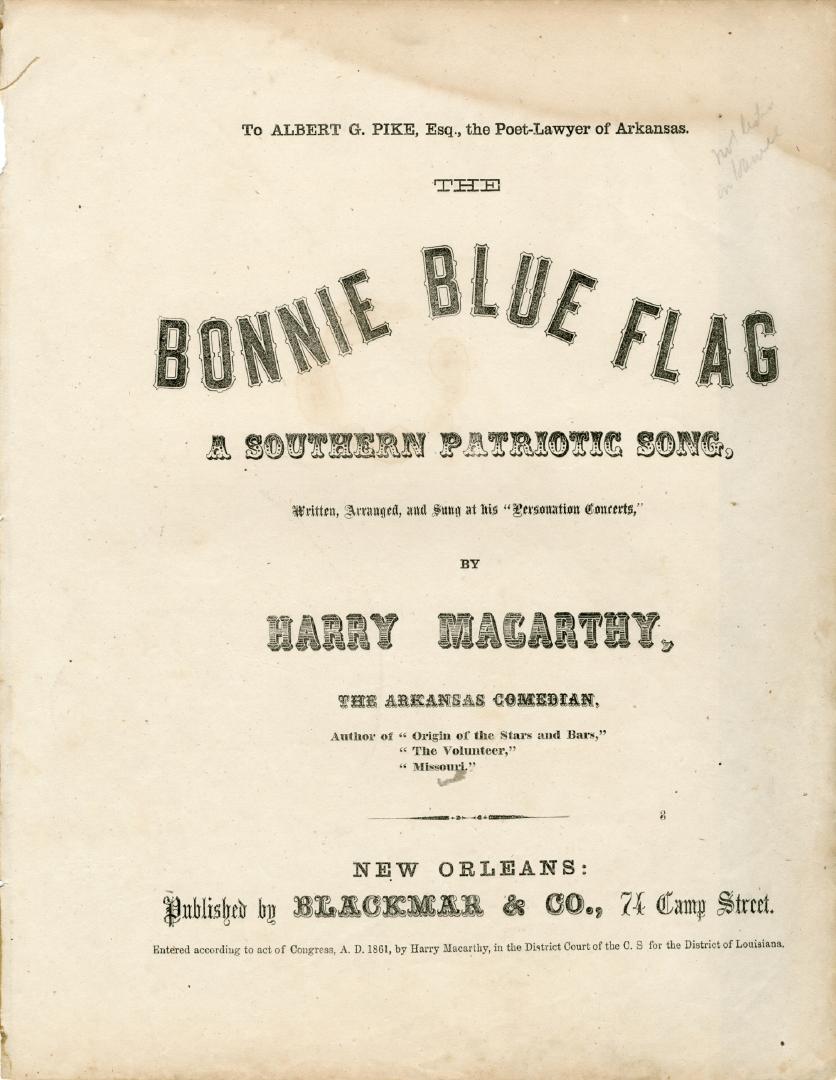
"The Bonnie Blue Flag"
One of the earliest imprints of "The Bonnie Blue Flag" from 1861, published by Blackmar & Co. at their original Camp Street location. Courtesy of the Collections of the Louisiana State Museum, Gift of Hon. John M. Wisdom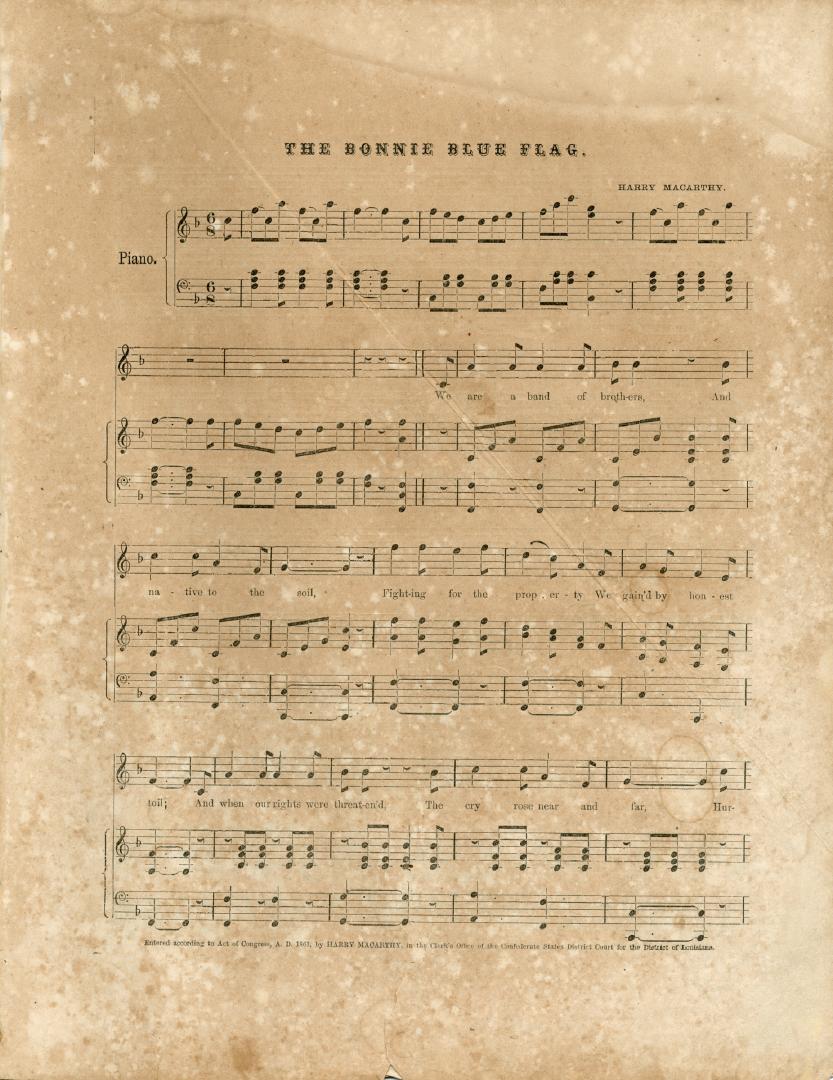
First page of "The Bonnie Blue Flag" sheet music
The tune is set to the melody of an Irish song called "The Irish Jaunting Car," and resembles the simple, sing-a-long style of other patriotic tunes. Courtesy of the Collections of the Louisiana State Museum, Gift of Hon. John M. Wisdom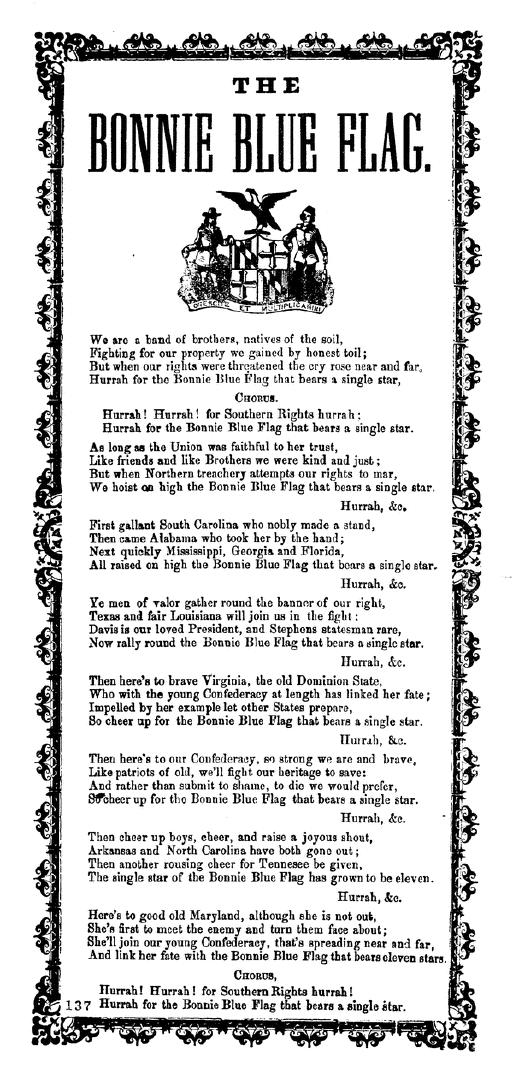
"The Bonnie Blue Flag" Song Sheet
Song sheets were published for popular songs of the period. Song sheets allowed customers to learn the lyrics of a song without having to purchase the sheet music in its entirety. Courtesy of the Library of Congress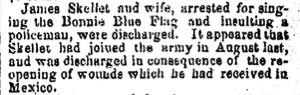
Daily Picayune, 3/13/1863
This is one of many arrest records found in the Daily Picayune of residents caught singing the Bonnie Blue Flag. This couple was lucky, but punishments often ranged from fines to sentences at the workhouse. Courtesy of the Times-Picayune.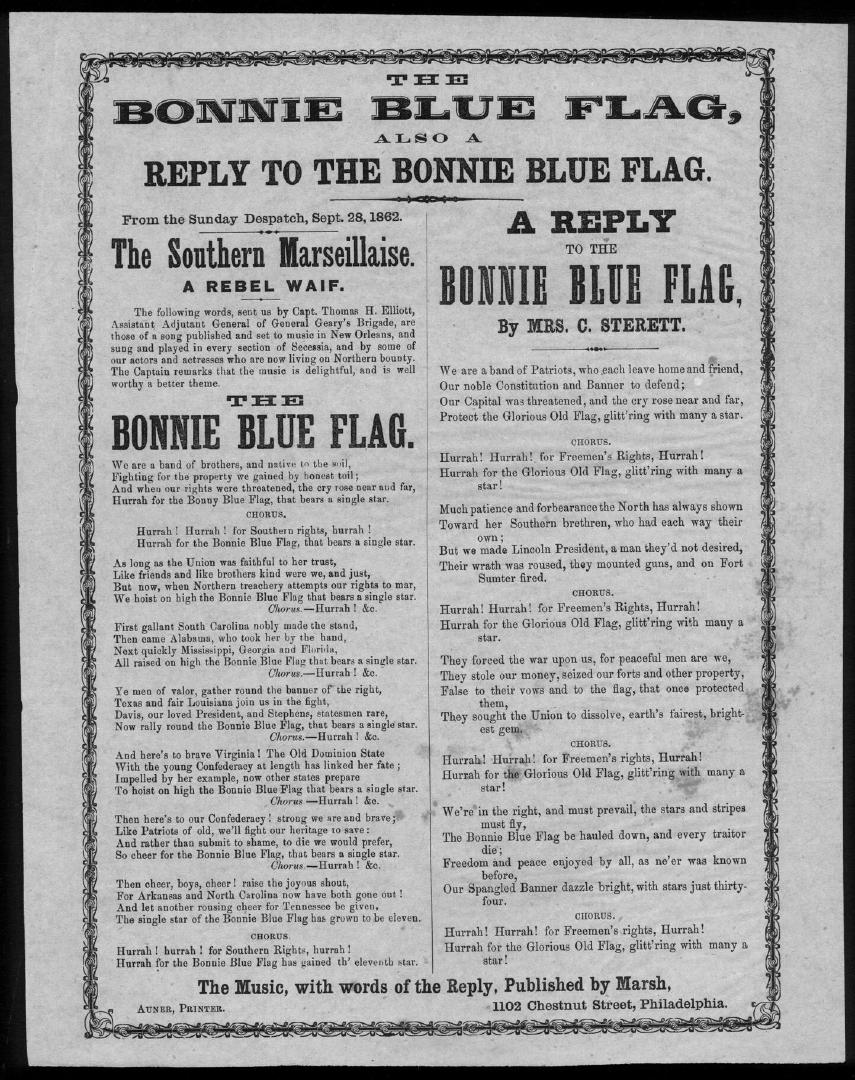
"Reply to the Bonnie Blue Flag"
Written by M.H. Frank, this song sheet was published in Philadelphia as a response to the popularity of "The Bonnie Blue Flag." It puts the blame for the war on southern aggression and reworks the chorus: "Hurrah! Hurrah! for Freemen's Rights, Hurrah! Hurrah for the Glorious Old Flag, glitt'ring with many a star!" Library of Congress, Music Division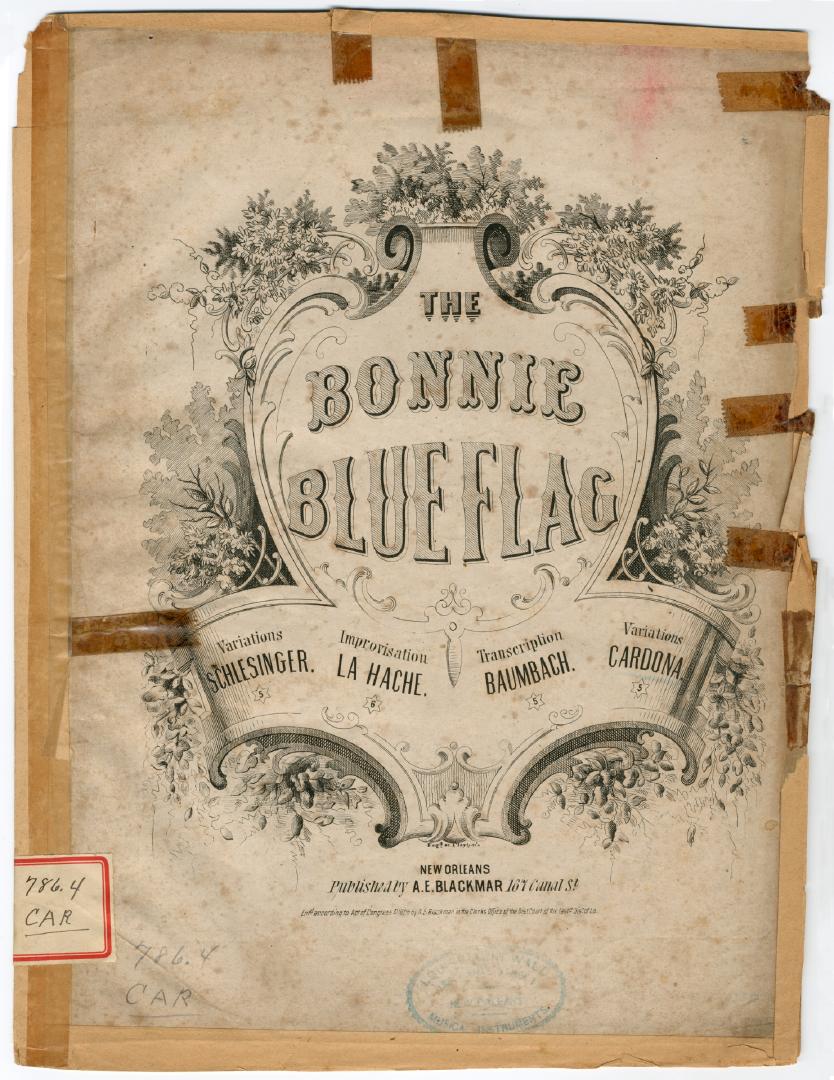
Variations on "The Bonnie Blue Flag"
This popular tune became reworked in various ways throughout the war. This sheet music, also published by Blackmar, was printed in 1862 and provides a more complex rendition of the popular patriotic tune. Courtesy of the Collections of the Louisiana State Museum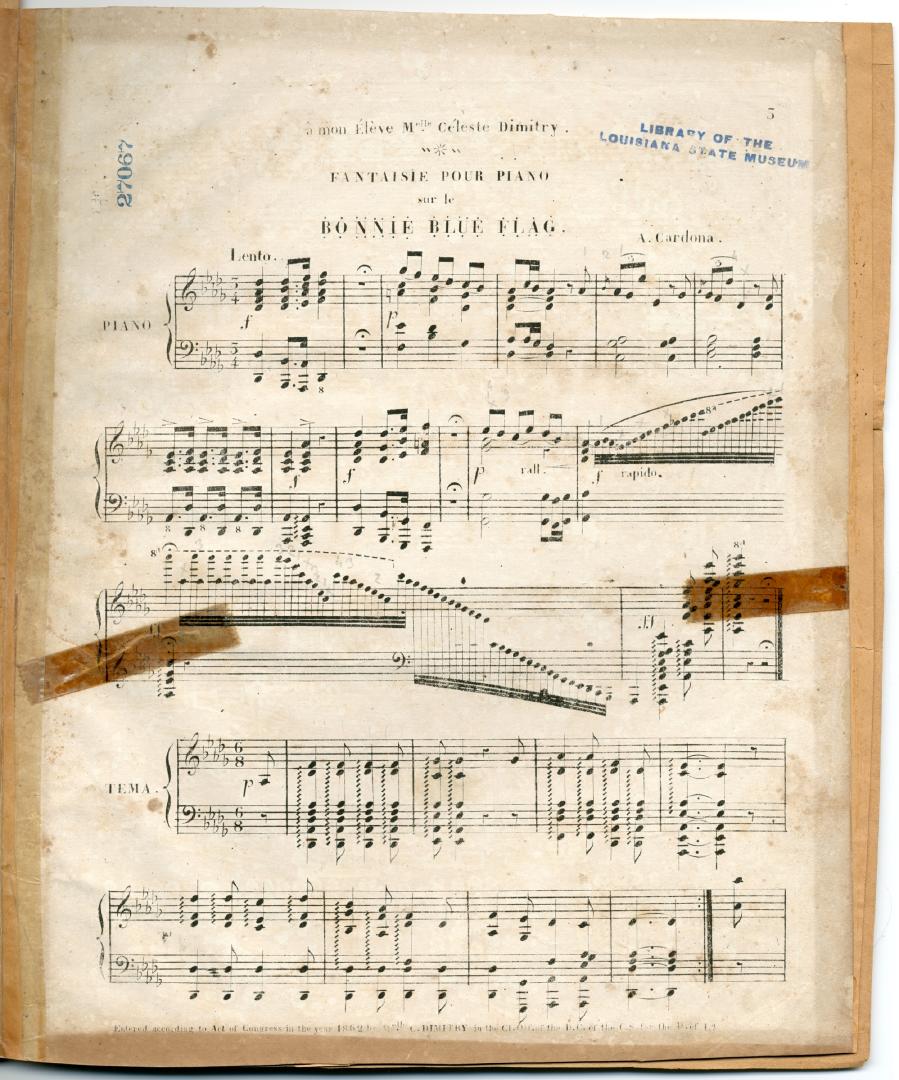
Variations on "The Bonnie Blue Flag" music
The first page of the sheet music calls the song "Fantasie pour piano sur le Bonnie Blue Flag." From just the first page, it is clear that the simple Irish melody has been reworked into a more classical sound. This version would not be used as an anthem like the original, but rather as an artistic nod to the popular tune. Courtesy of the Collections of the Louisiana State Museum