Paper Monuments Project
Paper Monuments was a public art and public history project designed to elevate the voices of the people of New Orleans, as a critical process towards creating new narratives and symbols of our city that represent our collective vision, and to honor the erased histories of the people, places, movements, and events that have made up the past 300 years as we look to the future.
The removal of four Jim Crow monuments in the spring of 2017, the result of generations of organizing by Black New Orleanians including Dorothy Mae Taylor, the Rev. Avery Alexander, and the Take Em' Down NOLA Coalition, revealed deep-seated divisions in our communities. It also sparked important conversations: about the ties between symbols and systems, the links between the present and the past, the differences in how we experience our built environment, and what stories we tell and remember.
This tour is a digital record of a physical public history project, with each map point corresponding to the location where each poster was originally hung.
Access: Online only
Stories 44
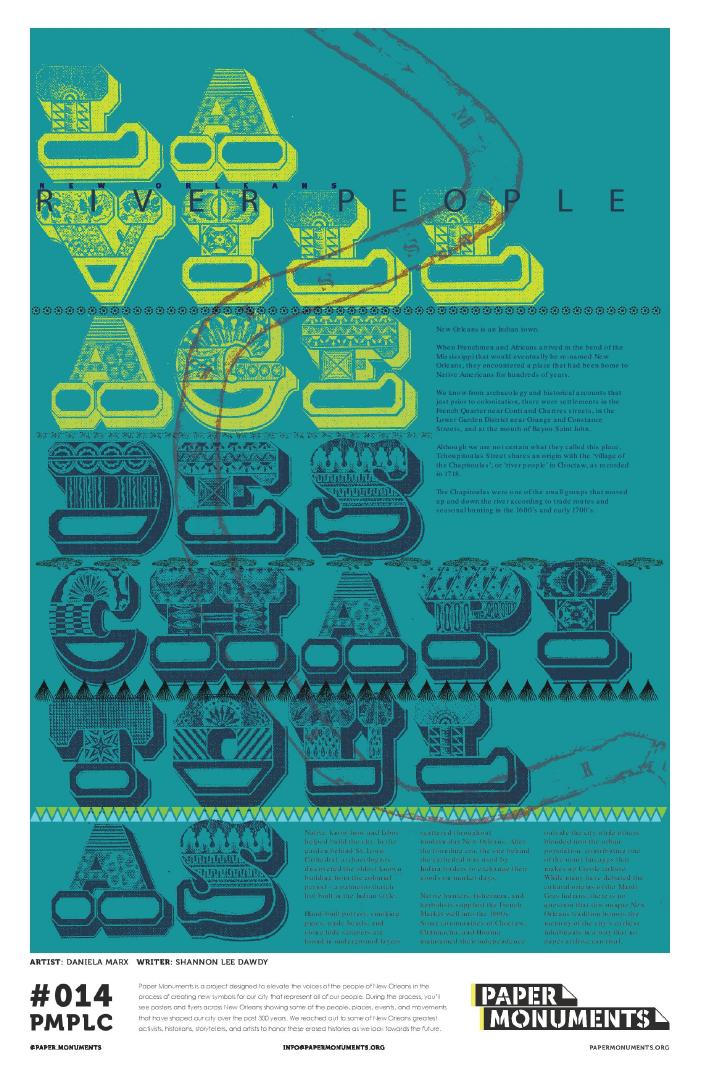
La Village des Chapitoulas
Paper Monuments Project #014: La Village des Chapitoulas: When Frenchmen and Africans arrived in the bend of the Mississippi that would eventually be re-named New Orleans, they encountered a place that had been home to Native Americans for hundreds of years.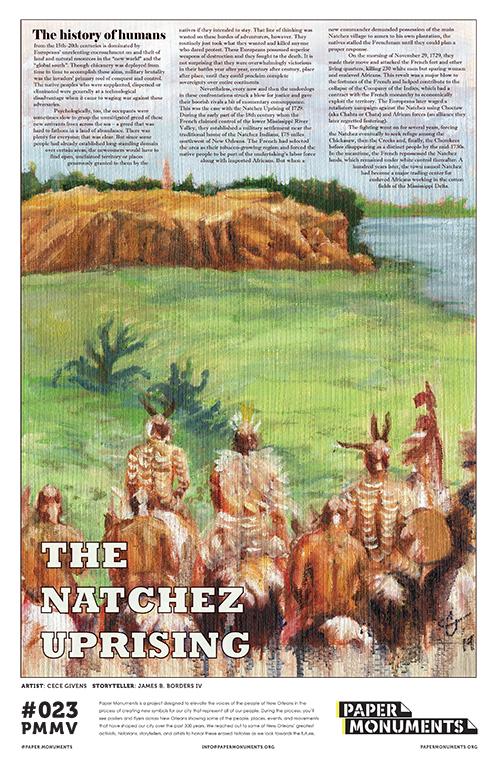
The Natchez Uprising
Paper Monuments Poster #023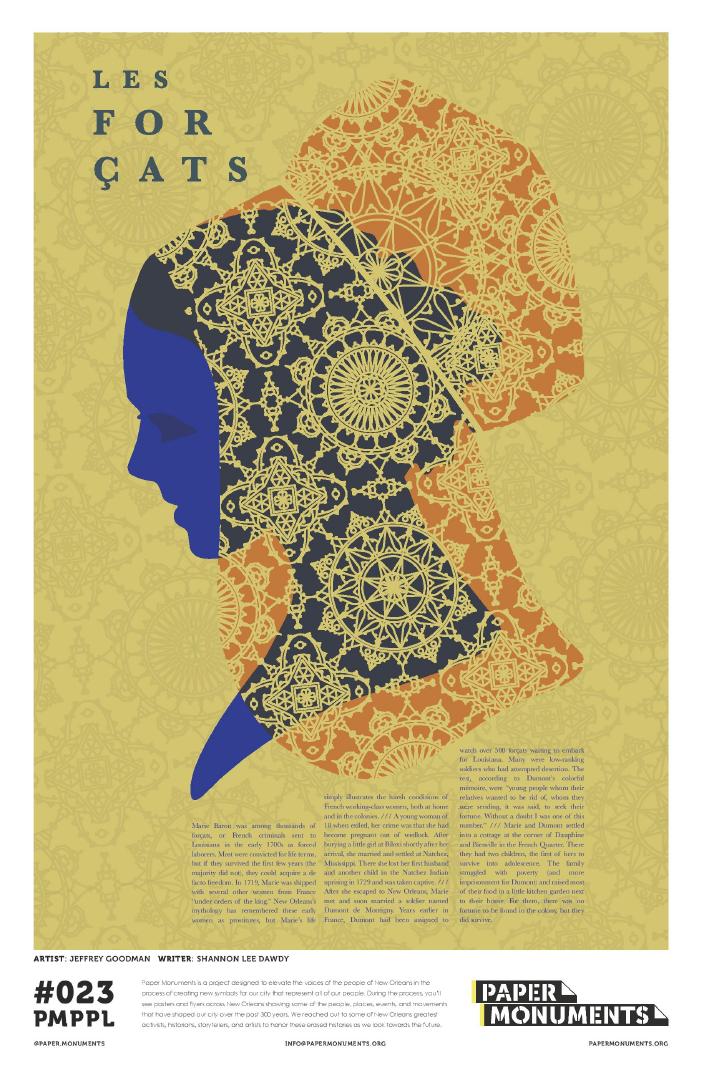
Marie Baron and Les Forcats
Paper Monument #023: Marie Baron was among thousands of forçats, or French criminals sent to Louisiana in the early 1700s as forced laborers. Marie’s life illustrates the harsh conditions of French working-class women, both at home and in the colonies.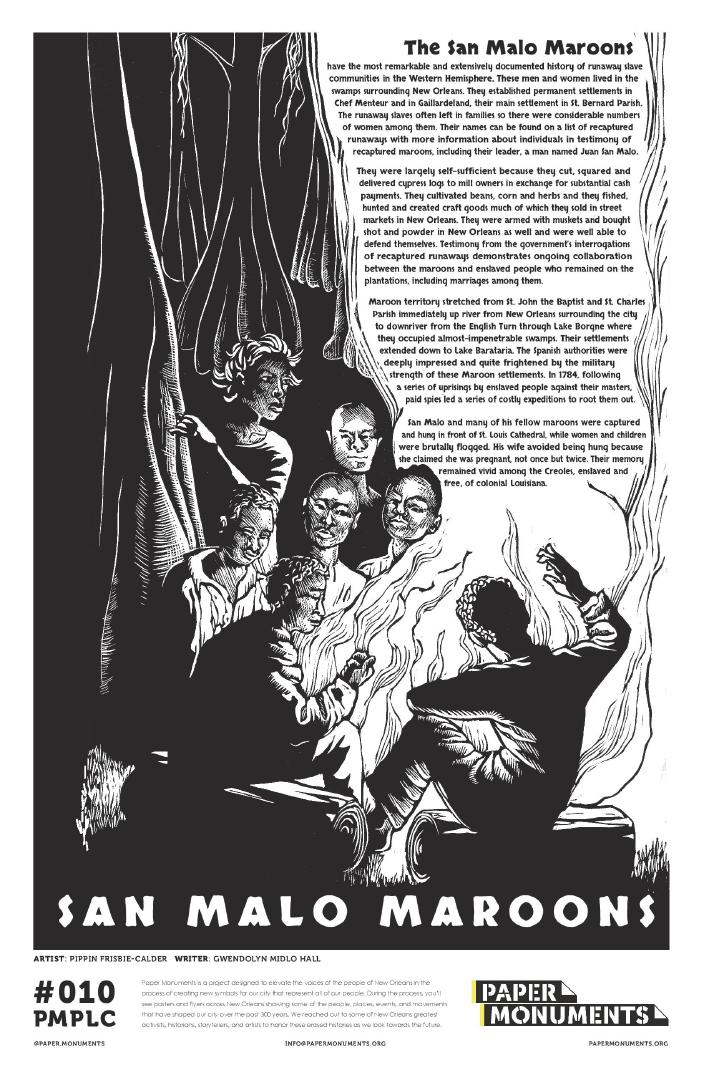
San Malo Maroons
Paper Monuments Project #010: The San Malo Maroons have the most remarkable and extensively documented history of runaway slave communities in the Western Hemisphere. The Spanish authorities were deeply impressed and quite frightened by the military strength of these Maroon settlements.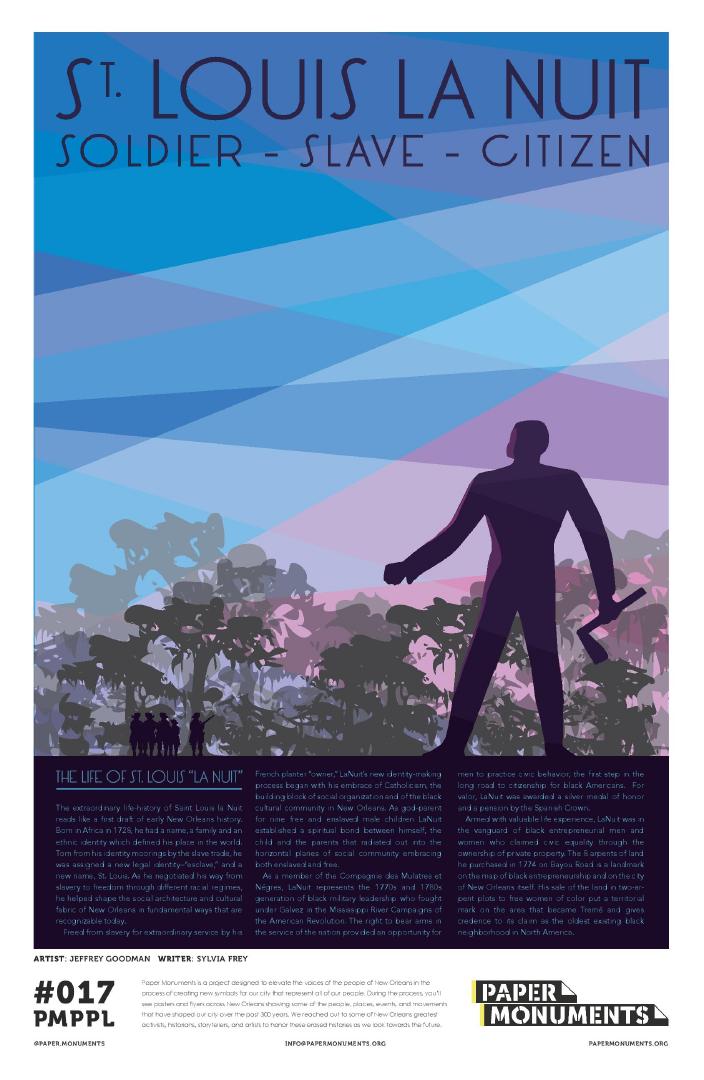
St. Louis La Nuit: Soldier, Slave, CItizen
Paper Monuments Project #017: Freed from slavery for extraordinary service by his French planter “owner,” La Nuit’s was in the vanguard of black entrepreneurial men and women who claimed civic equality in New Orleans.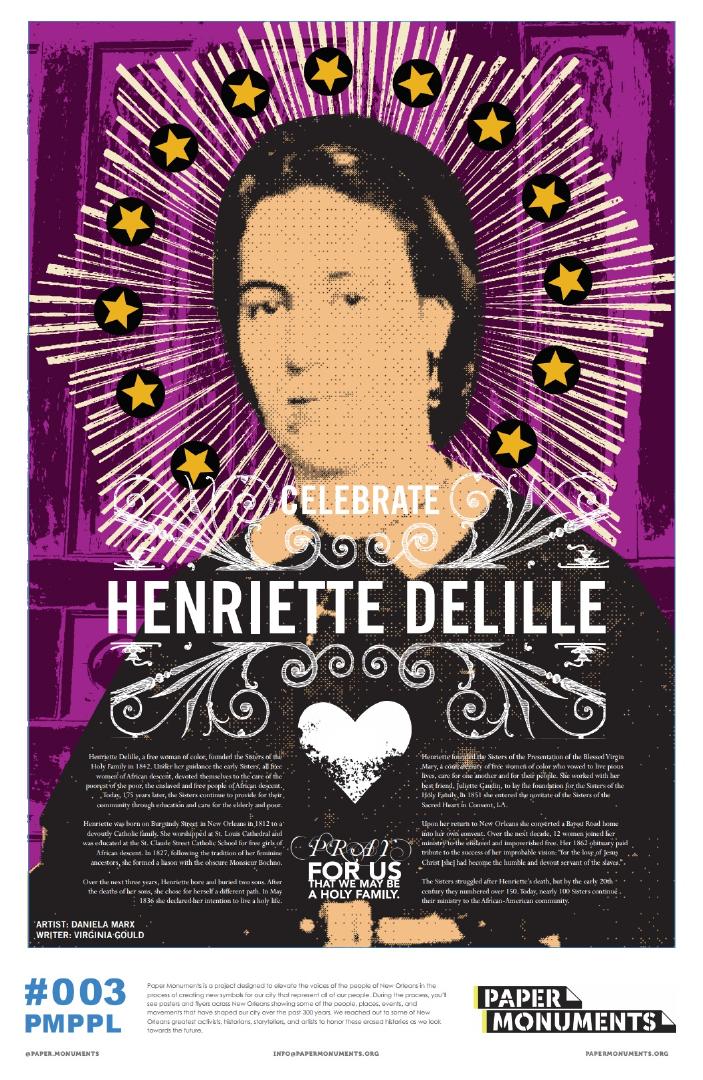
Henriette Delille
Paper Monument Project #003: Henriette Delille, a free woman of color, founded the Sisters of the Holy Family in 1842. The sisters were devoted to the care of impoverished enslaved people and free people of African descent.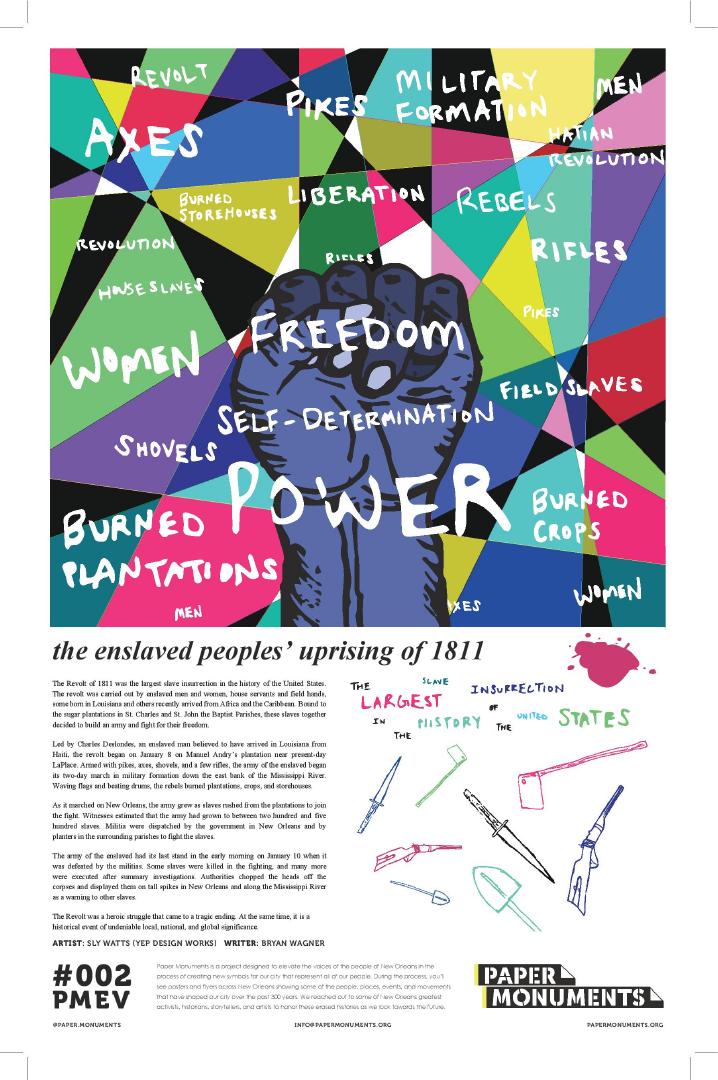
The Enslaved Peoples' Uprising of 1811
Paper Monument Project #002: The 1811 Louisiana Slave Revolt was the largest slave insurrection in the history of the United States that came to a tragic ending. It is a historical event of undeniable local, national, and global significance.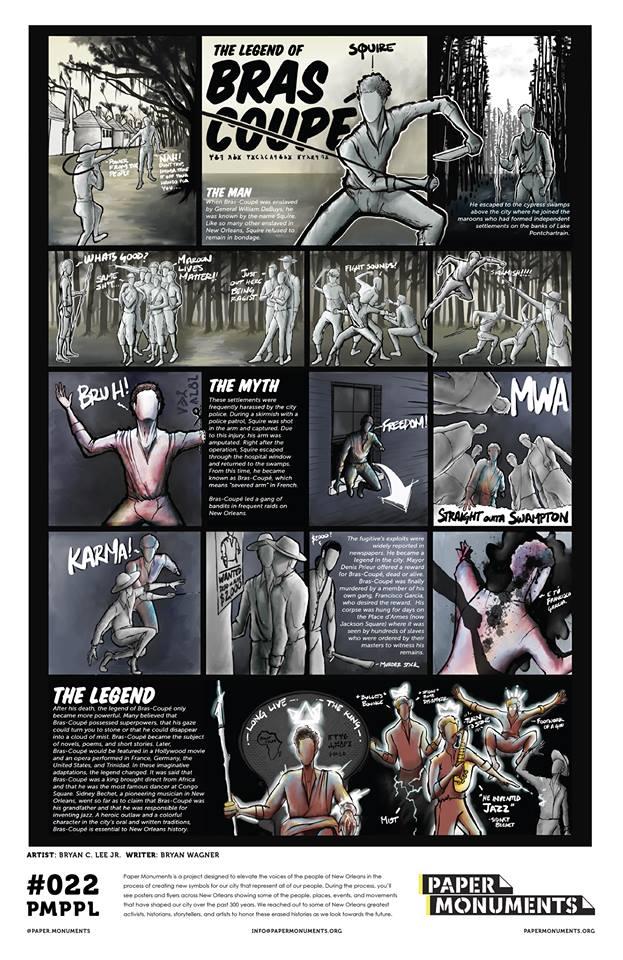
Bras-Coupé
Paper Monument #022: When Bras-Coupé was a slave owned by General William DeBuys, he was known by the name Squire. Like so many other slaves in New Orleans, Squire refused to remain in bondage.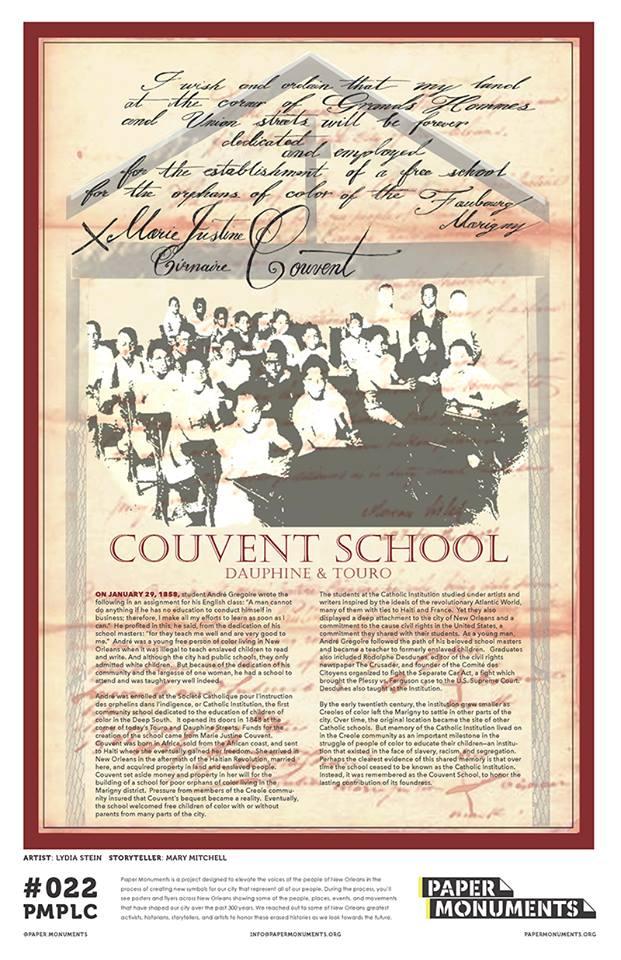
Couvent School
Paper Monuments Project #022: Catholic Institution, the first community school dedicated to the education of children of color in the Deep South opened its doors in 1848 Funds for the creation of the school came from Marie Justine Couvent. Couvent was born in Africa, sold from the African coast, and sent to Haiti where she eventually gained her freedom.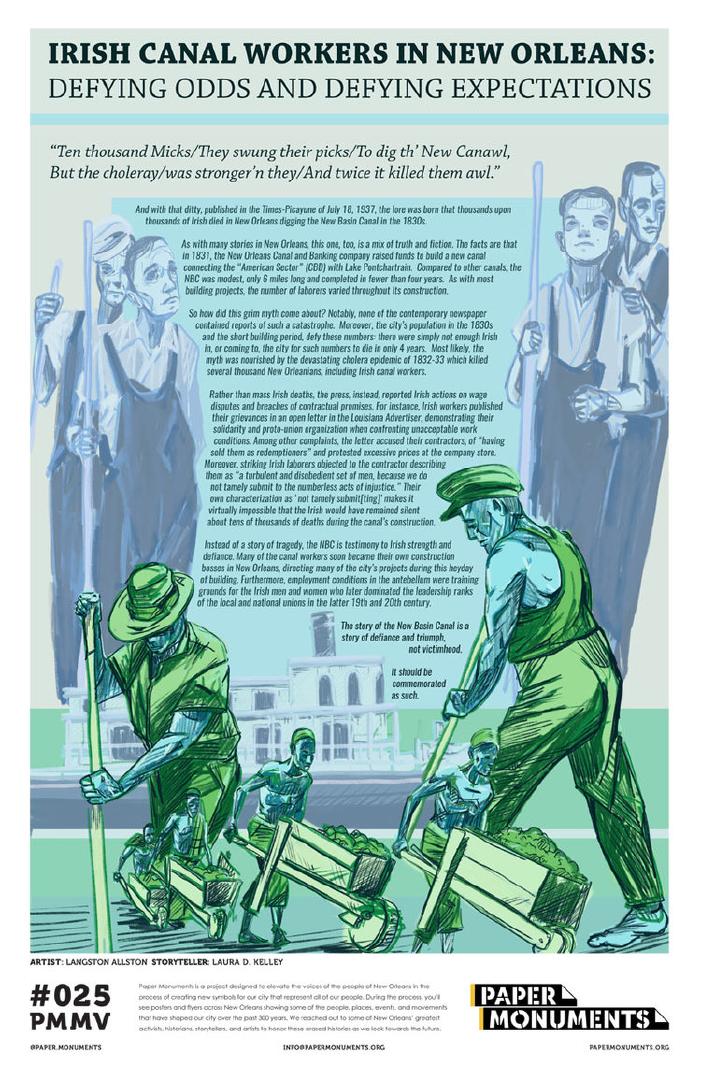
Irish Canal Workers: Defying Odds and Defying Expectations
Paper Monuments Project #025: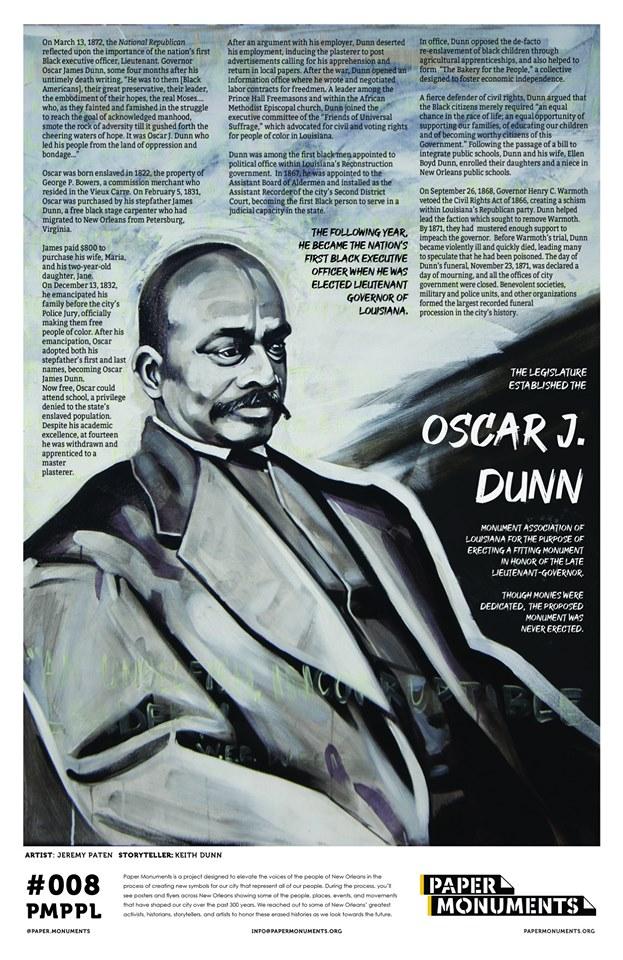
Oscar James Dunn
Black civil rights activist and Reconstruction Era politician, whom W.E.B. Du Bois called, "an unselfish, incorruptible, leader."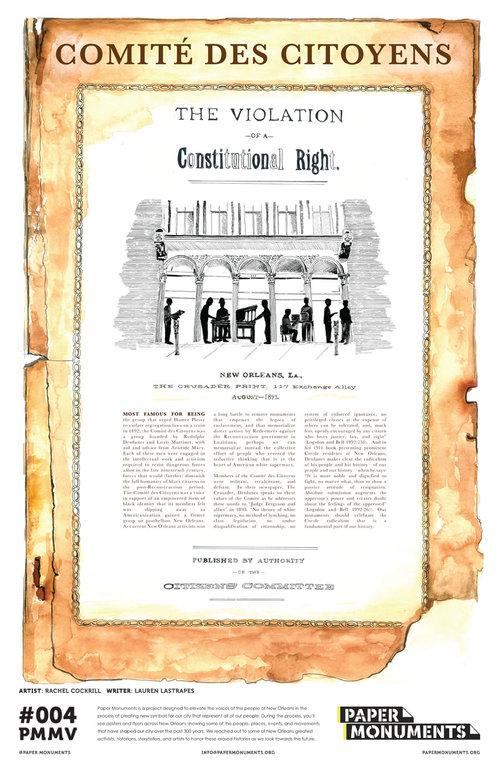
Comité des Citoyens
Comité des Citoyens, most famous for being the group that organized member Homer Plessy's violation of railroad segregation laws on a train in 1892, was a group that advocated for black New Orleanians in the post-Reconstruction period.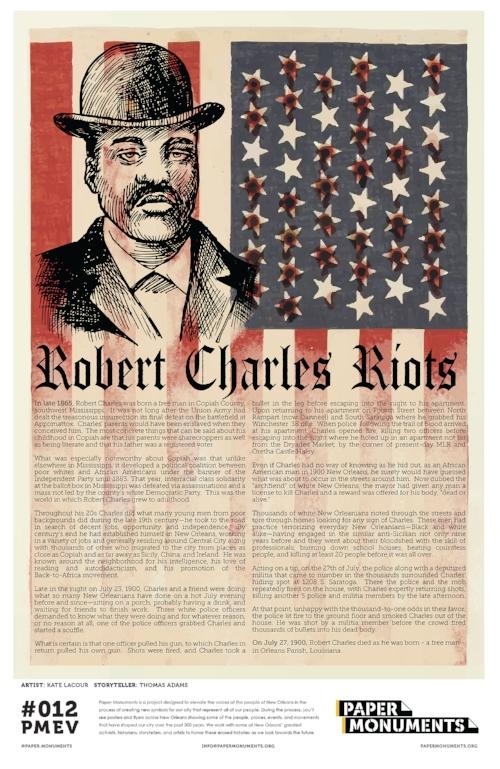
Robert Charles Riots
In late 1865, Robert Charles was born a free man in Copiah County, southwest Mississippi. It was not long after the Union Army had dealt the treasonous insurrection its final defeat on the…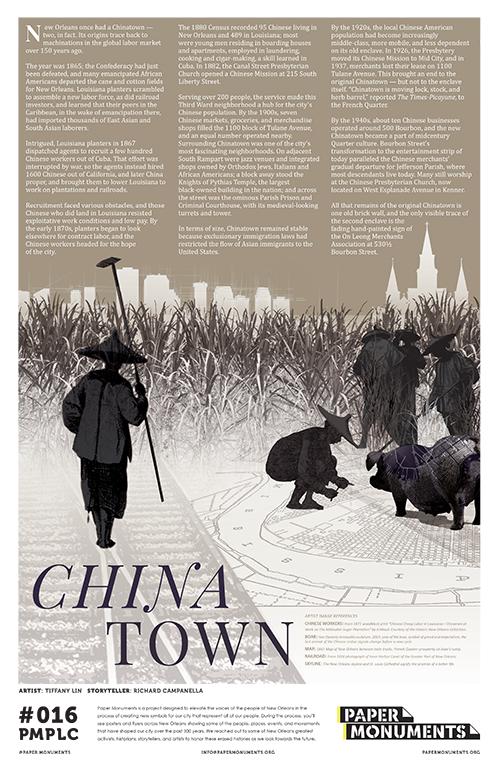
Chinatown
Paper Monument Project #016 Chinatown: New Orleans once had a Chinatown — two, in fact. Its origins trace back to machinations in the global labor market over 150 years ago.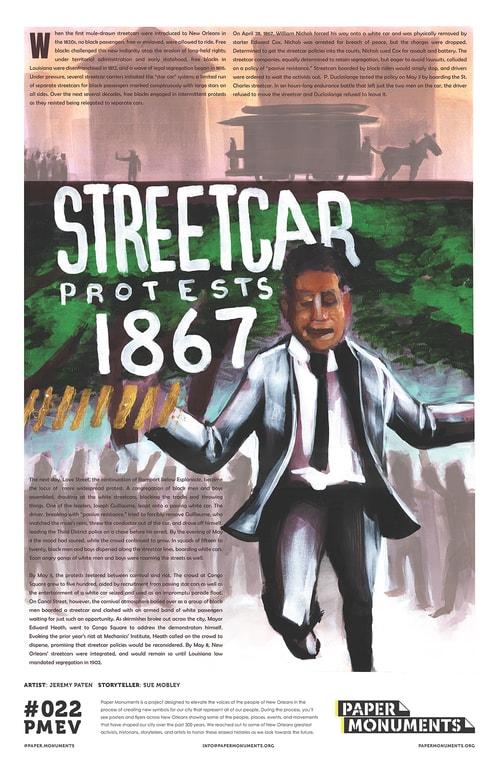
Streetcar Protest 1867: April 28, 1867
Paper Monument Project #022: On May 8, 1867, New Orleans’ streetcars were integrated, and would remain so until Louisiana law mandated segregation again in 1902.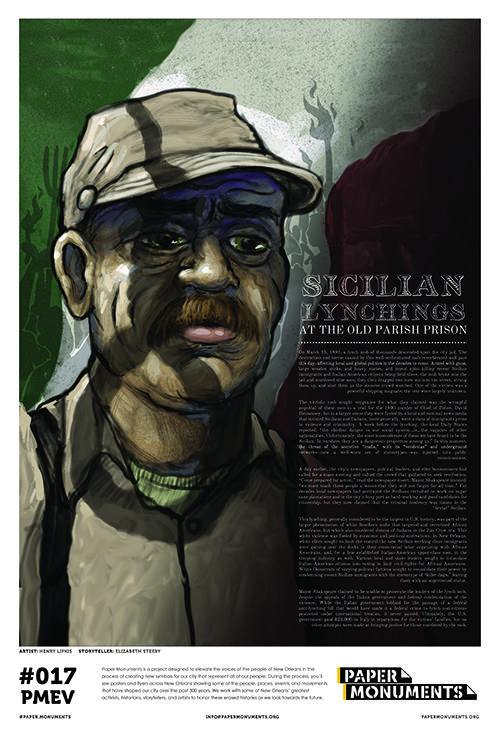
Sicilian Lynchings at the Old Parish Prison
On March 15, 1891, a lynch mob of thousands descended upon the city jail. The destruction and terror caused by this well-orchestrated mob reverberated well past this day, affecting local and global…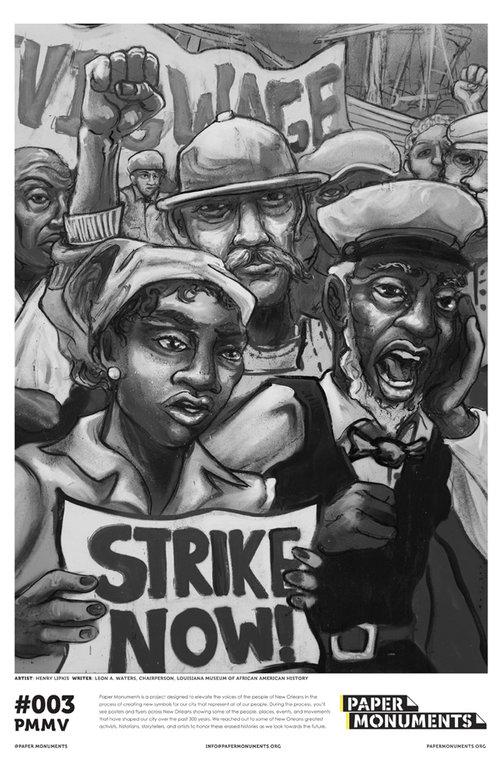
The General Strike of 1892
Over 120 years ago, one of the greatest united strikes happened here in New Orleans.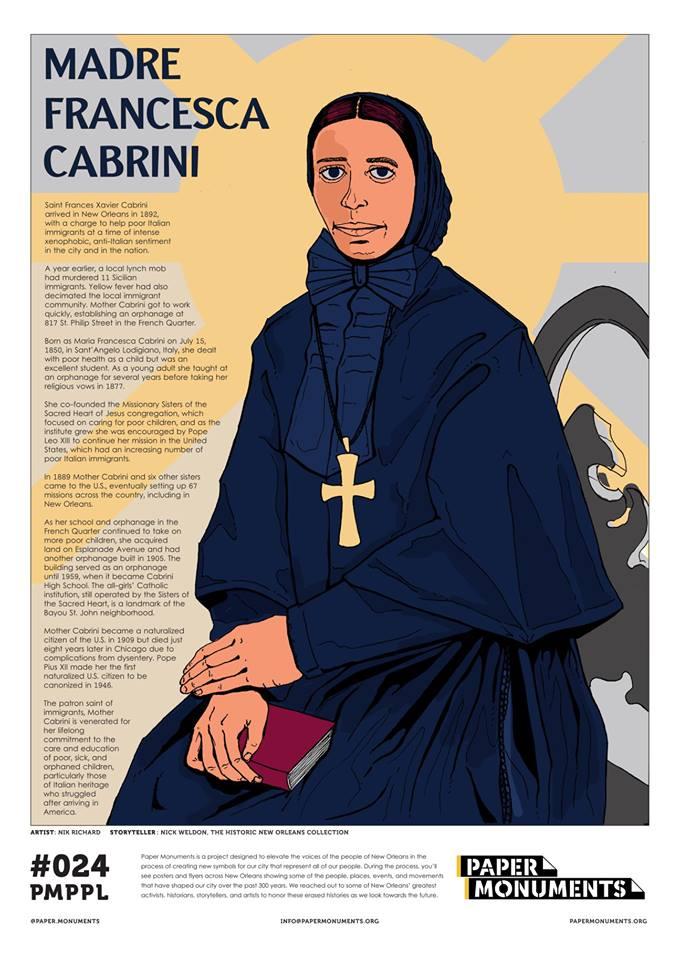
Madre Francesca Cabrini
Paper Monuments Project #024: The story of Mother Cabrini's work on behalf of Italian immigrants in late-19th and early 20th-century New Orleans.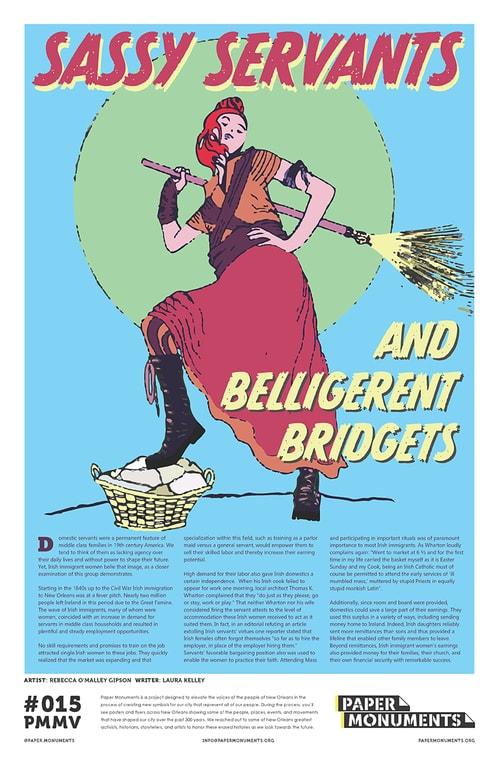
Sassy Servants and Belligerent Bridgets: Irish Domestic Workers in the 19th Century
Paper Monuments Project #015: Starting in the 1840s up to the Civil War Irish immigration to New Orleans was at a fever pitch. The wave of Irish immigrants, many of whom were women, coincided with an increase in demand for servants in middle-class households.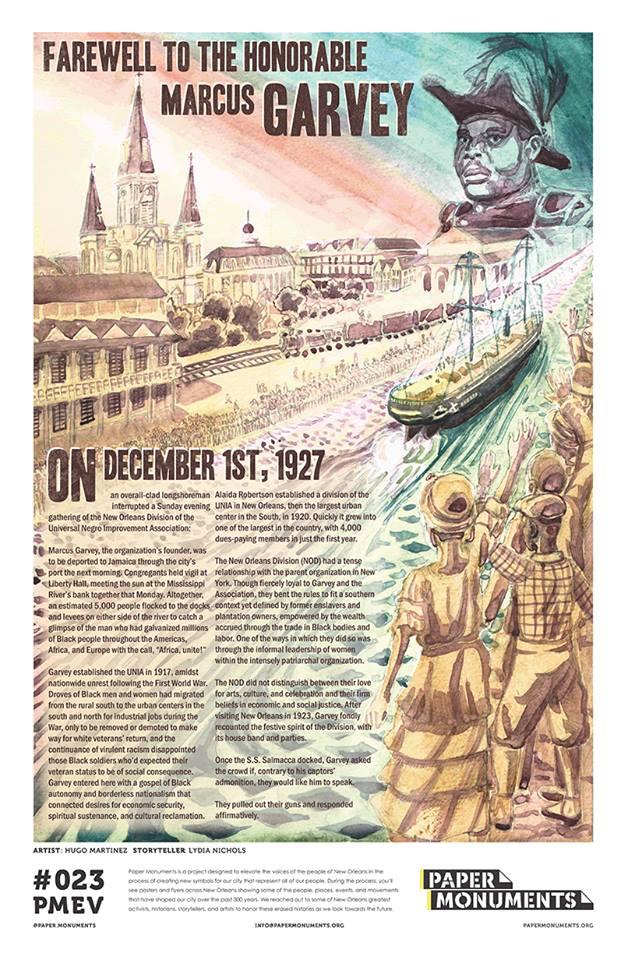
Farewell to the Honorable Marcus Garvey
Paper Monument Poster #023: Remembering Marcus Garvey's deportation and commemorates the New Orleans members of the United Negro Improvement Association who stood on the shores of Mississippi to bid goodbye to Garvey.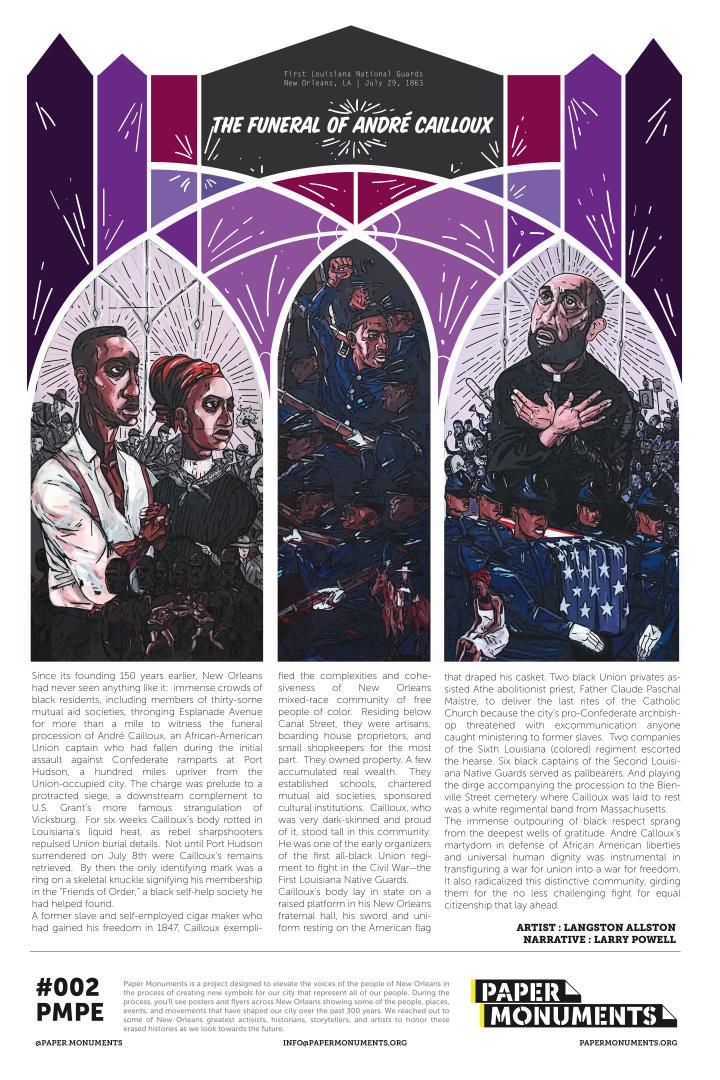
The Funeral of André Cailloux: Fallen Captain of the Louisiana Native Guards Buried July 29, 1863
Paper Monument #002: Thousands lined Esplanade Avenue to witness the funeral procession for Captain André Cailloux, the one of the early organizers of the Louisiana Native Guards, the first all-black Union regiment of the Civil War.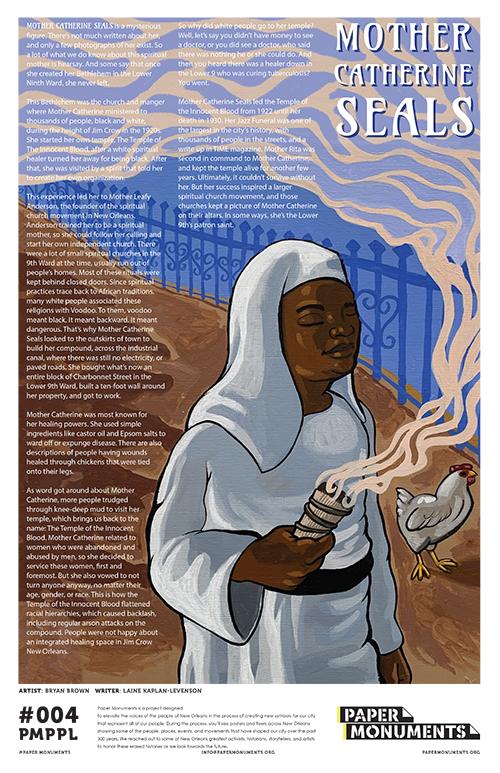
Mother Catherine Seals
Paper Monuments Project #004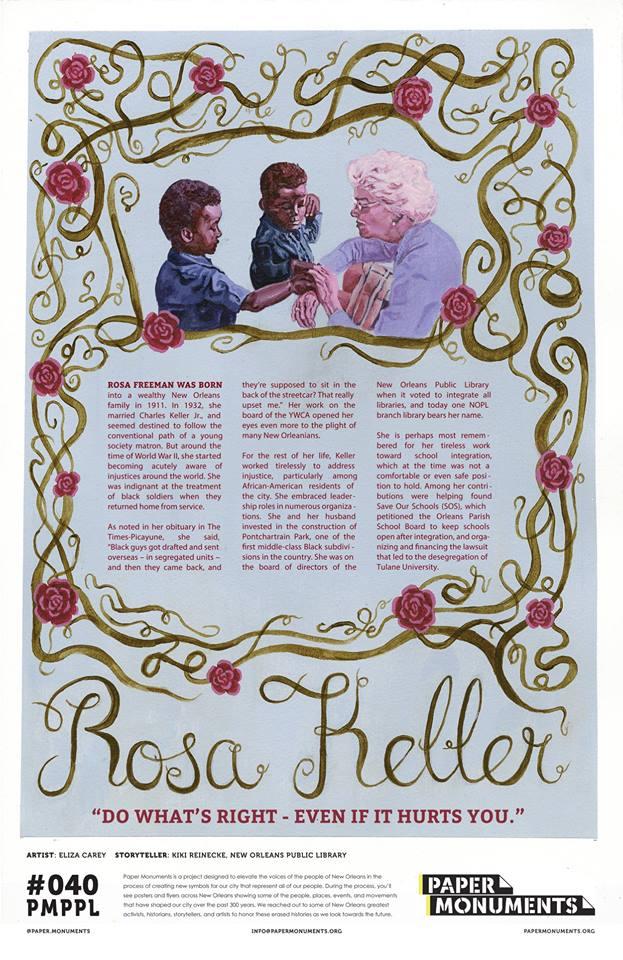
Rosa Keller
Paper Monuments Poster #040: Rosa Keller worked tirelessly to address injustice, particularly among African-American residents of New Orleans following World War II.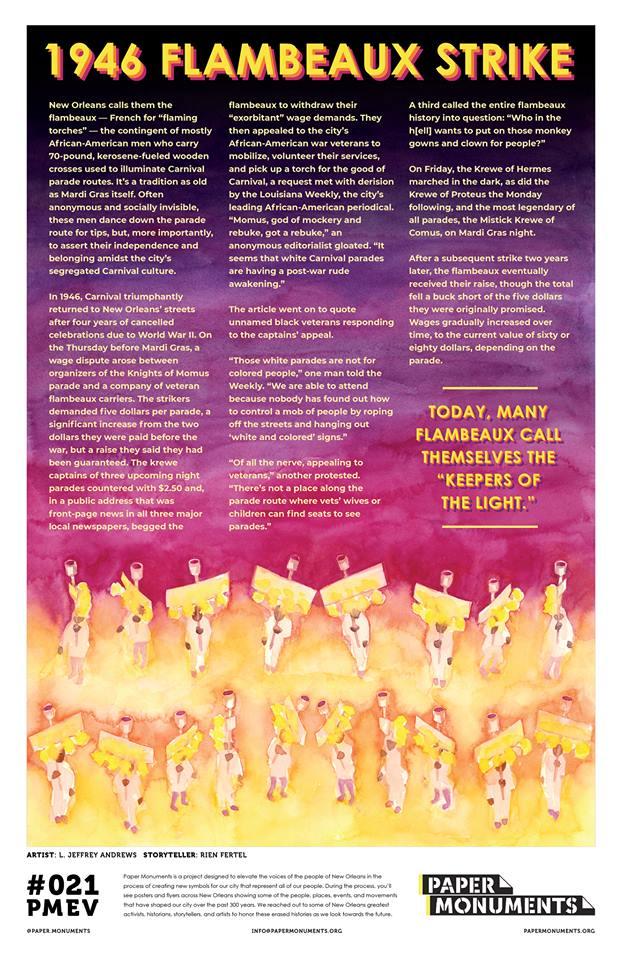
1946 Flambeaux Strike
Paper Monuments Project #021: In 1946, Carnival triumphantly returned to New Orleans’ streets after four years of canceled celebrations due to World War II. On the Thursday before Mardi Gras, a wage dispute arose between organizers of the Knights of Momus parade and a company of veteran flambeaux carriers.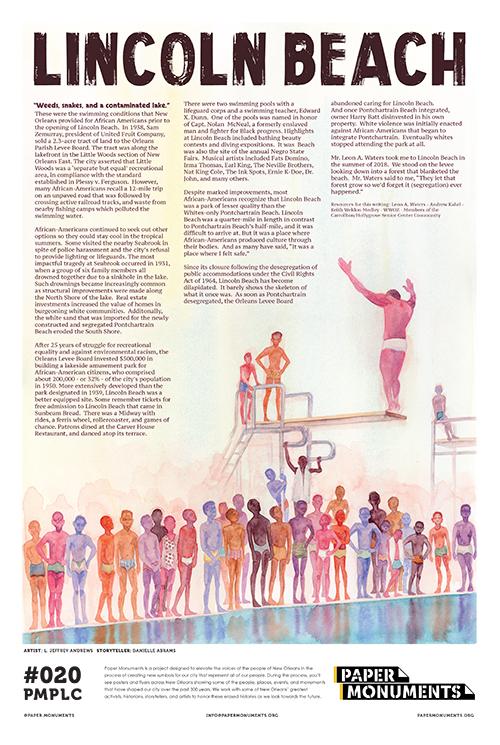
Lincoln Beach
Paper Monuments Project #020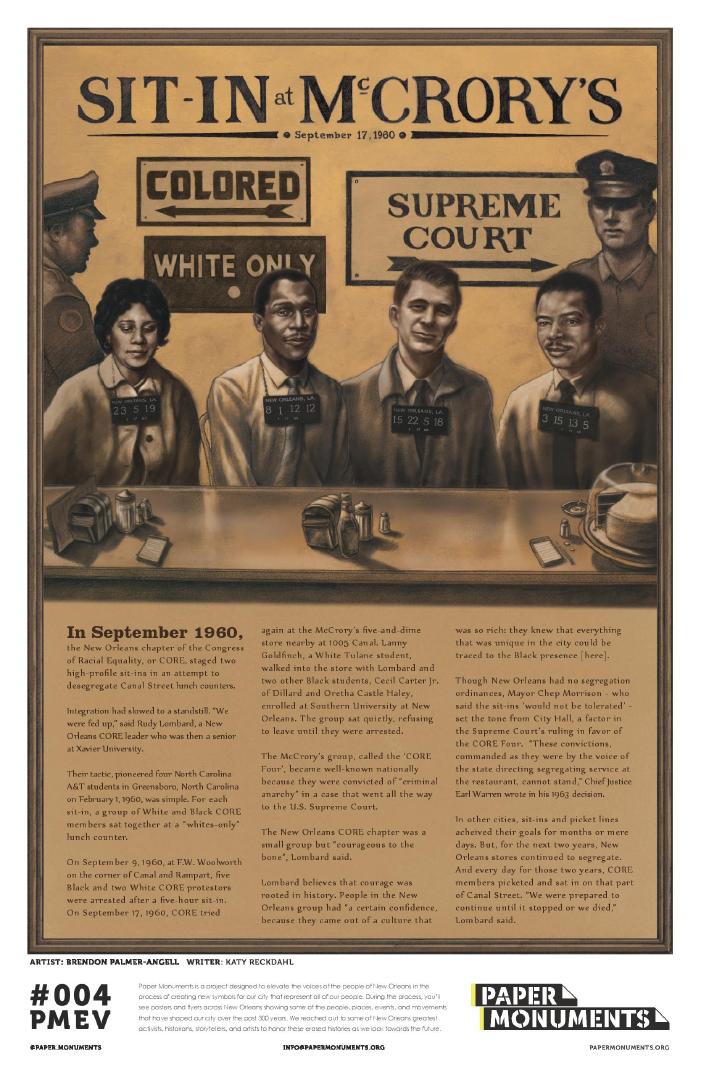
Sit-In at McCrory's: September 17, 1960
Paper Monument Project #004: In September 1960, the New Orleans chapter of the Congress of Racial Equality, or CORE, staged two high-profile sit-ins in an attempt to desegregate Canal Street lunch counters.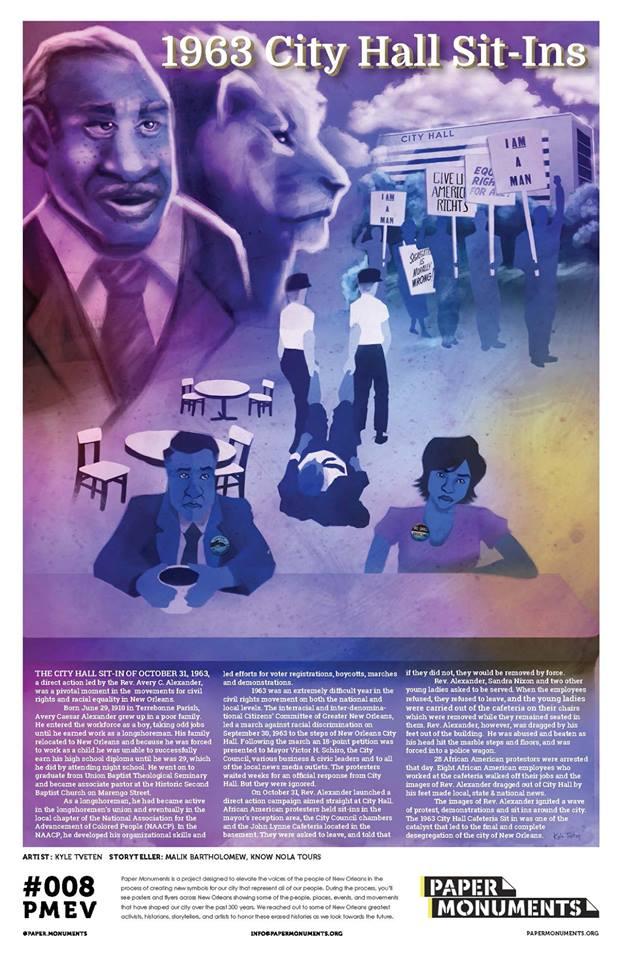
City Hall Cafeteria Sit-In
Paper Monument Poster #008: The City Hall Sit-In of 1963, a direct action led by the Rev. Avery C. Alexander, served as a pivotal moment in the history of the civil rights movement and racial equality in the city of New Orleans.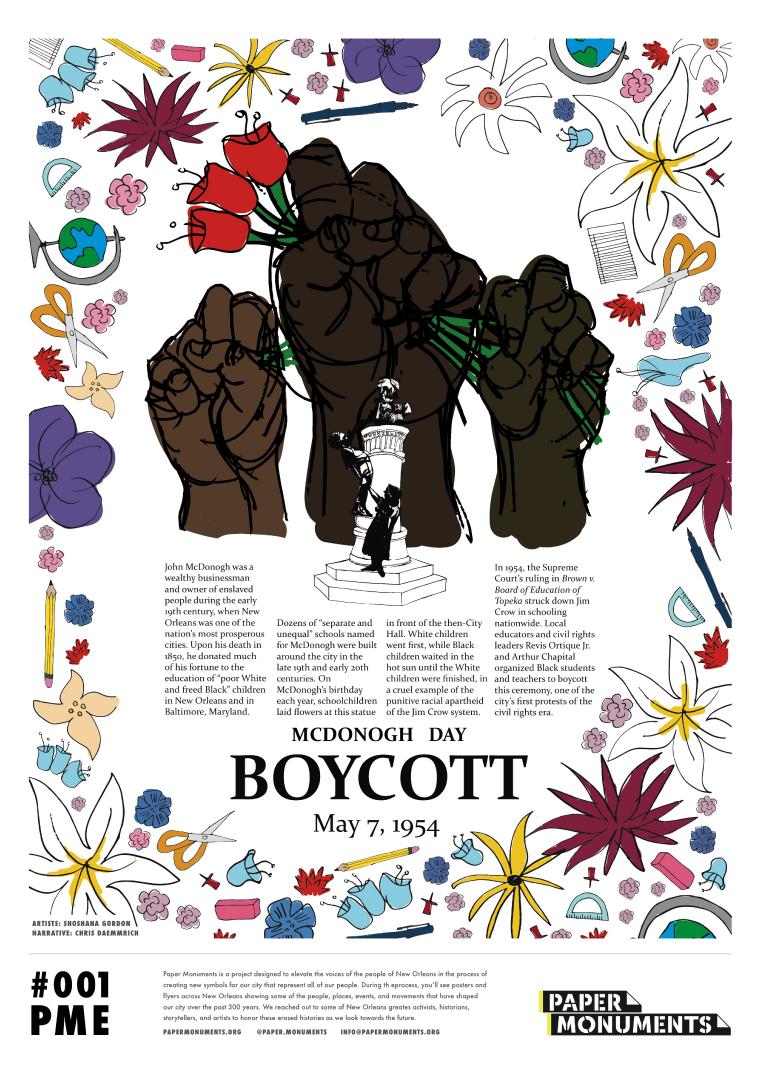
McDonogh Day Boycott: May 7, 1954
Paper Monument Project #002: On May 7, 1954, Lafayette Square was the site of one of the South's earliest organized civil rights protests centered on equality in public schooling. It was also one of the earliest civil rights protests in New Orleans.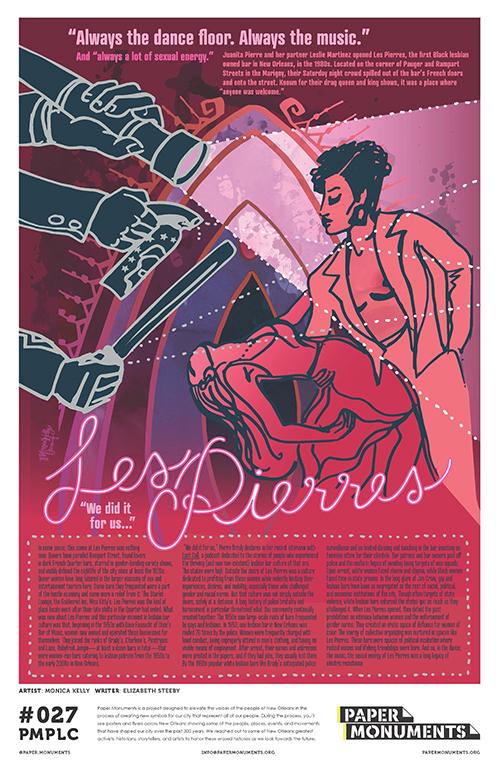
Les Pierres
“Always the dance floor. Always the music.” And “always a lot of sexual energy.”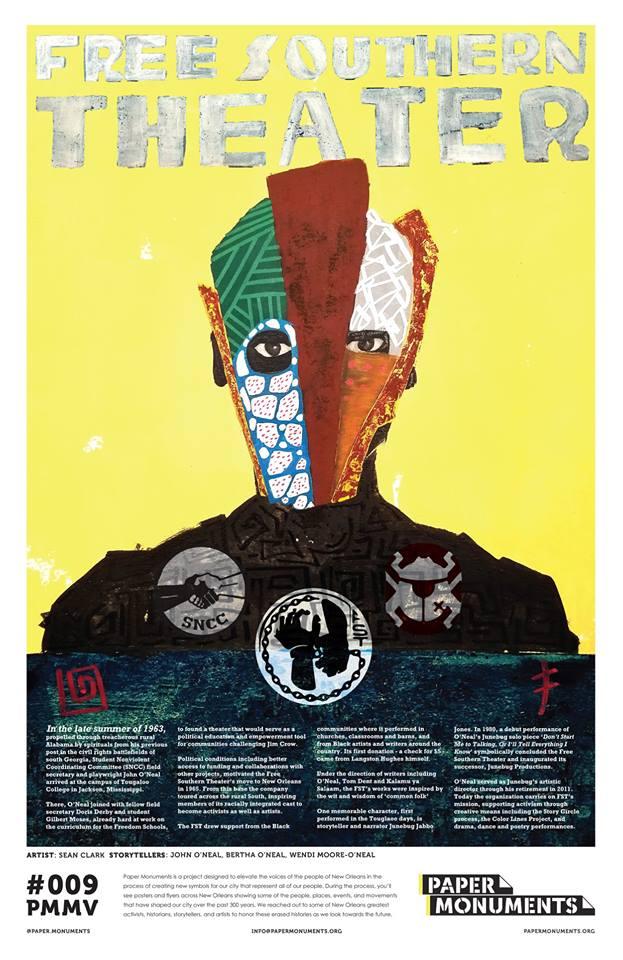
Free Southern Theater
Paper Monuments Project #009: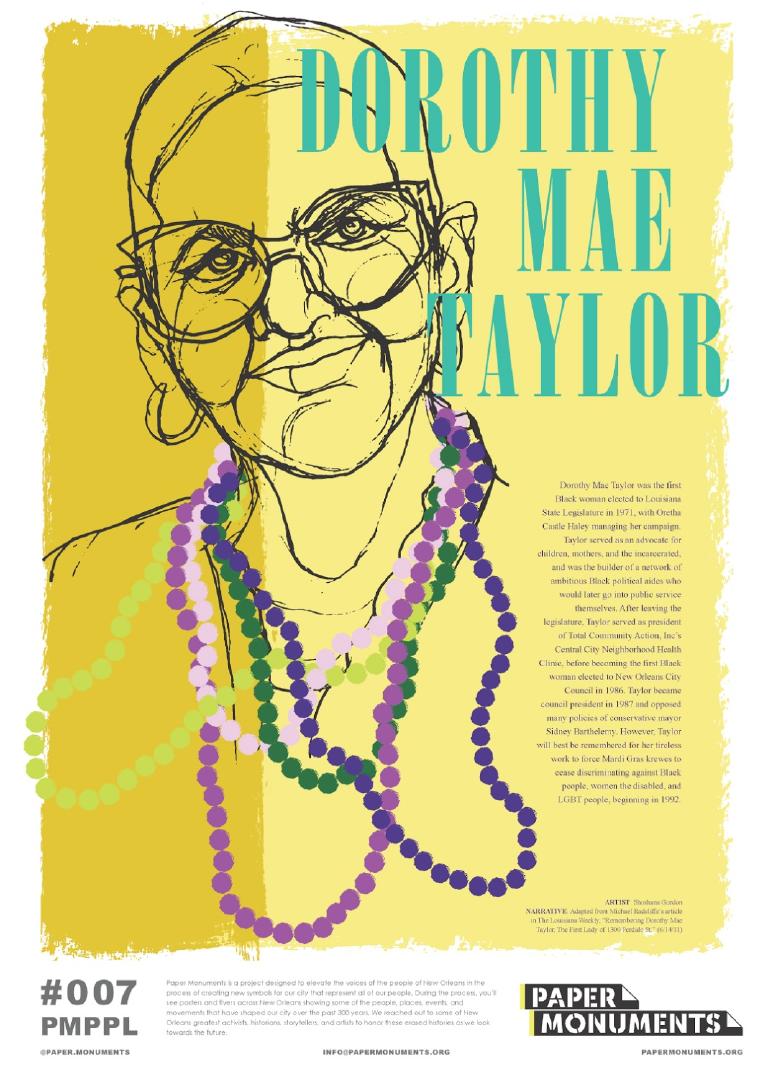
Dorothy Mae Taylor
Paper Monument Project #007: Dorothy Mae Taylor was the first Black woman elected to Louisiana State Legislature, celebrated for her tireless work to end discrimination by Mardi Gras krewes.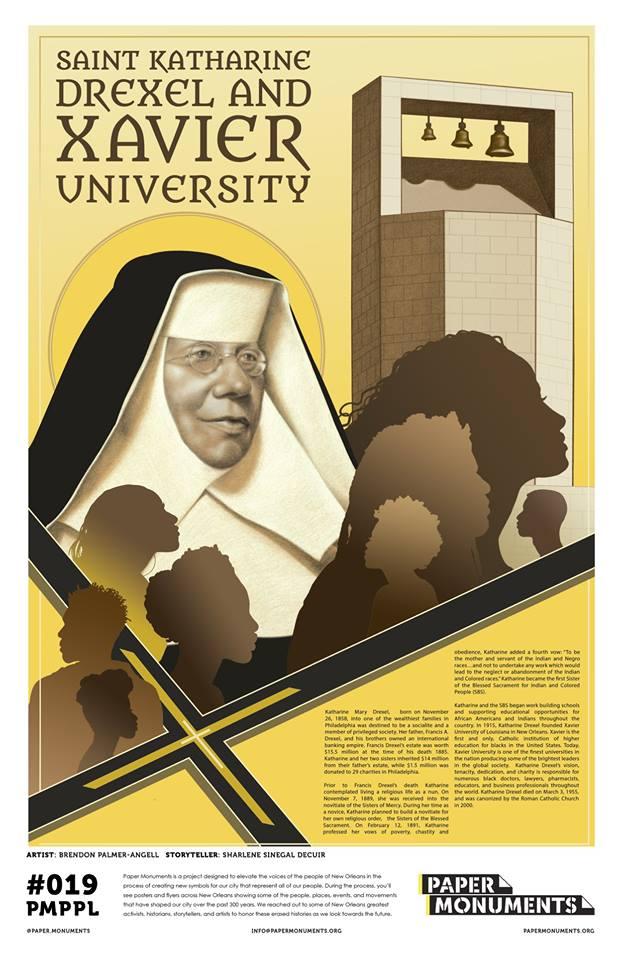
Saint Katharine Drexel and Xavier University
Katharine Mary Drexel, born on November 26, 1858, into one of the wealthiest families in Philadelphia was destined to be a socialite and a member of privileged society. He father, Francis A. Drexel…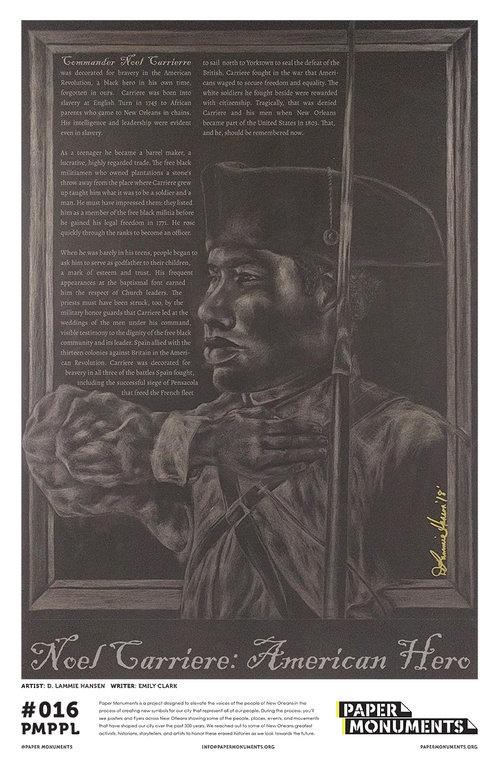
Commander Noel Carriere
Paper Monuments Project #016: Commander Noel Carriere, decorated for his actions during the Revolutionary War, was a member of the free black militia before he gained his legal freedom in 1771.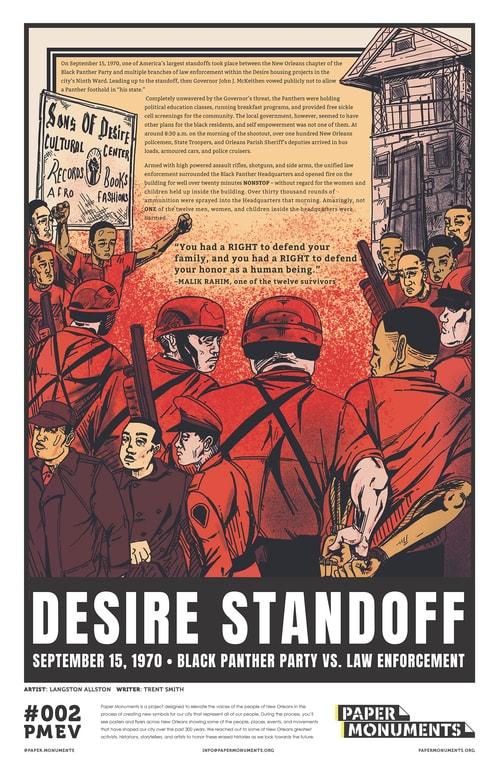
Desire Standoff
Paper Monuments Project #002: The New Orleans chapter of the Black Panther Party and multiple branches of law enforcement within the Desire housing projects in the city’s Ninth Ward engaged in one of America’s largest standoffs.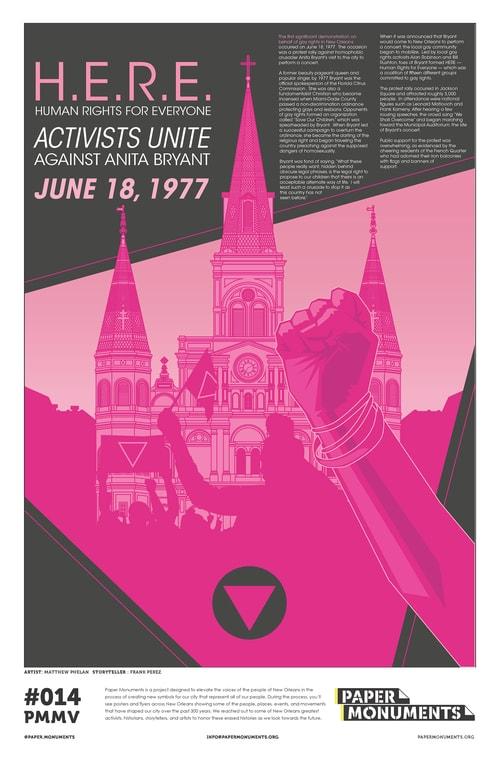
H.E.R.E. (Human Rights for Everyone) Activists Unite Against Anita Bryant: June 18, 1977
Paper Monument Project #014: The first significant demonstration on behalf of gay rights in New Orleans occurred on June 18, 1977. The occasion was a protest rally against homophobic crusader Anita Bryant’s visit to the city to perform a concert.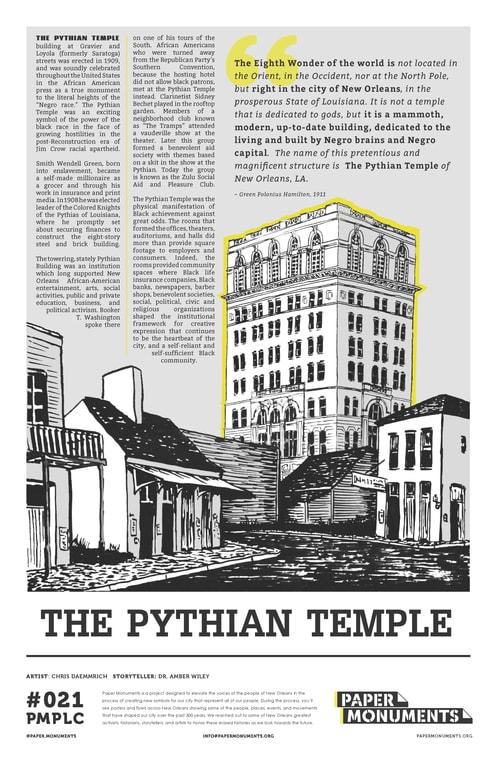
The Pythian Temple
Paper Monument Project #021: "The Eighth Wonder of the world is not located in the Orient, in the Occident, nor at the North Pole, but right in the city of New Orleans, in the prosperous State of Louisiana. It is not a temple that is dedicated to gods, but it is a mammoth, modern, up-to-date building, dedicated to the living and built by Negro brains and Negro capital. The name of this pretentious and magnificent structure is the Pythian Temple of New Orleans, La." --Green Polonius Hamilton, 1911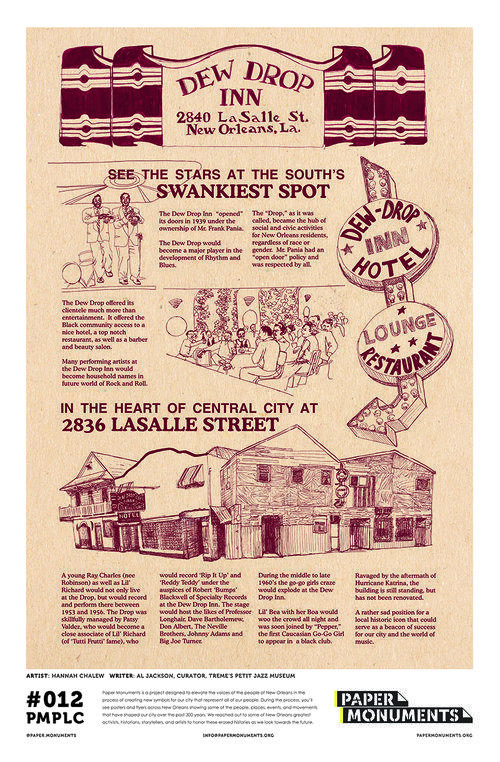
Dew Drop Inn
Paper Monuments #012: Many performing artists at the Dew Drop Inn would become household names in the future world of Rock and Roll.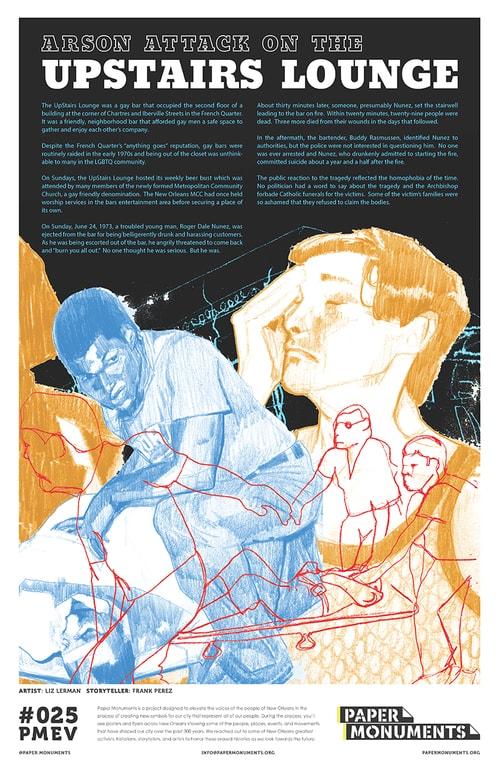
Arson Attack on the UpStairs Lounge
Paper Monument Project #025: Despite the French Quarter’s “anything goes” reputation, gay bars were routinely raided in the early 1970s and being out of the closet was unthinkable to many in the LGBTQ community.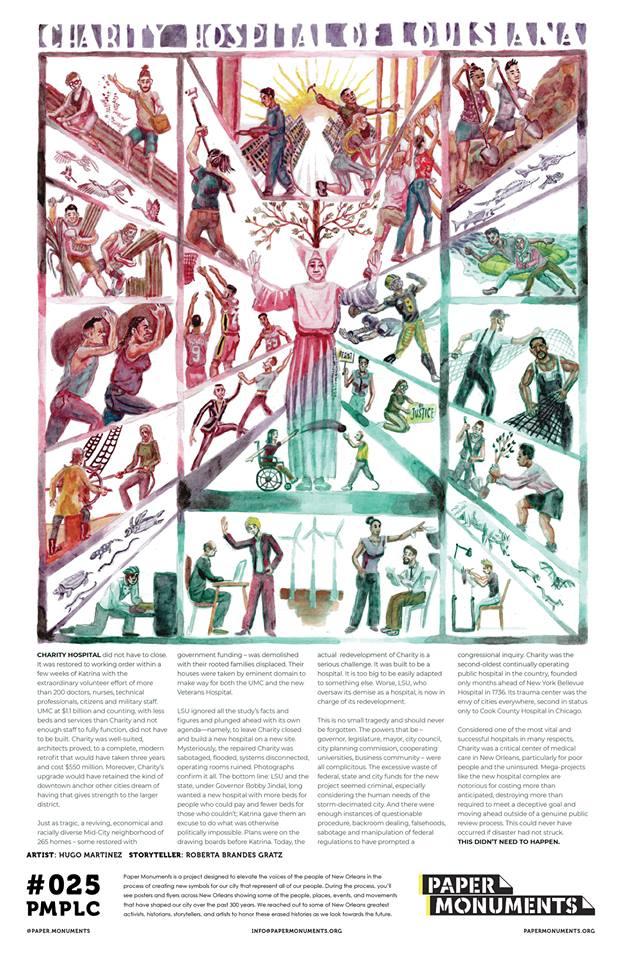
Charity Hospital
Paper Monument Project #025: Charity was the second-oldest continually operating public hospital in the country.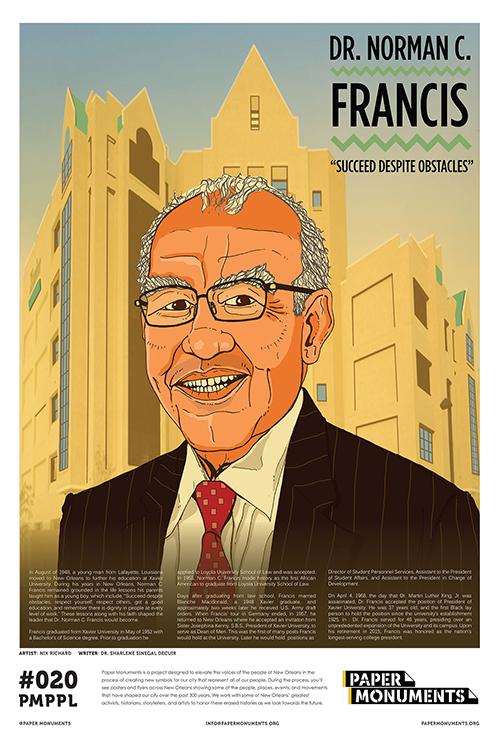
Dr. Norman C. Francis
Paper Monument Poster #020: Norman C. Francis was President of Xavier University for 46 years and is honored as the nation’s longest-serving college president.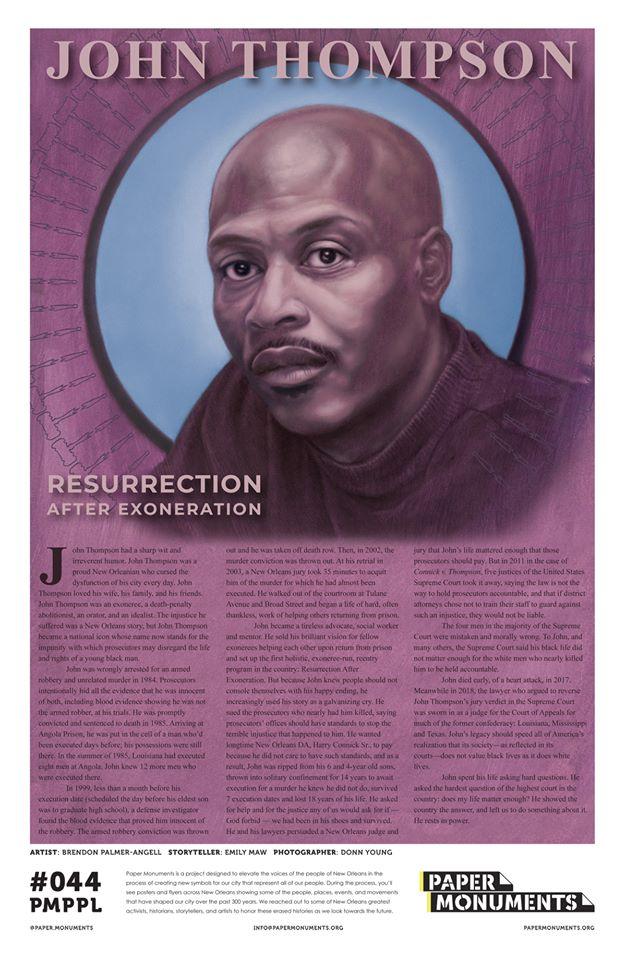
John Thompson: Resurrection After Exoneration
Paper Monument Poster #044: John Thompson was an exoneree, a death-penalty abolitionist, an orator, and an idealist. The injustice he suffered was a New Orleans story, but John Thompson became a national icon whose name now stands for the impunity with which prosecutors may disregard the life and rights of a young Black man.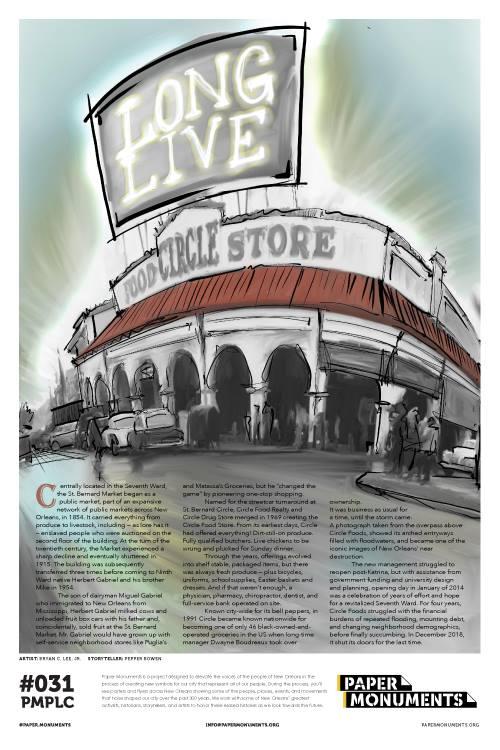
Circle Food Store
Paper Monuments Project #031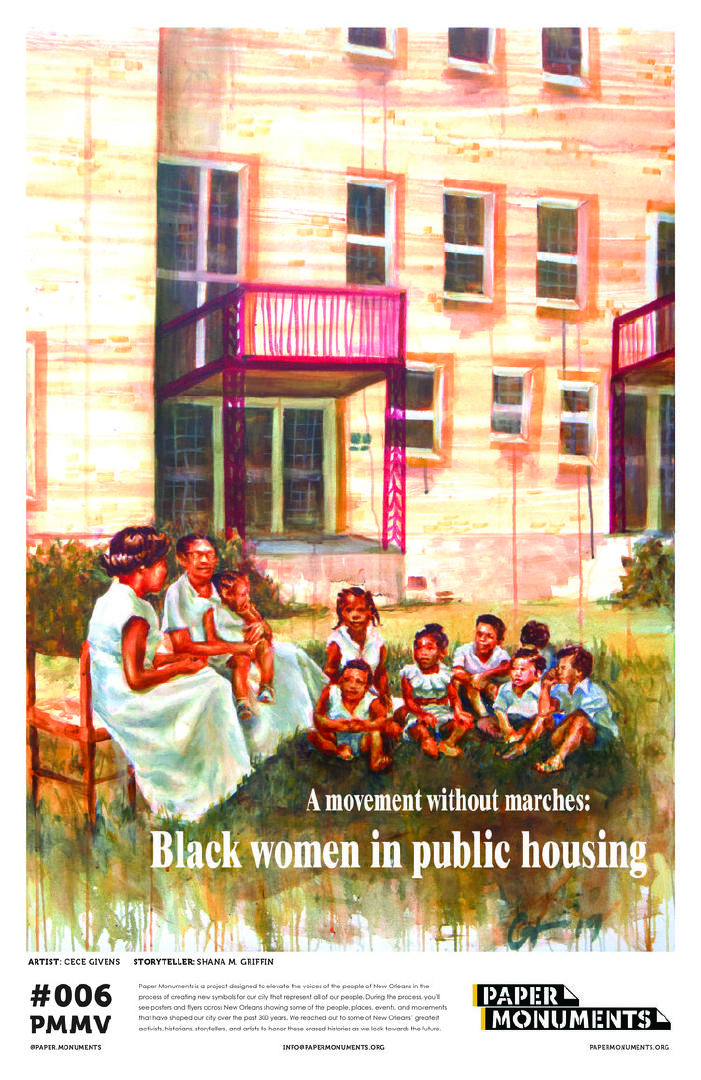
A Movement Without Marches: Black Women in Public Housing
Starting in the 1920s and increasing exponentially in the 1930s, and onwards, the urban landscape of New Orleans, like many urban municipalities across the country, began to change as a result of a…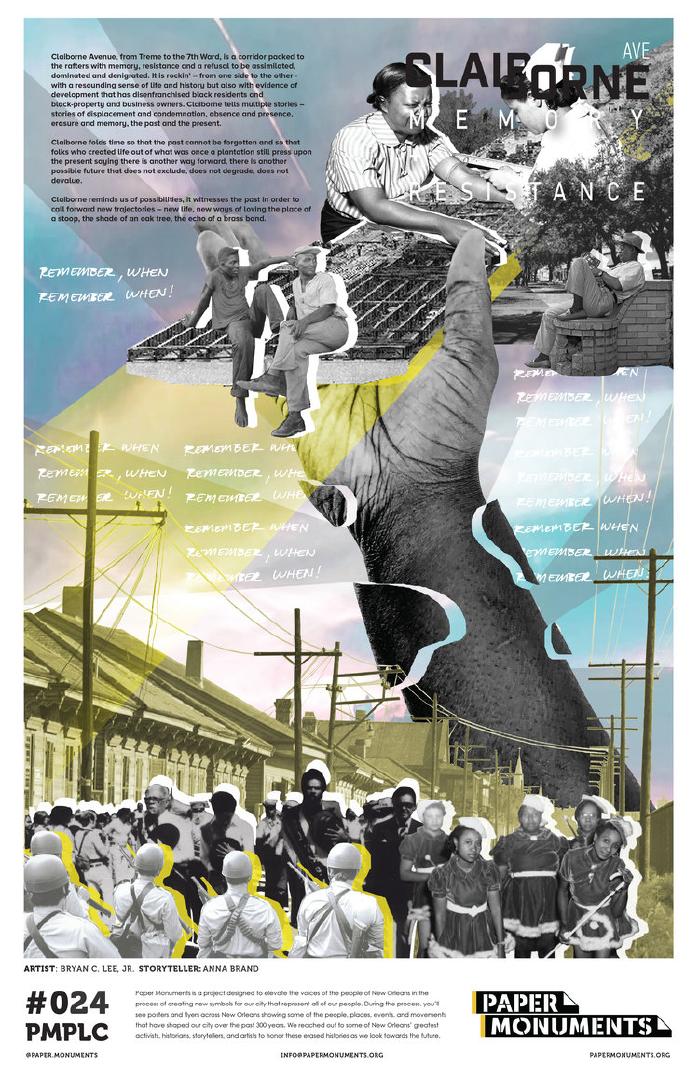
Claiborne Avenue
Claiborne Avenue, from Treme to the 7th Ward, is a corridor packed to the rafters with memory, resistance and a refusal to be assimilated, dominated and denigrated. It is rockin’ – from one side to…Tour curated by: PAPERMONUMENTS.ORG | For more information on Paper Monuments, visit PAPERMONUMENTS.ORG and on Twitter @Paper.Monuments or email them at INFO@PAPERMONUMENTS.ORG #papermonuments #peoplesmonuments #monumentsforall