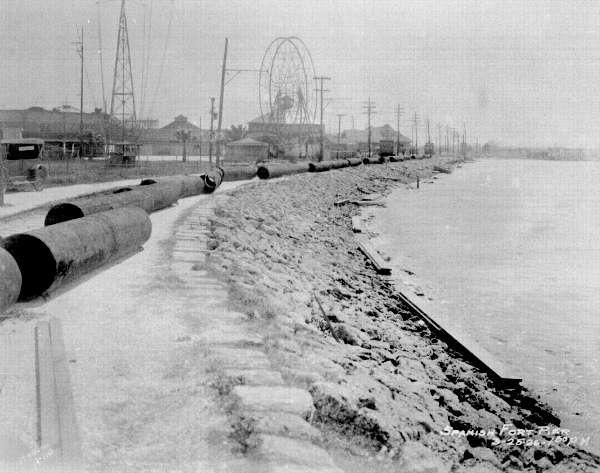
Spanish Fort at Bayou St. John
Text
A small fort was erected in 1701 before the founding of the city of New Orleans by the French where Bayou St. John empties into Lake Pontchartrain. The settlers sought to protect the important trade route along Bayou St. John.
The fort was first used in 1793 under the authority of Governor Carondelet during the Battle of New Orleans where Major Jean Baptiste Plauche's battalion carried out observations from the fort at the direction of General Andrew Jackson.
The fort stayed active until after the Louisiana Purchase where an act of Congress allowed the sale of all obsolete military sites. In 1823, the government sold the Spanish Fort to Harvey Elkins as surplus. Elkins transformed the fort into the Pontchartrain Hotel.
In 1903, the popularity of Pontchartrain Hotel at Spanish Fort declined as a result of the suspension of steam railroad services. Subsequently, the fort's buildings were burned by an unknown source. In 1909, the resort was acquired by the New Orleans Railway and Light Company who revived it in 1911 with the introduction of electric car lines. These lines were extended to Spanish Fort until October 16, 1932.
Due to the popularity of the competing West End pier, attendance began to dwindle, leaving the Spanish Fort's future uncertain.
In 1933, the resort finally closed to facilitate the implementation of the Orleans Parish Levee Board's plans for the development of the lakefront from West End to the Industrial Canal. During the reclamation project of the Lakefront in the 1930s, the amusement park at Spanish Fort was disassembled and subsequently moved to the new Pontchartrain Beach located several miles further down the lakefront.
The area surrounding the Spanish fort was sold for residential use, leaving only a half an acre of remains left for preservation.
Files
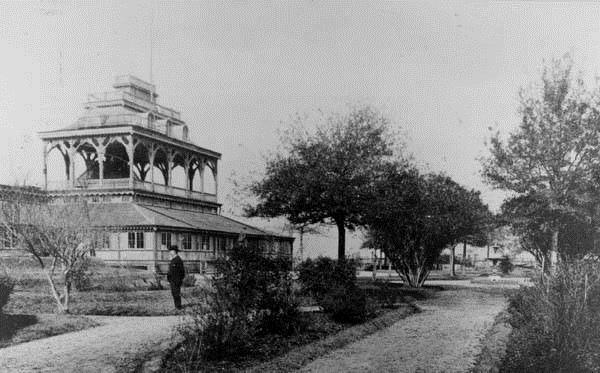
Spanish Fort, near the entrance
Courtesy of Louisiana Division/City Archives, New Orleans Public Library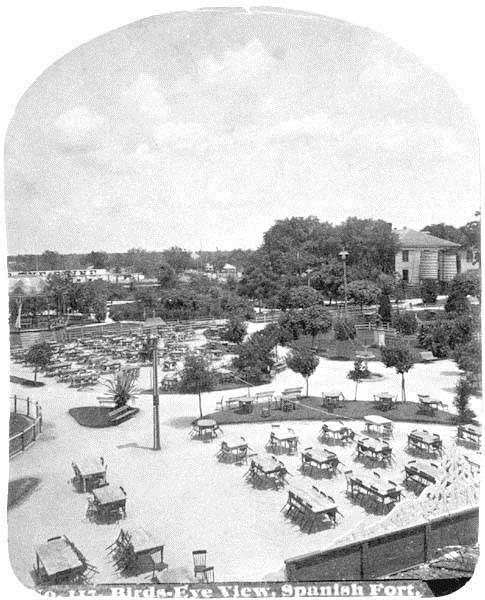
Birds eye view of Spanish Fort, circa early 1900s
This image depicts the fort as viewed from Bayou St. John. The Opera House is visible in the upper right corner, where noted speakers including William Makepeace Thackeray, General Ulysses S. Grant, and Oscar Wilde appeared. Courtesy of Louisiana Division/City Archives, New Orleans Public Library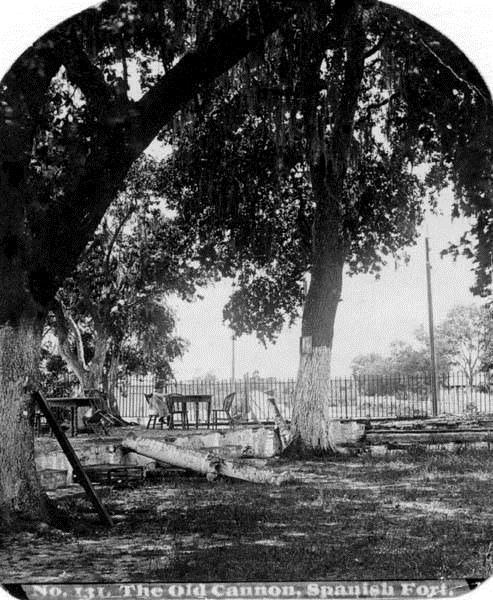
The Old Cannon at Spanish Fort
Although the fort was decommissioned and turned into an amusement party, some artifacts remained. Here, a young girl sits at a table near the old cannon. Courtesy of Louisiana Division/City Archives, New Orleans Public Library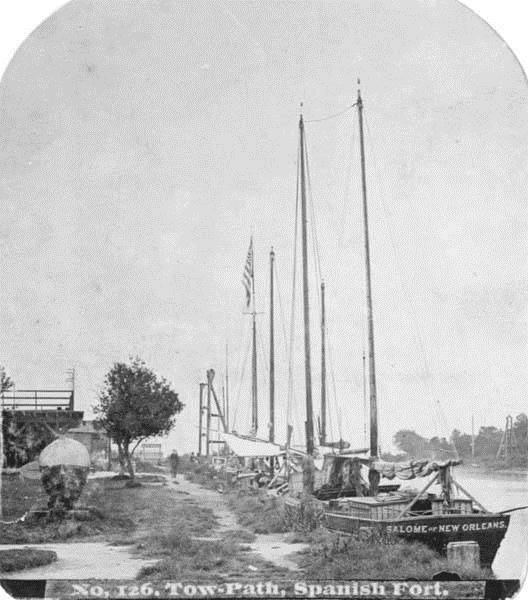
Tow path on Bayou St. John
While traveling into New Orleans through Bayou St. John, the Spanish Fort Amusement Park was a favorite point of embarkment. A torpedo boat recovered from the bayou after the Civil War is visible in the lower left corner. Courtesy of Louisiana Division/City Archives, New Orleans Public Library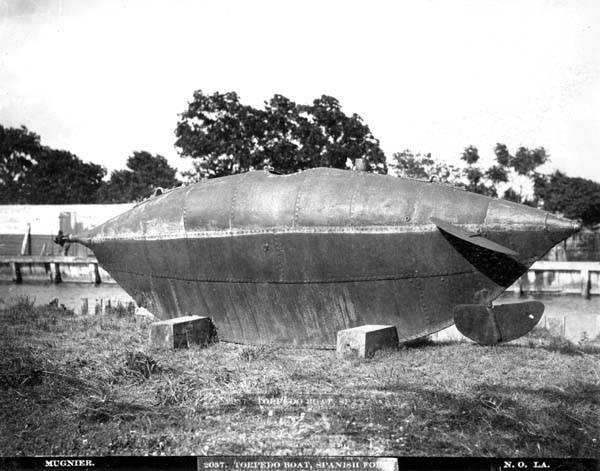
Submarine found in Bayou St. John
After the Civil War in 1878, this submarine was recovered from Bayou St. John near Spanish Fort. About 1895 it was put on display at Spanish Fort, where it remained for about a decade. The vessel was thought to be "The Pioneer," a Confederate torpedo boat that was scuttled after Admiral Farragut's fleet invaded New Orleans. However, the construction of this boat does not match plans found of The Pioneer. The boat is now owned by the Louisiana State Museum, but the origin of the craft is still unclear. Courtesy of Louisiana Division/City Archives, New Orleans Public Library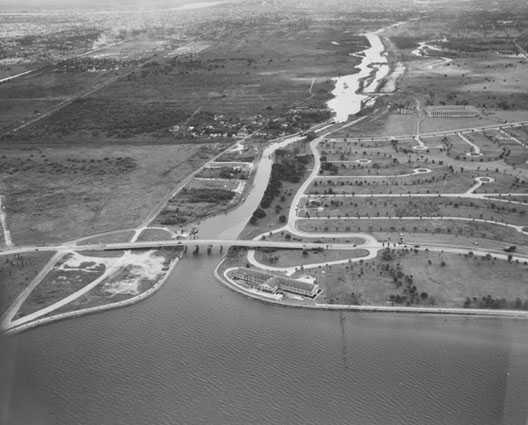
The Mouth of Bayou St. John at Lake Ponchartrain, 1948
On the right of the old bridge is the Coast Guard Station (now gone) and the area known as the "Old Beach," the original home of Pontchartrain Beach. Above the Old Beach is Lake Vista, after the streets were built, but before homes went up. At the right of the Bayou is open ground which became Lake Terrace. Courtesy of Louisiana Division/City Archives, New Orleans Public Library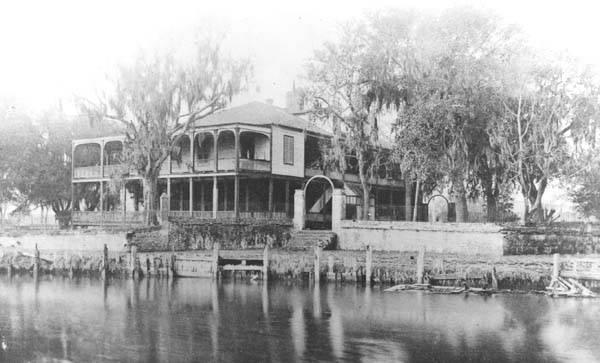
Pontchartrain Resort Hotel alongside ruins of Spanish Fort from across Bayou St. John.
Harvey Elkins erected the Pontchartrain Hotel in 1823. The property changed hands several times, but John Slidell eventually acquired the building and renamed it the Spanish Fort Hotel. Another owner was the Canal Street, City Park, and Lake Railroad Company which provided transportation from downtown New Orleans to the hotel on a steam train built in 1877. When the enterprising Moses Schwartz bought the property in 1878, he turned it into a splendid resort with a casino, pavilion, theater, restaurants, gardens, bathing piers, and picnic facilities for families. Steam train service was discontinued in 1903, and a fire in 1906 destroyed many of the buildings. The property was then bought by the New Orleans Railway and Light Company. The company built an electrified rail line to the site and rebuilt the resort as an amusement park, complete with a roller coaster and Ferris wheel. The park was unable to compete with the popular West End Amusement Park, and closed in 1926. Courtesy of Louisiana Division/City Archives, New Orleans Public Library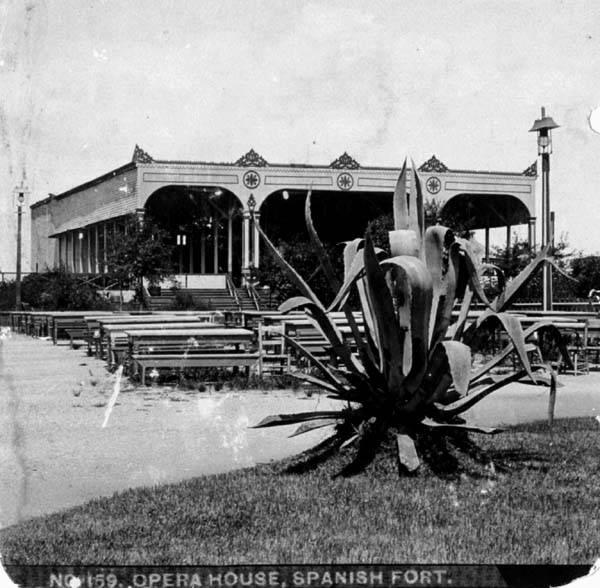
Opera House at Spanish Fort
Courtesy of Louisiana Division/City Archives, New Orleans Public Library