<?xml version="1.0" encoding="UTF-8"?>
<feed xmlns="http://www.w3.org/2005/Atom">
  <title type="text">New Orleans Historical</title>
  <updated>2026-09-08T16:36:03+00:00</updated>
  <generator uri="http://framework.zend.com" version="1.12.20">Zend_Feed_Writer</generator>
  <link rel="alternate" type="text/html" href="https://mail.neworleanshistorical.org/"/>
  <link rel="self" type="application/atom+xml" href="https://mail.neworleanshistorical.org/items/browse?output=rss2"/>
  <id>https://mail.neworleanshistorical.org/</id>
  <author>
    <name>New Orleans Historical</name>
    <uri>https://mail.neworleanshistorical.org</uri>
  </author>
  <link rel="hub" href="https://pubsubhubbub.appspot.com/"/>
  <entry>
    <title type="html"><![CDATA[Duncan Plaza]]></title>
    <summary type="html"><![CDATA[<img src="https://mail.neworleanshistorical.org/files/fullsize/0b87c8d5bef372fe0fedb679ad39ef55.jpg" alt="Map Overlay" /><br/><p>This past July, if you happened to be downtown near the Superdome and New Orleans City Hall, you might have seen something unexpected: in the public park known as Duncan Plaza, there were students digging, screening and sorting through buckets of dirt, and recovering thousands of artifacts from the “back-of-town” neighborhood that Louis Armstrong once called home, lost to urban renewal after World War II. Up until the end of the 1940s, this area had been part of a dense working-class neighborhood filled with tenements, saloons, and dance halls. At least a portion of Duncan Plaza had also been a part of an African American red light district that was the segregated counterpart of the better-known Storyville District. The back-of-town was a crucible for Black culture in New Orleans: Louis Armstrong’s childhood home was just a few doors down from this summer’s excavations, as was the Union Sons Hall, better known as the original “Funky Butt”, the dance hall where Armstrong supposedly heard legendary jazz musician Buddy Bolden play. The neighborhood was razed after World War II as part of the construction of the new downtown municipal complex that includes the present-day City Hall.</p><p>The City of New Orleans (CNO) allowed a team of professors, staff, and students from the University of New Orleans and the New Orleans Baptist Theological Seminary to conduct archaeological excavations at Duncan Plaza. Team members placed test units across what would have been the rear yards of homes on Perdido Street, finding thousands of artifacts in the process. One of the most exciting finds was a densely-filled nineteenth century privy shaft, perfectly bisected by one of our units. That unit alone produced over 25 boxes of artifacts! It was filled with a remarkable array of animal bone, everything from fragments of cow skulls to duck bills to tiny bits of bone from fish, not to mention hundreds or reconstructable glass bottles and ceramic items.</p><p>The Summer 2025 field school literally just scratched the surface of what Duncan Plaza holds, but it represents an important baseline for managing the remains of what once was a bustling urban neighborhood. Moreover, it is the latest demonstration of UNO’s long-standing commitment to documenting and preserving the City’s history through its archaeology.</p><p><em><strong><a href="https://mail.neworleanshistorical.org/items/show/1735">For more (including 7 images) view the original article</a></strong></em></p>]]></summary>
    <published>2026-04-29T18:35:17+00:00</published>
    <updated>2026-07-15T16:20:24+00:00</updated>
    <link rel="alternate" type="text/html" href="https://mail.neworleanshistorical.org/items/show/1735"/>
    <id>https://mail.neworleanshistorical.org/items/show/1735</id>
    <author>
      <name>D. Ryan Gray</name>
    </author>
  </entry>
  <entry>
    <title type="html"><![CDATA[McDonogh No. 5]]></title>
    <summary type="html"><![CDATA[<img src="https://mail.neworleanshistorical.org/files/fullsize/de52e880b15b4789f77576c1c64c7c43.jpg" alt="Overview photo of the southern part of the project area, facing southwest. " /><br/><p>In 2020, the Federal Emergency Management Agency provided funding to the Recovery School District (RSD) authorizing the renovation of Martin Berhman Elementary School under the Robert T. Stafford Disaster Relief and the Emergency Assistance Act. RC Goodwin and Associates, a cultural resource management company, conducted archaeological excavations of the historic school properties that predated the existing Martin Berhman Elementary School Gymnasium. The site is located north of Red Allen Way, formerly Slidell Street, south of Opelousas Avenue, west of Vallette Street, and east of Verret Street, in Algiers Square 125. The excavation focused predominantly on the historic schoolhouse, a portress dwelling, and a playground used from the Reconstruction Era to the Great Depression.	</p><p>The property was originally a plantation owned by Canadian immigrants Pierre and Marguerite Gosselin, who moved to New Orleans in the 1770s. The land was passed down through the family line until it was sold by Marguerite Françoise Gosselin to Jean Baptiste Olivier, who maintained ownership of the space until his death in 1869. By 1882, the Gosselin property became the location of a school for African American children in Algiers Point. The McDonogh No. 5 campus expanded to cover over a fourth of the block. In addition to the school building and portress housing, the campus contained five other structures, two of which archaeologists identified as play sheds. </p><p>By 1904, plans were made to renovate McDonogh No. 5 and reopen it as a segregated white-only school to accommodate the growing white population in the area. The Orleans Parish School Board, with approval from Mayor Behrman, adopted a resolution to displace the Black student population. Due to vehement protests from Black families, whose children had no other school to attend close by, the Orleans Parish School Board constructed a new school for African American children, McDonogh No. 32. The white student population quickly exceeded the existing campus’s capacity. By 1930, construction began on the new Martin Behrman Public School.</p><p>The 2020 renovations provided local archaeologists with the opportunity to examine how this space developed in response to the social and political changes in the decades following the Civil War, as Reconstruction ended and the era of Jim Crow segregation began. In New Orleans, the turn of the century is known both for its Progressive era reforms and its regressive racial policies. From writing utensils and medicine to children’s toys and clothing, the artifacts excavated from this site provide valuable insight into the changing role of schools and the student experience within a segregated education system. </p><p><em><strong><a href="https://mail.neworleanshistorical.org/items/show/1734">For more (including 5 images) view the original article</a></strong></em></p>]]></summary>
    <published>2026-03-11T19:34:33+00:00</published>
    <updated>2026-09-08T16:34:51+00:00</updated>
    <link rel="alternate" type="text/html" href="https://mail.neworleanshistorical.org/items/show/1734"/>
    <id>https://mail.neworleanshistorical.org/items/show/1734</id>
    <author>
      <name>Ashlyn Durr, edited by Elizabeth Williams</name>
    </author>
  </entry>
  <entry>
    <title type="html"><![CDATA[The Old Ursuline Convent]]></title>
    <summary type="html"><![CDATA[<img src="https://mail.neworleanshistorical.org/files/fullsize/cbefb6412f971ea6cd198e6bb83bb0f4.jpg" alt="Site Overview: The Old Ursuline Convent" /><br/><p>In 2011, Shannon Lee Dawdy, an archaeologist and professor with the University of Chicago’s Department of Anthropology, conducted an excavation with students and volunteers at the site of the Ursuline Convent. The first Ursuline Convent building was begun in 1727 and completed in 1734 after years of delays, but it was structurally unsound and prone to rot. The second convent building replacing it was designed in 1745; it is now considered the oldest standing building in the Mississippi Valley. </p><p>Traditionally, Ursuline nuns were cloistered from the rest of French society, except for the education and catechism of young girls. In New Orleans, the Ursulines who arrived in the colony had expanded responsibilities. During the French colonial period, this group of Ursuline Sisters ran the Royal Hospital, raised orphaned children, did missionary work for enslaved and Indigenous people, and had a day school, in addition to educating young girls from wealthy New Orleans families. As a result, the convent was not socially separated from the rest of the city. Foot traffic in and out of the convent was common. The main building and outbuildings formed a courtyard. Based on artifact finds from the archaeological excavations, such as clothing pins, and a lack of typically male artifacts like pipe fragments, this courtyard was interpreted as a female-only space. This points to the fact that even though the Ursuline convent was a liberal, fluid institution, there were cloistered activity areas. </p><p>Despite being a place of mixed races, classes, and genders, the Ursuline Convent was designed with segregation in mind. The second convent building had dedicated sections for orphans and sick people, and separate quarters for enslaved people which were situated behind the convent. These sections were kept separate from the classroom for young girls of wealthy families. </p><p>While these areas were segregated, a large amount of aboriginal pottery was found throughout at the site. The local, handmade pottery was most likely made by Native American girls and women living at the convent,  though hand-built pottery could also have been made by Europeans or people of African descent. The presence of this pottery may point to an inclusion of Native Americans in convent life without a demand for complete separation from their families or material culture. </p><p>There were few identifiable religious artifacts found at the site. In addition to the educational and earthly mission of the convent, the excavation reveals the space functioned as a practical, secular space, in contrast to other religious sites in New Orleans. </p><p><em><strong><a href="https://mail.neworleanshistorical.org/items/show/1733">For more (including 6 images) view the original article</a></strong></em></p>]]></summary>
    <published>2026-03-11T19:11:54+00:00</published>
    <updated>2026-09-08T16:36:03+00:00</updated>
    <link rel="alternate" type="text/html" href="https://mail.neworleanshistorical.org/items/show/1733"/>
    <id>https://mail.neworleanshistorical.org/items/show/1733</id>
    <author>
      <name>Phonenix McIntosh, edited by Elizabeth Williams</name>
    </author>
  </entry>
  <entry>
    <title type="html"><![CDATA[Yellow Fever Hospital, Excavations at Thurgood Marshall School]]></title>
    <summary type="html"><![CDATA[<img src="https://mail.neworleanshistorical.org/files/fullsize/c1057b7035fb7d78a93186bf48ec134d.jpg" alt="Thurgood Marshall School" /><br/><p>In 2017, Federal Emergency Management Agency (FEMA) funded the repairs to Thurgood Marshall School caused by the Hurricane Katrina levee breaches. The site had been a school for over one hundred years. By 1884 it had been repurposed from a historical mansion that had been constructed on the site as part of a residential estate in the early 1800s. The remains of both the mansion and the schoolhouse were located within the modern footprint of the damaged school. In this case, the process of repairing the school could have destroyed any underground historical remains so, in compliance with federal law, FEMA conducted archaeological excavations at the property prior to repair. The excavations uncovered two privies – outhouses - one that’s contents dated to when the historical schoolhouse had been used as a quarantine hospital during the Yellow Fever Epidemic (1897), and the other to when Hannah Ford, the school caretaker, lived and worked at the school property (1890s-1913). Excavation of the privy used during the Yellow Fever Epidemic exposed debris relating to turn-of-the-century medical equipment including chamber pots, invalid feeders, nursing bottles, and glass disinfectant containers. Much of the material in the privy was burned, displaying clues of how medical professionals were attempting to sanitize items that had come into contact with the sick. The second privy contents related to the life of Hannah Ford. As a widow, she became the school caretaker and lived on the grounds with her school-aged children. The contents of her privy included porcelain figurines, a cake plate, and a highly decorated Imari/Arita porcelain vase. The contents, albeit scarce, suggested that Hannah Ford enjoyed baking, entertaining, and decorating her home with beautiful things while she took care of the school children.</p><p><i>Adapted from an exhibit originally published on GNOARCH.com.</i></p><p><em><strong><a href="https://mail.neworleanshistorical.org/items/show/1732">For more (including 5 images) view the original article</a></strong></em></p>]]></summary>
    <published>2025-11-25T21:51:43+00:00</published>
    <updated>2026-07-15T16:20:24+00:00</updated>
    <link rel="alternate" type="text/html" href="https://mail.neworleanshistorical.org/items/show/1732"/>
    <id>https://mail.neworleanshistorical.org/items/show/1732</id>
    <author>
      <name>Staff at Federal Emergency Management Agency (FEMA)&amp;#32;&amp;amp;&amp;#32;UNO &amp;#039;s Archaeological and Curation Facility (UNO ARC)</name>
    </author>
  </entry>
  <entry>
    <title type="html"><![CDATA[Development on Bayou Road: McDonogh (Bricolage Academy) Senior High School]]></title>
    <summary type="html"><![CDATA[<img src="https://mail.neworleanshistorical.org/files/fullsize/43e81837005b2d521bc784fe628d1137.jpg" alt="Historic Waterways and Ownership" /><br/><p>John McDonogh Senior High School (now Bricolage Academy) suffered damages from Hurricane Katrina. The Federal Emergency Management Agency (FEMA) that funded the repairs also funded archaeological excavations. These excavations were along Bayou Road, one of the oldest roads of the city, and home to a handful of early settlers. Archaeologists combed through records including early maps, historical census records, diaries, and other documents that describe a small collection of <i>habitations </i>or homesteads along Bayou Road. These properties included homes with barns, stables, wells, outhouses, woodsheds, and other structures arranged on the property. By 1830s, the country-like setting along Bayou Road was eventually replaced by the urban block system, often integrating the old structures into the new square’s arrangement. Other times, these buildings were removed and replaced, like the residence of Paul Capdeville, mayor of New Orleans. For its time, this home on the corner of Rocheblave Street and Esplanade Avenue was a ‘palatial mansion’ with large, landscaped grounds. It remained a residence until its destruction in 1912 when it was replaced with the Esplanade Avenue Girls High School, designed by architect E.A. Christy, that would become John McDonogh Senior High School (Bricolage Academy). Archaeological excavations on the property revealed a wooden well along Bayou Road with few artifacts yet full of unusable construction debris. Unfortunately due to the nature of record keeping in those days, the identity of those residents is not clear, although it is likely that they were part of the Free People of Color community who settled the neighborhood of Tremé. Due to the amount of construction debris in the well, archaeologists could tell that the residents were demolishing the older building mapped on the site. However, because there were primarily broken construction fragments located in the well, it was clear that the demolition occurred by a careful process of deconstruction so that the past residents could reuse all the intact construction material to rebuild. This cycle continued throughout the development of the properties along Bayou Road in the process of Tremé’s eventual urbanization.</p><p><i>Adapted from an exhibit originally published on GNOARCH.com.</i></p><p><em><strong><a href="https://mail.neworleanshistorical.org/items/show/1731">For more (including 5 images) view the original article</a></strong></em></p>]]></summary>
    <published>2025-11-25T21:40:04+00:00</published>
    <updated>2026-07-15T16:20:24+00:00</updated>
    <link rel="alternate" type="text/html" href="https://mail.neworleanshistorical.org/items/show/1731"/>
    <id>https://mail.neworleanshistorical.org/items/show/1731</id>
    <author>
      <name>Staff at Federal Emergency Management Agency (FEMA)&amp;#32;&amp;amp;&amp;#32;UNO &amp;#039;s Archaeological and Curation Facility (UNO ARC)</name>
    </author>
  </entry>
  <entry>
    <title type="html"><![CDATA[Immigrant Households in Mid-City: Excavations from Albert Wicker Elementary School]]></title>
    <summary type="html"><![CDATA[<img src="https://mail.neworleanshistorical.org/files/fullsize/e770a0e48a9dcfbb95abbcd60700181a.jpg" alt="Overview of site" /><br/><p>Albert Wicker Elementary School had been located on Bienville Street in Mid-City 1971. Due to the effects of Hurricane Katrina, the school was damaged to the extent that the Orleans Parish School Board elected to demolish a new school and build another in the same place. Because the demolition of the school risked damaging cultural remains underneath the surface, the Federal Emergency Management Agency (FEMA) sent archaeologists to excavate select areas in order to mitigate any damage that might occur.</p><p>The excavations and archives that the archaeologists uncovered related to first residents of the new neighborhood just prior to the Civil War. Most of these residents were European immigrants. The artifacts revealed the tastes and habits of these families new to New Orleans. These include artifacts such as the poëlon, or German ceramic pan belonging to the Haabs family, one of the first residents on the block. They included a stag copper luster pitcher with molded stags depicted on either side belonging to the Cunningham family, and Irish family who lost their home to creditors in 1860. They also include an organ pull that belonged to Ferdinand Kodlin, a German immigrant who retired in 1890 from running the largest piano store in New Orleans. </p><p>These select artifacts are among the over 4000 artifacts that archaeologists identified on this city square that put together the daily lives of the shoemakers, pharmacists, grocers, and shopkeepers who first moved into this neighborhood. </p><p> </p><p><i>Adapted from an exhibit originally published on GNOARCH.com.</i></p><p><em><strong><a href="https://mail.neworleanshistorical.org/items/show/1730">For more (including 5 images) view the original article</a></strong></em></p>]]></summary>
    <published>2025-11-25T21:08:37+00:00</published>
    <updated>2026-07-15T16:20:24+00:00</updated>
    <link rel="alternate" type="text/html" href="https://mail.neworleanshistorical.org/items/show/1730"/>
    <id>https://mail.neworleanshistorical.org/items/show/1730</id>
    <author>
      <name>Staff at Federal Emergency Management Agency (FEMA)&amp;#32;&amp;amp;&amp;#32;UNO &amp;#039;s Archaeological and Curation Facility (UNO ARC)</name>
    </author>
  </entry>
  <entry>
    <title type="html"><![CDATA[Archaeological Excavations at Spanish Fort]]></title>
    <summary type="html"><![CDATA[<img src="https://mail.neworleanshistorical.org/files/fullsize/d78db302ee2f2151ae0e58eaf50bc834.jpg" alt="Cotton Centennial Map of New Orleans" /><br/><p>At the junction of Lake Pontchartrain and Bayou St. John, swells of land, ruins of brick, and clusters of live oak trees mark the spot that today is called “Fort St. John.” Otherwise known as “Spanish Fort,” for which the ruins are rumored to belong to, this strip of land had in fact been occupied long before the Spanish ruled the colony (ca. 1769-1803) by Native Americans who built the land up with native clam shells (Rangia cuneata). The French colonists later occupied the raised land and constructed a fort that the Spanish and later the Americans repurposed. By the early nineteenth century, this type of fortification became obsolete after military technology advanced, and so the American Department of War abandoned the fort. They sold the land to Harvey Elkins, who developed it into a hotel. The hotel became a resort, and eventually a modern-day Amusement Park with rollercoasters, waterslides, and other forms of entertainment. Today it remains a part of City Park. </p><p>Archaeological monitoring and excavations of road reconstruction in the adjacent neighborhood of Lake Vista (2021) by the City of New Orleans and University of New Orleans, funded by the Federal Emergency Management Agency, excavated windows of past uses of this site. It located glass bottles and household garbage from a fishing camp before the neighborhood’s development in 1930, a shooting gallery related to the Spanish Fort Amusement Park during the 1920s, and at mix of material dredged from the historic fort itself used to fill in low-lying hummocks while the neighborhood was infilled and leveled to its current geography. The artifacts excavated from this site include sherds of decorated Indigenous pottery, faience and majolica and other European colonial ceramic types, and post-twentieth century objects that dated to the area’s use as a resort and amusement park.</p><p><i>Adapted from an exhibit originally published on GNOARCH.com.</i></p><p><em><strong><a href="https://mail.neworleanshistorical.org/items/show/1729">For more (including 5 images) view the original article</a></strong></em></p>]]></summary>
    <published>2025-11-25T20:08:33+00:00</published>
    <updated>2026-07-15T16:20:24+00:00</updated>
    <link rel="alternate" type="text/html" href="https://mail.neworleanshistorical.org/items/show/1729"/>
    <id>https://mail.neworleanshistorical.org/items/show/1729</id>
    <author>
      <name>Staff at UNO&amp;#039;s Archaeological Research and Curation (UNO ARC) Lab with collaboration with UNO students</name>
    </author>
  </entry>
  <entry>
    <title type="html"><![CDATA[Saint Louis Cathedral]]></title>
    <summary type="html"><![CDATA[<img src="https://mail.neworleanshistorical.org/files/fullsize/0f6afa98b45a49f9713b0a5b4c0acaa5.jpg" alt="[Untitled]" /><br/><p>The Saint Louis Cathedral is an iconic fixture of the New Orleans landscape. The present structure is at least the third building to serve as a Catholic church here since the French occupied the territory in 1718. In 2024, three hundred years after the first permanent structure was erected on the site, the building needed serious renovations. The Archdiocese contacted the University of New Orleans’s (UNO) Department of Anthropology during test excavations along the Cathedral’s foundation meant to inform those plans. </p><p>Dr. Ryan Gray from UNO led a team of students and volunteers to expose the centuries of history accumulated in layers across the site. The team found Indigenous, French, Spanish, and English pottery, beads and elements from religious medals, straight pins that fastened muslin cloth to the windows to allow light into the building before glass was available in the colony, stained glass fragments, and other artifacts from the eighteenth and nineteenth centuries. </p><p>At the time of this writing, UNO is still processing artifacts from the series of excavations. Please look for updates from our future website (<a href="http://www.gnoarch.com">www.gnoarch.com</a>) expected to go live in Summer of 2024.</p><p><em><strong><a href="https://mail.neworleanshistorical.org/items/show/1727">For more (including 5 images) view the original article</a></strong></em></p>]]></summary>
    <published>2024-04-12T15:42:31+00:00</published>
    <updated>2026-08-24T00:30:02+00:00</updated>
    <link rel="alternate" type="text/html" href="https://mail.neworleanshistorical.org/items/show/1727"/>
    <id>https://mail.neworleanshistorical.org/items/show/1727</id>
    <author>
      <name>Elizabeth Williams, edited by D. Ryan Gray</name>
    </author>
  </entry>
  <entry>
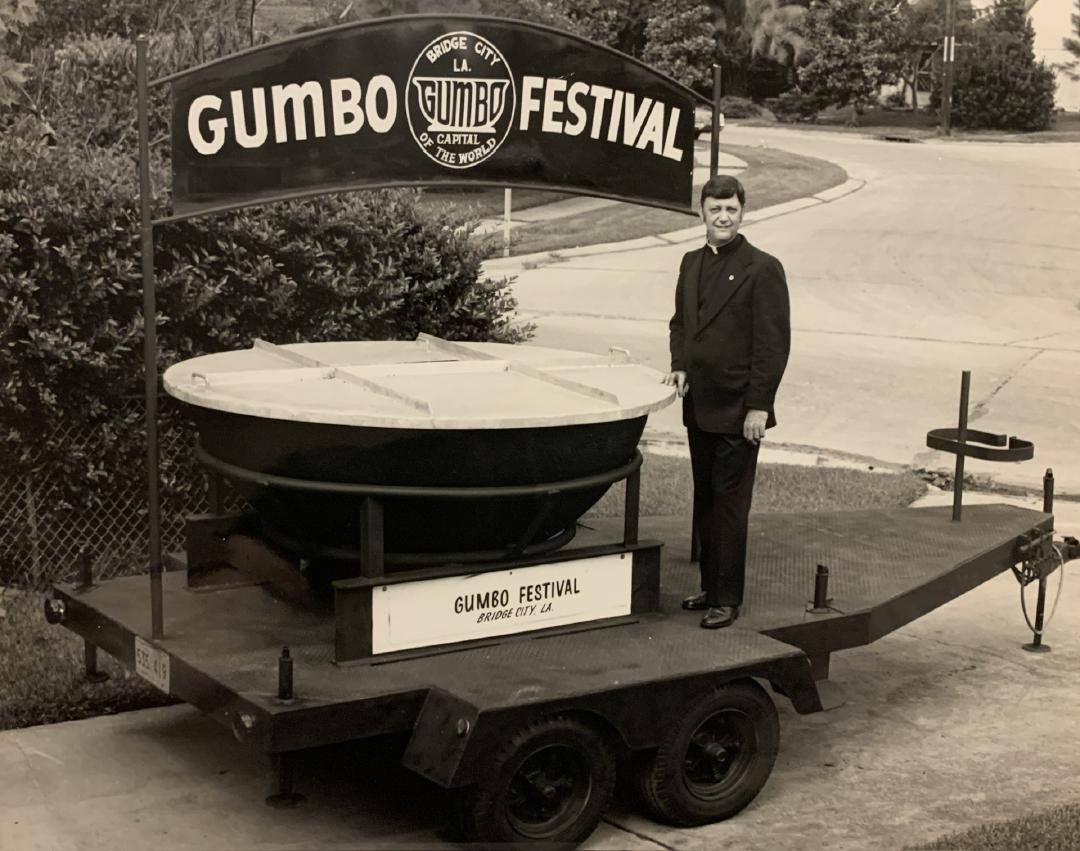
    <title type="html"><![CDATA[Bridge City Gumbo Festival: A Celebration of Food and Community]]></title>
    <summary type="html"><![CDATA[<p><strong><em>Once a year, the small community of Bridge City, Louisiana, welcomes locals and visitors to the Bridge City Gumbo Festival. Since the early 1970s, the festival has taken place on the second full weekend in October pausing only twice during Hurricane Katrina and Hurricane Ida.</em></strong></p><img src="https://mail.neworleanshistorical.org/files/fullsize/d19cdf8943ea969e515cf696117ef2b6.jpg" alt="Reverend Monsignor J. Anthony Luminais" /><br/><p>For over fifty years, the Bridge City Gumbo Festival has served up a family-oriented and fun-filled weekend at the base of the Huey P. Long Bridge across from New Orleans on the Westbank of the Mississippi River. It began in 1967 as a small, local fair to benefit Holy Guardian Angels Catholic Church. By 1973, Reverend Monsignor J. Anthony Luminais grew the event into a larger festival with the support and assistance of Holy Guardian Angels’ parishioners. This caught the attention of Governor Edwin Edwards, who soon declared Bridge City “The Gumbo Capital of the World.” Ever since, thousands of festival-goers have flocked to Bridge City to get a taste of its “World Famous” gumbo.</p><p>Each year, the festival serves over 2,000 gallons of gumbo. It features two classic varieties: seafood gumbo and chicken and sausage gumbo. Attendees can also taste a sampling of other Louisiana dishes including jambalaya, red beans and rice, and fried seafood, as well as All-American favorites like funnel cakes, hot dogs, and hamburgers. The festival invites members of the community to participate in the Gumbo Cooking Contest. Contestants are asked to submit their  best seafood or chicken and sausage gumbo to be judged. The winners are announced on stage, receiving a ribbon along with the bragging rights and satisfaction of having the best gumbo in town. </p><p>In addition to food, the festival celebrates other aspects of Louisiana’s culture. Attendees can purchase crafts and other goods from local vendors. The Ferris wheel is a highlight of the festival’s carnival rides and games, providing riders a bird’s eye view of the festival grounds and the Huey P. Long Bridge. The festival also includes live, local entertainment that represents the diversity of Louisiana’s music traditions including swamp pop, Latin, and zydeco music. A common feature of many Louisiana festivals, festival-goers may also get a glimpse of the reigning royalty, better known as Miss Creole Gumbo and King Creole Gumbo. After the festival ends, these representatives travel across the state encouraging everyone they meet to make the trip to Bridge City the following year.</p><p><em><strong><a href="https://mail.neworleanshistorical.org/items/show/1726">For more (including 16 images) view the original article</a></strong></em></p>]]></summary>
    <published>2023-10-10T02:48:25+00:00</published>
    <updated>2026-08-24T00:30:02+00:00</updated>
    <link rel="alternate" type="text/html" href="https://mail.neworleanshistorical.org/items/show/1726"/>
    <id>https://mail.neworleanshistorical.org/items/show/1726</id>
    <author>
      <name>Alexandra Mahler&amp;#32;&amp;amp;&amp;#32;Edited by Jessica Dauterive </name>
    </author>
  </entry>
  <entry>
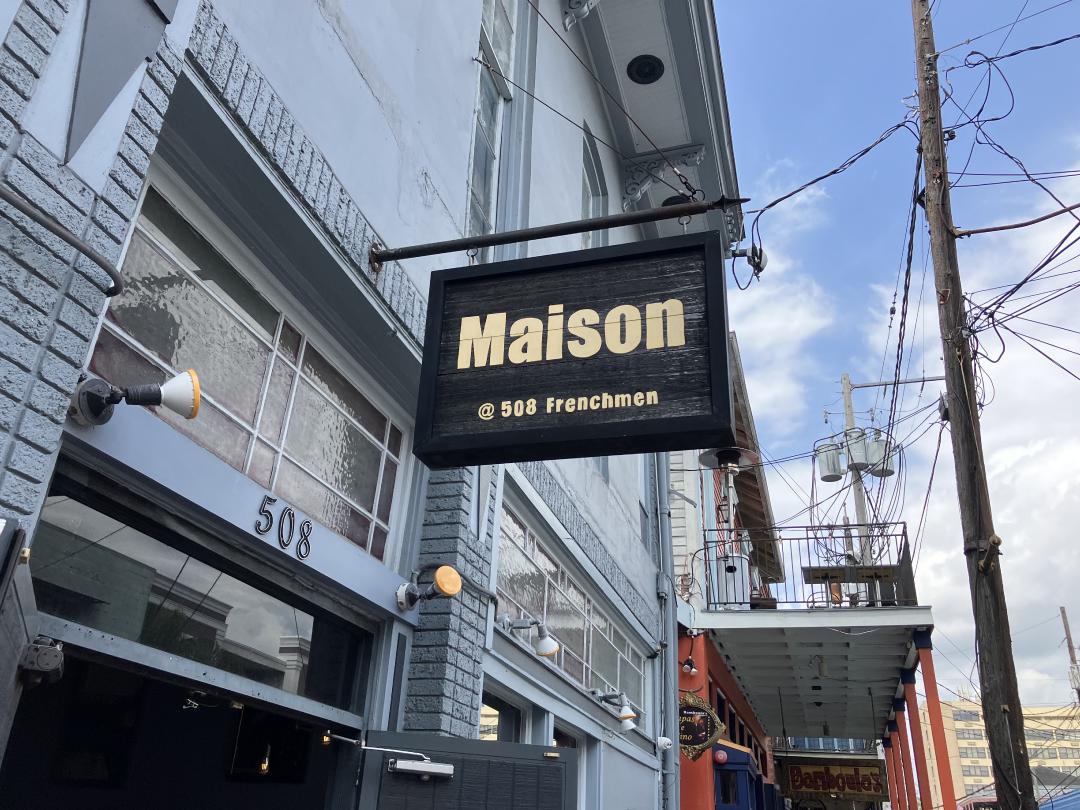
    <title type="html"><![CDATA[Maison: Sierra Green Entertains The Entertainer]]></title>
    <summary type="html"><![CDATA[<p><strong><em>Frenchmen denizens are known for holding up their homegrown heroes rather than kowtowing to celebrity. (Think <a href="https://frenchmennotes.com/?p=2099">Coco Robicheaux</a>, <a href="https://frenchmennotes.com/?p=2082">Uncle Lionel</a>, <a href="https://frenchmennotes.com/?p=3121">Little Freddie King</a>…) But that doesn’t mean that an internationally famous face in the audience can’t sometimes turn a regular gig into something special.</em></strong></p><img src="https://mail.neworleanshistorical.org/files/fullsize/5cea7ef44bc57ebab7efadbad8a2d185.jpg" alt="Maison sign hangs over Frenchmen Street." /><br/><p><p class="p1">The Maison has one of the most varied music lineups on Frenchmen St, hosting rock, funk, brass bands, jazz, fusion and more. Singer and bandleader Sierra Green has been a regular part of the calendar on many memorable nights over the last decade. But when asked to describe her favorite night on Frenchmen, it was an audience member in the Maison that made the night special.  <p class="p1"><i>“I actually went to a comedy show in 2019 before my gig, with my best friend and we were going to see all the great kings of comics and Cedric the Entertainer was there. I was just messing with my friend like, “Wouldn’t it be cool if they come downtown to our show after the gig”? </i> <p class="p1">In many cities, this kind of speculation would simply be fantasy, with no possible chance of coming true.….But a few hours later: <p class="p1"><i>“Girl, I’m singing on-stage when Cedric the Entertainer walks in with two All-Stars, they sit down and get a table and they record us and post us and all that good stuff and I got to meet them. So that was a favorite night for me ‘cause I was like, I manifested that!” </i> <p class="p1">Any musician knows that the audience is a key part of a show. Frenchmen street offers a unique format of audience, because the number of venues in a few blocks means that tourists and locals seeking music can wander up and down the street, in and out of different venues. This means musicians play for an ever-changing audience, as audience members go and see see 2 or 3 or even 4 different shows, without walking more than a few hundred feet. In turn, this means that gigs on Frenchmen, especially weekly or monthly or other regular gigs, can expose up-and-coming musicians to a larger audience than they would find anywhere else. <p class="p1">Sierra Green was in the right place at the right time, but that kind of place and time couldn’t happen anywhere else besides the music-venue clump on Frenchmen St. in New Orleans.</p><p><em><strong><a href="https://mail.neworleanshistorical.org/items/show/1725">For more (including 2 images) view the original article</a></strong></em></p>]]></summary>
    <published>2023-09-30T18:48:35+00:00</published>
    <updated>2026-07-15T16:20:24+00:00</updated>
    <link rel="alternate" type="text/html" href="https://mail.neworleanshistorical.org/items/show/1725"/>
    <id>https://mail.neworleanshistorical.org/items/show/1725</id>
    <author>
      <name>Laura DeFazio &amp;#32;&amp;amp;&amp;#32;Hannah Kreiger-Benson</name>
    </author>
  </entry>
  <entry>
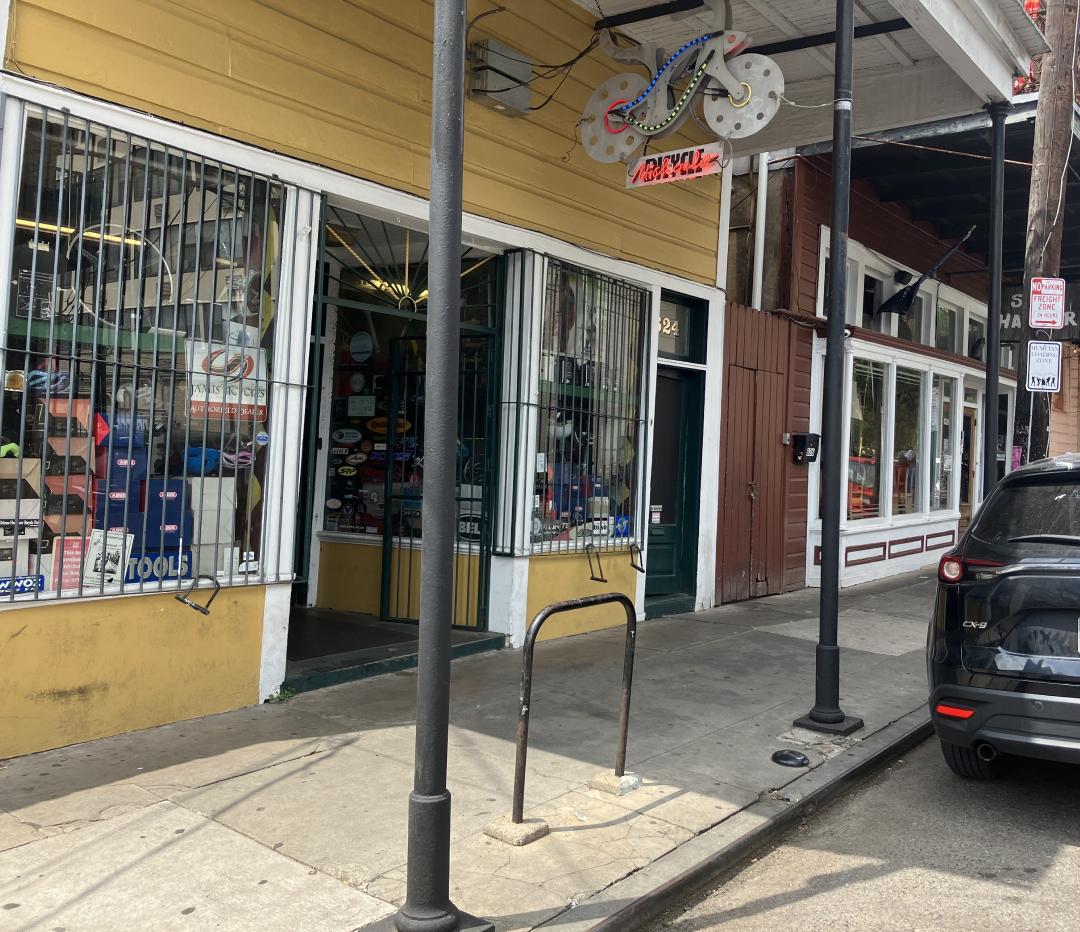
    <title type="html"><![CDATA[Bicycle Michael’s: Post-Katrina Chair-Racing on a Freshly-Paved Street]]></title>
    <summary type="html"><![CDATA[<p><strong><em>Bicycle Michael’s is the oldest bike shop in New Orleans. As soon as Michael Ferrand opened it--on Royal Street, in 1983--his rent was inflated in anticipation of the 1984 World’s Fair. He was forced to relocate, a little off the beaten path, to Frenchmen Street. These days, his bike shop is a fixture in the neighborhood community.</em></strong></p><img src="https://mail.neworleanshistorical.org/files/fullsize/0759f4f98b6cfe6cb6c9c7c8a84a8a04.jpg" alt="Bicycle Michael&#039;s and part of a not-so-freshly paved street." /><br/><p><p class="p1">We wandered into <a href="https://frenchmennotes.com/?p=2701">Bicycle Michael’s</a> one day in 2019 to ask Ferrand and longtime bike mechanic/philosopher Tim Eskew if they had any particularly memorable stories they wanted to share from their tenure on Frenchmen Street. To which Tim responded, <i>“Do you want to hear about chair-racing after Katrina?”</i> (Yes, of course.) <p class="p1">His story took place several weeks after the hurricane, as glum Frenchmen residents and business owners trickled back to the city to take stock of their battered neighborhood. People felt powerless, and not just because the power wouldn’t be turned on until October. However, Tim and Mike found a weird way to make a little joy out of the mess around them.  <p class="p1"><b><i>TE: </i></b><i>Everybody knew that while we were all away—while most of us were away, I should say—Frenchmen Street was guarded by Jimbo, who owns the building across the street, Adé at Café Brasil, Kenny Claiborne, and George, who owned Snug Harbor before he died, rest his soul. They held anybody off from breaking into any of these places, with no weapons. </i> <p class="p1"><i>At some point, Jimbo was roaming around looking for things, as you do, and I think it was Mr. B’s Bistro that had thrown out all of their chairs. They were rolling chairs, the kind you can roll across carpet….</i> <p class="p1"><i>Now, not long before Katrina, Frenchmen got refinished so it was as smooth as glass. It was the semi-centennial re-paving. Michael would be barbecuing every day out there on the sidewalk, dogs and burgers and whatnot…”</i> <p class="p1"><b><i>MF:</i></b><i> I’d go to Baton Rouge to get a bunch of stuff from Whole Foods, because that was the closest grocery store open, and we’d barbeque right in front of the shop and anyone who came by was welcome.</i> <p class="p1"><b><i>TE: </i></b><i>We had all kinds of foods, and then one day there’s chairs everywhere—</i> <p class="p1"><b><i>MF: </i></b><i>Lots of veggies and chicken and whatnot—</i> <p class="p1"><b><i>TE:</i></b><i> —and we had chair races in the street. You’d take the chair and you’d sit in and you’d race by kicking yourself backwards. Something to do to pass the time on Frenchman Street with no one around. Of course then whenever a car would now and then come down the street, we’d be like, “Toll road. $100 bucks.”</i> <p class="p1"><b><i>MF:</i></b><i> Cuz you could look down Frenchmen Street and there would be no cars—</i> <p class="p1"><b><i>TE: </i></b><i>No cars.</i> <p class="p1"><b><i>MF:</i></b><i> —in either direction.</i> <p class="p1"><b><i>TE:</i></b><i> There were many days that I had the only car on the block.</i> <p class="p1"><b><i>MF:</i></b><i> No power, of course.</i> <p class="p1"><b>Interviewer: </b>Were there any particularly skilled chair racers you remember? <p class="p1"><b><i>TE:</i></b><i> I was the champion. I don’t have any fear of falling over backwards. …Also, I was racing mostly people significantly older than me.</i> <p class="p1">Champion of the chairs and champion of the neighborhood. The guys at Bicycle Michael’s brought some light to a dark time, a great example of the community spirit that pulled people through. Indeed, many interviewees cite their favorite era of Frenchmen as <i>“right before and right after Katrina,”</i> as if everyone had collectively refused to let such a disaster draw a line in the sand.</p><p><em><strong><a href="https://mail.neworleanshistorical.org/items/show/1724">For more view the original article</a></strong></em></p>]]></summary>
    <published>2023-09-30T18:47:10+00:00</published>
    <updated>2026-07-15T16:20:24+00:00</updated>
    <link rel="alternate" type="text/html" href="https://mail.neworleanshistorical.org/items/show/1724"/>
    <id>https://mail.neworleanshistorical.org/items/show/1724</id>
    <author>
      <name>Laura DeFazio&amp;#32;&amp;amp;&amp;#32;Hannah Kreiger-Benson</name>
    </author>
  </entry>
  <entry>
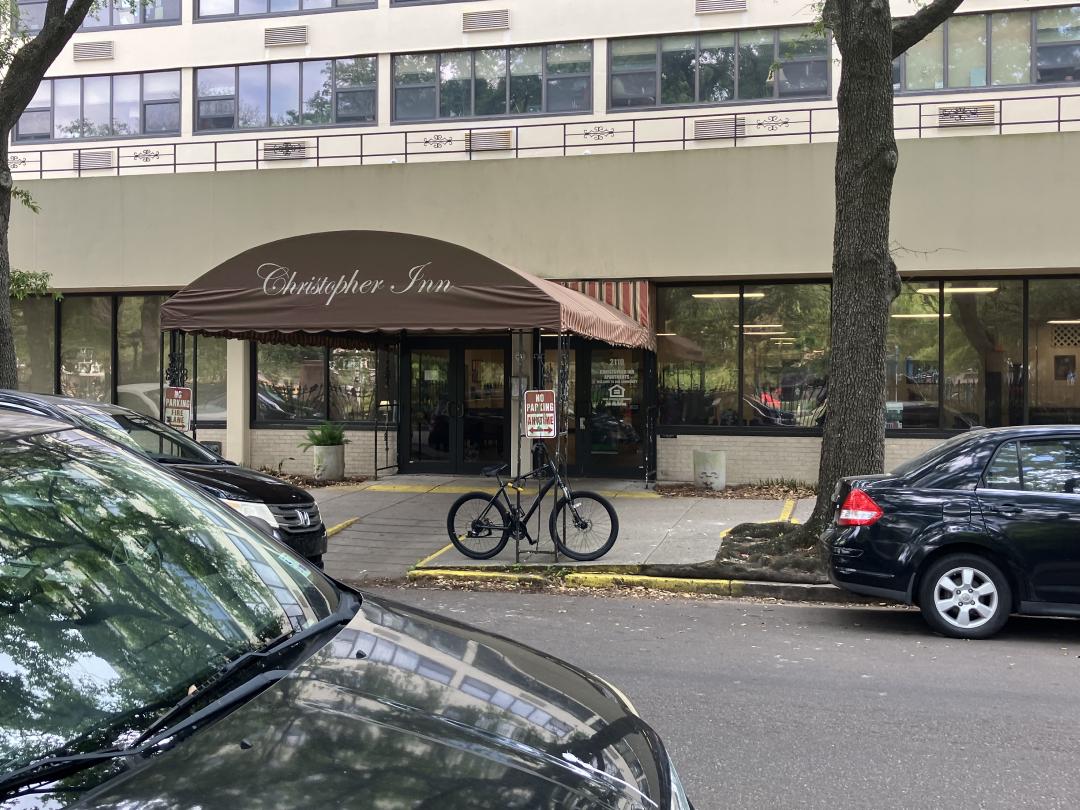
    <title type="html"><![CDATA[The Christopher Inn: Soaked After the Second-Line]]></title>
    <summary type="html"><![CDATA[<p><strong><em>Sometimes referred to as the Patron Saint of Frenchmen Street and local style icon “Uncle” Lionel Batiste was a patriarch of the famed Treme Brass Band and one of the so-called “Benchmen of Frenchmen”--the eclectic crew that hung out on the bench outside the Apple Barrel to shoot the sh*t and pass along wisdom and/or dirty jokes to subsequent generations. In 2012, “Unc” passed away at the age of 80, at home at the Christopher Inn, where he lived on the corner of Royal and Frenchmen. Crowds of friends and neighbors and fellow musicians gathered on July 20th in the torrential rains, getting ready for the second-line...</em></strong></p><img src="https://mail.neworleanshistorical.org/files/fullsize/62134017f4a7e6eec69f16871d61063a.jpg" alt="The entrance to the Christopher Inn on Royal Street." /><br/><p><p class="p1">The second-line parade is a quintessentially Black New Orleans tradition rooted in historic jazz funerals, although not all second-lines today are funeral second-lines. The name refers to the “second line” of everyday revelers who follow in the wake of the band and the rest of the official procession, be it a hearse, a wedding party, or the celebratory members of a Social Aid & Pleasure Club. The big logistical difference between attending a regular parade and attending a second-line is that at the former, you find a spot to post up and watch it pass. At the latter, you’re walking the route too.  <p class="p1">On the day of Uncle Lionel’s funeral, a public second-line was planned to help dance the body from the service to the cemetery. Here’s how Big Red, an attendee and friend of Unc’s, <a href="https://frenchmennotes.com/?p=2082">remembers that day</a>: <p class="p1"><i>“Uncle Lionel seriously f*cked with everybody when he passed. The day that his burial was supposed to happen, he sent torrential rains… They’re like, ‘We’re canceling the jazz-funeral procession because we can’t get to the cemetery. It’s underwater. The carriage house with the horse-drawn hearse is underwater, so we’re gonna have to send Uncle Lionel home later.’</i> <p class="p1"><i>“The whole gang there was like, ‘F*ck that.’ Everybody’s like, ‘We’re going to do it anyway.’ The brass band and everything but the hearse. Everybody’s already knee-deep in water in Tremé, in Armstrong Park. We blow up. We start rambling around. </i> <p class="p1"><i>“We go from Mahalia Jackson through Tremé up to Frenchmen Street coming up Kerlerec to go back onto Royal to come up to Christopher Inn, where Uncle Lionel had lived. The rain is coming so f*cking heavy again now, and by the time we get up there and we’re about to meet Royal again, just below Marigny Brasserie, it’s like up past our knees. </i> <p class="p1"><i>“Everybody on the second line that’s holding umbrellas throws them down and just starts rolling in the water. The rain is so percussive, and Uncle Lionel was the bass drummer of a Treme Brass Band, and as we approach Christopher Inn, the rain is hammering out a distinct beat. I was like, ‘Okay, Unc. We hear you. We hear you. We hear you, and we hear you.’”</i> <p class="p1">The whole gang there was like, “<i>F*ck that</i>”... <p class="p1">The “whole gang” she was referring to that day included everyone from Uncle Lionel’s close family members to the Mayor of New Orleans, natives and transplants, Black and not, world-renowned musicians and locally-renowned winos. Fellow Benchmen of Frenchmen and fellow residents of the Christopher Inn, where the second-line ultimately wound up. (The burial was pushed back three days.) <p class="p1">The Christopher Inn, often cheerfully referred to as “The Old Folks’ Home,” is an affordable senior living center and--at least in this subjective opinion--one of the most underrated parts of what makes Frenchmen Street. For a scene so vibrant, local, and inclusive, it seems fitting that you’ll find revelers of all ages mingling in the bars and on the dancefloors.</p><p><em><strong><a href="https://mail.neworleanshistorical.org/items/show/1722">For more (including 2 images) view the original article</a></strong></em></p>]]></summary>
    <published>2023-09-30T18:34:47+00:00</published>
    <updated>2026-07-15T16:20:24+00:00</updated>
    <link rel="alternate" type="text/html" href="https://mail.neworleanshistorical.org/items/show/1722"/>
    <id>https://mail.neworleanshistorical.org/items/show/1722</id>
    <author>
      <name>Laura Defazio, Hannah Kreiger-Benson,&amp;#32;&amp;amp;&amp;#32;Edited by Jessica Dauterive</name>
    </author>
  </entry>
  <entry>
    <title type="html"><![CDATA[30/90, Cafe Negril, Spotted Cat: Hannah’s Three-Venue Runaround]]></title>
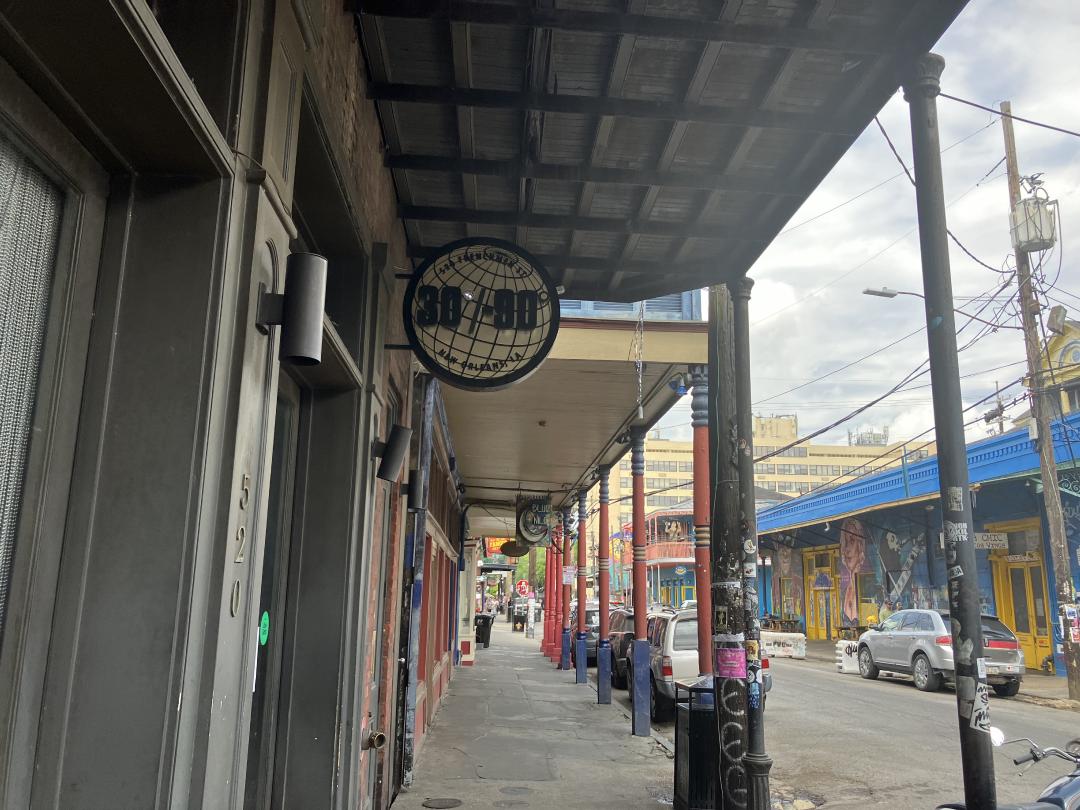
    <summary type="html"><![CDATA[<p><strong><em>In many places where the music industry thrives, bands and businesses are competitive, proprietary, or just plain isolated from one another. Frenchmen Street, on the other hand, has traditionally subscribed to the “borrow a cup of sugar” model… </em></strong></p><img src="https://mail.neworleanshistorical.org/files/fullsize/7f89b8fd27e1a01df93e22b06f35e672.jpg" alt="The sign to 30/90 looking onto Frenchmen Street." /><br/><p><p class="p1">Curtis Casados, a longtime bartender who’s worked at various Frenchmen locations over the years (<a href="https://frenchmennotes.com/?p=2021">read his Spotted Cat storm story here</a>), has always been struck by the camaraderie he’s felt on the street. <i>“Frenchmen itself was just a big large family,”</i> he says. <i>“We all intermingled and drank together. We’d borrow bottles of liquor across the street, or towels, or whatever. It was like, ‘Hey, can I borrow a cup of sugar?’”</i> <p class="p1">The principle applies to musicians as well. One thing that even a new-to-town tourist can observe after a couple days of hanging out on Frenchmen is the way all the same people show up playing in various combinations under various names up and down the street. <p class="p1">Hannah Kreiger-Benson, a local piano player and one of the authors of this tour, describes an ‘only-on-Frenchmen’ experience she had one night that illustrates this point perfectly.  <p class="p1"><i>“So, I was playing with a band at 30*90, and our gig was 5-8, I think, yeah. This was in…2017? 2018? In the middle of our gig, a guy comes running in, says he works at Cafe Negril, [next block, same side of the street], and that their booking from 7-10, the band they’d booked, couldn’t come. He asked did we want to come play at Negril as soon as we finished, from like 8ish until 10, so that they’d only have half an empty music slot. We said sure, why not!”</i>  <p class="p1">The density of venues on Frenchmen St. allows for this kind of interactions, with the physical proximity creating almost one large entity. Hannah continues: <p class="p1"><i>“We finished at 30*90, and then did this like goofy running-down-the-street-with-our-gear parade [laughs] it didn’t make sense to properly pack up/break down, so we just carried the gear down the street in batches. Like, guitar not in the case in one hand, guitar stand in the other hand. And then as we got set up at Negril, we realized that there weren’t enough mic cables. Since the same folks managed Negril and the Spotted Cat, [diagonally across the street], the manager or whoever this guy was, he and I run across to borrow a mic cable from the [Spotted] Cat. There was a band in full swing, I think it was Panorama, and I literally crawled in front of the low stage, to rummage in the bin of spare cables on the floor. I remember looking up at Ben Schenck [clarinet and bandleader for Panorama], and I was like like ‘hi Ben, ‘scuse us, pardon me…’ and he was sort of bemused, like ‘uh, oh hello musician I know who’s doing some undignified nonsense on the floor’. </i> <p class="p1"><i>We got the cable and played a fun half-set at Negril. That whole sequence really, you know, captured the… interconnectedness of Frenchmen! [laughs]”</i></p><p><em><strong><a href="https://mail.neworleanshistorical.org/items/show/1721">For more (including 3 images) view the original article</a></strong></em></p>]]></summary>
    <published>2023-09-30T18:33:10+00:00</published>
    <updated>2026-07-15T16:20:24+00:00</updated>
    <link rel="alternate" type="text/html" href="https://mail.neworleanshistorical.org/items/show/1721"/>
    <id>https://mail.neworleanshistorical.org/items/show/1721</id>
    <author>
      <name>Laura DeFazio &amp;#32;&amp;amp;&amp;#32;Hannah Kreiger-Benson</name>
    </author>
  </entry>
  <entry>
    <title type="html"><![CDATA[The Vacant Lot: Ashes to Oranges]]></title>
    <summary type="html"><![CDATA[<p><strong><em>Coors Underground (<a href="https://frenchmennotes.com/?p=3547">or is it Chords Underground? ....</a><a href="https://frenchmennotes.com/?p=3547"><i>Cords</i></a><a href="https://frenchmennotes.com/?p=3547">?</a>) was an old Frenchmen Street venue that was destroyed in a violent explosion in the mid-70s. It’s exceedingly hard to find any information about the place online, and not many people we’ve talked to seem to know about it. Those who do remember disagree on how to spell it, which likely contributes to the difficulty of tracking it down. Curiously, its main legacy seems to be the void it left behind: a charred vacant lot.</em></strong></p><img src="https://mail.neworleanshistorical.org/files/fullsize/d4da35b3b70642d1cce4128421bcae9c.jpg" alt="The former site of the Vacant Lot." /><br/><p><p class="p1">The lot may not have looked like much, but this non-space took on a life of its own, growing slowly and organically into an unconventional hub for neighborhood creatives, a beloved local institution owned by no one and shared by all. <p class="p1">Alan Langhoff--owner of the famed former venue the Dream Palace--is one person who <i>does </i>remember the original venue, Cords/Chords/Coors. He described it as a “<i>disco-type thing for kids to wear their slick stuff and go get f*cked up.</i>” He recalls being outside, working on the Dream Palace building across the street in preparation for its 1976 grand opening, and watching hopeful young people waiting in long lines to get into C’s, only to be turned away for not meeting the dress code. Langhoff always assured the dejected would-be drinkers they’d be more than welcome in his club when it opened, whatever their attire.  <p class="p1">But by the time he opened the Dream Palace, the competition had (literally) gone up in flames. <p class="p1">Jazz guitarist Sid Snow remembers that day, and recalls how the owner claimed it was a gas fire. “<i>But come to find out, the place was all electric! … Well, he went to jail.</i>”  <p class="p1">An anonymous source, eyes flashing angrily, described how the reckless explosion nearly killed a man living in a house nearby, someone they’d known and liked. A sobering perspective on an old insurance scam, and an inauspicious outlook for the property. <p class="p1">But flash forward to the turn of the millennium, and the ashy ruins had become fertile ground for creative collaborations and art from the fringes. It was a wacky, shared neighborhood performance space, featuring fire-eaters, brass bands, circus performers, and all manner of “<i>grungy people that just had a little charm to them.</i>” Local artist Conan sold his drawings, the nitrous balloon man made his rounds, there was even a nighttime book fair. All in all, in the words of one enthusiastic, it was “<i>lawless, and wild, and fucking awesome</i>.”  <p class="p1">As Frenchmen’s fame as a music corridor grew (due as least in part to HBO’s Treme, season one of which was released in 2010) audience demographics began shifting towards tourists spending vacation dollars. Use of space on the street changed accordingly. <p class="p1">When a franchise moved into the Vacant Lot in 2014, it broke the hearts of many, including bassist “Magic” Wanda Joseph. She remembers vividly when they began construction: <p class="p1"><i>“You remember when there used to be that lot right there… with the fire-eaters? Girl, look: when I came there and found them cutting down that palm tree right there, I was pissed.</i> <p class="p1"><i>“Then, they cut that orange tree. There was an orange tree right there! I say, ‘Why are you all cutting?’ </i> <p class="p1">[She pauses.] <p class="p1"><i>“He say, </i>‘Baby.’  <p class="p1">[... And even hearing it secondhand, you want to stagger a little under the weight of the word.] <p class="p1"><i>“I stood there—I was so mad, I was like, ‘Motherf*****!’</i> <p class="p1"><i>“I was waiting on that orange tree to grow, too. Because I had just noticed it was an orange tree, all them years. They came and they tore it down.”</i> <p class="p1">It’s hard not to understand the orange tree as a metaphor--for rebirth, for a community’s tenaciousness, for everything that can grow against all odds from the ashes--so it’s hard not to understand the encroachment of corporate capitalism as a violently unwelcome sort of post-script. But maybe it’s just the natural cycle of things. When one spot’s time is up, the great hope is that the spirit moves elsewhere, and that orange trees (real and metaphorical) will continue to push their way up from unlikely soils.</p><p><em><strong><a href="https://mail.neworleanshistorical.org/items/show/1719">For more view the original article</a></strong></em></p>]]></summary>
    <published>2023-09-30T18:25:54+00:00</published>
    <updated>2026-08-24T00:30:02+00:00</updated>
    <link rel="alternate" type="text/html" href="https://mail.neworleanshistorical.org/items/show/1719"/>
    <id>https://mail.neworleanshistorical.org/items/show/1719</id>
    <author>
      <name>Laura DeFazio&amp;#32;&amp;amp;&amp;#32;Hannah Kreiger-Benson</name>
    </author>
  </entry>
  <entry>
    <title type="html"><![CDATA[d.b.a.: Margie Perez gets a Wonderful Surprise]]></title>
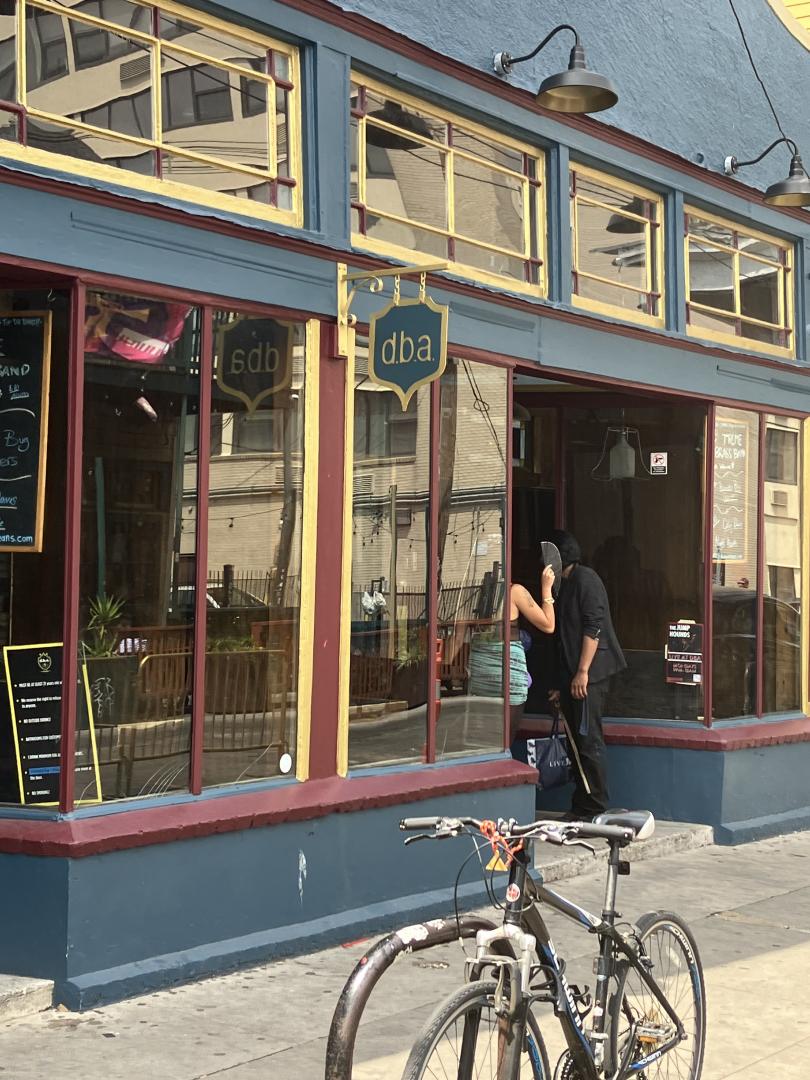
    <summary type="html"><![CDATA[<p><strong><em>Anything can happen on Frenchmen St. when the stars align! Margie Perez recounts a magic night on Frenchmen, capturing a moment in time: shortly after Hurricane Katrina, before smart phones, and populated with a few local legends who we have since sadly lost.</em></strong></p><img src="https://mail.neworleanshistorical.org/files/fullsize/cd1c1ea85db761fcd4c00974ffe9b2f2.jpg" alt="The d.b.a.  sign hangs over Frenchmen Street." /><br/><p><p class="p1">When world-famous musicians come to perform in New Orleans, sometimes they then go sit in on local gigs, and lucky audience members occasionally catch the magic moment. <p class="p1">As Margie Perez remembers: <i>“It was the first anniversary of Katrina, in August of 2006, and Stevie Wonder played a concert I think at the Super Dome, or the Arena, and then he came down to Frenchmen.” </i>Margie has deep roots as a musician, bandleader and listener on Frenchmen St. Over the years, she found her whole band on the street, meeting each musician on various gigs. Even in a constellation of musical moments assembled over years, the occasional moment shines extra bright.  <p class="p1"><i>“This was 2006, everybody had flip-phones. I was hanging out at Cafe Negril, it was a Wednesday night and I would make my rounds.” </i>Making the rounds is a time-honored tradition on Frenchmen, musicians and listeners alike walk up and down the 3 blocks of music venues, seeing people. <p class="p1"><i>“I was hanging out outside—and it looked like the zombie apocalypse: everybody was sloooowly heading down the street. And then somebody said, ‘Stevie Wonder’s at DBA.’</i> Walter “Wolfman” Washington played every Wednesday at DBA, up until he passed away in 2022. <p class="p1"><i>“I went in. There wasn’t a cover at the time, and there was barely anybody on the street because it was a Wednesday. Well, everybody was in DBA, and that’s when they had the seats on the side, so he [Stevie Wonder] was sitting, he was absorbing it all. Like I said, everybody who was on Frenchmen Street—I think every musician that was playing in every other club—stopped what they were doing and went to DBA. And then Walter invited him to play. He sang, because they didn’t have a piano, and every single flip phone was up in the air taking pictures, and my phone died! It wouldn’t have taken a good picture anyways.” </i> <p class="p1">And then a few days later, Margie saw her friend who was part of Walter Washington’s backing band. <i>“I remember Kevin O’Day was playing drums for Walter, and a few days later I went to a gig he was playing and I said, ‘Sooooo, what was it like to back up Stevie Wonder?’ And he was like, ‘Oh-my-God-I-can’t-believe, I just jumped up and down on the bed!’ </i>Sadly, Kevin O’Day also passed away in 2022. <p class="p1">It is striking that in Margie’s story, local beloved community members like Wolfman and Kevin O’Day figure just as large as a world-famous musician like Stevie Wonder when he joined them onstage for a magical moment. Frenchmen St. has proved home to many such moments over the years, for those lucky enough to experience them.</p><p><em><strong><a href="https://mail.neworleanshistorical.org/items/show/1718">For more (including 2 images) view the original article</a></strong></em></p>]]></summary>
    <published>2023-09-30T18:24:17+00:00</published>
    <updated>2026-07-15T16:20:24+00:00</updated>
    <link rel="alternate" type="text/html" href="https://mail.neworleanshistorical.org/items/show/1718"/>
    <id>https://mail.neworleanshistorical.org/items/show/1718</id>
    <author>
      <name>Laura DeFazio &amp;#32;&amp;amp;&amp;#32;Hannah Kreiger-Benson</name>
    </author>
  </entry>
  <entry>
    <title type="html"><![CDATA[The Rooftop of Café Brasil: Adé Salgado Surveys The New Millennium]]></title>
    <summary type="html"><![CDATA[<p><strong><em>Famed coffeeshop-turned-music-incubator Café Brasil was a fixture on the Frenchmen Street scene between its opening in 1985 and its closure in 2006, the year after Hurricane Katrina. Although the venue is no longer in operation, it continues to loom large in the public imagination, and there’s probably no single person who shows up more in Frenchmen lore than Café Brasil’s charismatic, enigmatic owner: Adé Salgado.</em></strong></p><img src="https://mail.neworleanshistorical.org/files/fullsize/925bbfaed026f3e9c305260b2a5a306e.jpg" alt="The rooftop of Café Brasil. a" /><br/><p><p>Caf&eacute; Brasil, as you might gather from its name, was a major hub for the Latin scene that once flourished on Frenchmen Street. But it was host to a whole smorgasbord of musical weeklies as well.&nbsp;<br /><br /><em>&ldquo;Monday night they had a jazz band; Tuesday night, Klezmer [the Klezmer All-Stars] played there&mdash;the Yiddish band,&rdquo; bass player <a href="https://frenchmennotes.com/?p=3160">Wanda Joseph</a> remembers. &ldquo;I think Thursday was reggae, Ben Hunter&mdash;no, Ben Hunter must have been on Wednesday, because Thursday was a Brazilian band [<a href="https://frenchmennotes.com/?p=3111">Banda Logun</a>] and all the Brazilians used to come out for that. Lord, those people could dance!&rdquo;&nbsp;<br /></em><br />Caf&eacute; Brasil was the place where local staples like <a href="https://frenchmennotes.com/?p=2739">the Iguanas</a> (Chicano rock/New Orleans R&amp;B/Caribbean music) and Tribe Nunzio (rock/funk/worldbeat/post-punk) and a whole lot of others grew up and cut their teeth. It was a space where beautiful fusions were born and plenty of experiments flopped, but either way, people had the freedom to play around. Ad&eacute; <em>was </em>his venue, the soul of the scene, in a way you don&rsquo;t often see with venue owners anymore.<br /><br /><em>&ldquo;Ad&eacute; had this particular thing going with Caf&eacute; Brasil,&rdquo;</em> says musician <a href="https://frenchmennotes.com/?p=2530">Jonathan Freilich</a>. <em>&ldquo;Everything was always some sort of multicultural affair. The reason the whole thing took off was the guy had an incredible sense of aesthetics, in both the people that he hired and how he ran the place. How he kept changing it up&mdash;in ways that would totally drive you crazy, honestly&mdash;but it was his own personal art project.&rdquo;&nbsp;<br /><br />&ldquo;Would totally drive you crazy&rdquo;</em> is not an uncommon description of Salgado. He was renowned for his chaotic band-booking style&mdash;which was exacerbated by the fact that he didn&rsquo;t own a phone&mdash;and hairpin-trigger temper. But he was mostly known for his passion, generosity, and charm. In the words of some of Frenchmen&rsquo;s denizens:<br /><em>&ldquo;Ad&eacute; was always out there hosing down the sidewalk and the plate glass, and he had this long dark curly hair, and he never wore a shirt and he was really tan and his&ndash;his jeans hung off his hips just so. And I just thought he was the most beautiful creature I&rsquo;ve ever saw in my whole life.&rdquo;&nbsp;<br /></em>&ndash;Nita Ketner (radio personality)<br /><br /><em>&ldquo;Like when Coco lived above Caf&eacute; Brasil and his wife was burning candles and it burned her wedding dress down&ndash;there was a giant fire, and Ad&eacute;&rsquo;s on the roof, screaming with a hose, trying to put the fire out, and the firemen are like, &ldquo;Come down!&rdquo; And he&rsquo;s cursing them, and cursing everybody, and putting out the fire&hellip;&rdquo;<br /></em>&ndash;Tim Eskew (of Bicycle Michael&rsquo;s)<br /><br /><em>&ldquo;It was New Year&rsquo;s Eve of 1999. Iris Mae Tango is downstairs [at the Dream Palace] sounding f***ing great. I just remember the countdown to midnight, and I walk out on the balcony&mdash;it was at the last five minutes of this century, of this millennium&mdash;and Ad&eacute; was on the roof of Caf&eacute; Brasil, smoking a joint and surveying it all.&rdquo;<br /></em>&ndash;Davis Rogan (musician, radio personality)<br /><br />The landscape of Frenchmen has changed since Ad&eacute; looked out over the new millennium. Jonathan Freilich locates one of the biggest differences in the fact that today&rsquo;s bars are businesses first, as opposed to <em>&ldquo;people&rsquo;s personal art projects.&rdquo;</em> He bemoans the dullness that takes over the scene when venues have that mentality: <em>&ldquo;Things used to happen in a much more interesting way when people were inventing stuff, trying things out, creating something.&rdquo;<br /><br /></em>But although the creative incubator that was Caf&eacute; Brasil is no longer, Ad&eacute; is still presiding over Frenchmen from afar. He still lives above the venue, and according to local sources (including <a href="https://frenchmennotes.com/?p=2701">Tim Eskew, of Bicycle Michael&rsquo;s</a>), he still did not have a phone as of 2019. If you want to find him, you just <em>&ldquo;holler up there, and if he&rsquo;s there, he comes down.&rdquo;</em></p></p><p><em><strong><a href="https://mail.neworleanshistorical.org/items/show/1717">For more (including 2 images) view the original article</a></strong></em></p>]]></summary>
    <published>2023-09-30T18:23:31+00:00</published>
    <updated>2026-07-15T16:20:24+00:00</updated>
    <link rel="alternate" type="text/html" href="https://mail.neworleanshistorical.org/items/show/1717"/>
    <id>https://mail.neworleanshistorical.org/items/show/1717</id>
    <author>
      <name>Laura DeFazio &amp;#32;&amp;amp;&amp;#32;Hannah Kreiger-Benson</name>
    </author>
  </entry>
  <entry>
    <title type="html"><![CDATA[The Spotted Cat: Trombone Battle Of The Century]]></title>
    <summary type="html"><![CDATA[<p><strong><em>Young musicians on Frenchmen Street have unique opportunities to be inspired by their musical heroes on an up close and personal level. Jeremy Phipps, of the contemporary band People Museum, grew up going to Frenchmen Street and was able to witness some incredible virtuosic artistry even before he was old enough to get into the venues. Such as this mind-blowing event, observed from the sidewalk outside the Spotted Cat…</em></strong></p><img src="https://mail.neworleanshistorical.org/files/fullsize/cf3004149e5f82b6942fb40a34786adb.jpg" alt="The window to The Spotted Cat." /><br/><p><p class="p1">The Spotted Cat, open since 2001, hosts a variety of modern and traditional jazz, brass bands and brass/funk fusion. When Jeremy was a teenager he had his own brass band, and although they were too young to get into the Cat, they’d always stand outside and listen. <p class="p1">Jeremy says: <i>“When we first started playing out there, I was still not legal to go inside the bars… so must have been around 2009. Shamarr Allen and this dude, we call him Struts, but his real name's Steven Walker, used to play at Spotted Cat. Every week, we would go and sit outside the window at Spotted Cat. Me and Ashton</i> [Hines, trumpet player]<i> and my brother, Joshua. We would just watch."</i>  <p class="p1">Jeremy, Ashton and Joshua are just 3 of countless young musicians who were able to grow up on Frenchmen St., hearing the musicians they admired, meeting future bandmates, and experiencing the rhythm of weekly gigs. He rattles off name after name of musicians who are famous (locally and beyond) and have left indelible marks on the music of New Orleans <p class="p1"><i>“I remember one night, I had to be 17 or something, and I saw Steven Walker and Delfeayo Marsalis </i>[a son of another iconic local musical family] <i>onstage. At the time, it was like, ‘Delfeayo Marsalis! Struts! On the same stage!’</i> <p class="p1"><i>It was the trombone battle of the century. Still to this day, I don't know if I've seen playing on that level. Just going at it”</i> <p class="p1">At that time, the stage was on the opposite side from where it is today, and it was even smaller than the current, very small, stage. It was barely even big enough to fit 2 trombones at all, we can imagine them bursting physically and musically off the stage. While local audience members may have known what they were witnessing, any tourists who happened to be in the audience that night would likely have had no idea what a special moment they stumbled into.</p><p><em><strong><a href="https://mail.neworleanshistorical.org/items/show/1716">For more view the original article</a></strong></em></p>]]></summary>
    <published>2023-09-30T18:22:27+00:00</published>
    <updated>2026-07-15T16:20:24+00:00</updated>
    <link rel="alternate" type="text/html" href="https://mail.neworleanshistorical.org/items/show/1716"/>
    <id>https://mail.neworleanshistorical.org/items/show/1716</id>
    <author>
      <name>Laura DeFazio &amp;#32;&amp;amp;&amp;#32;Hannah Kreiger-Benson</name>
    </author>
  </entry>
  <entry>
    <title type="html"><![CDATA[The Bench: The Unofficial Landmark of a Bygone Era]]></title>
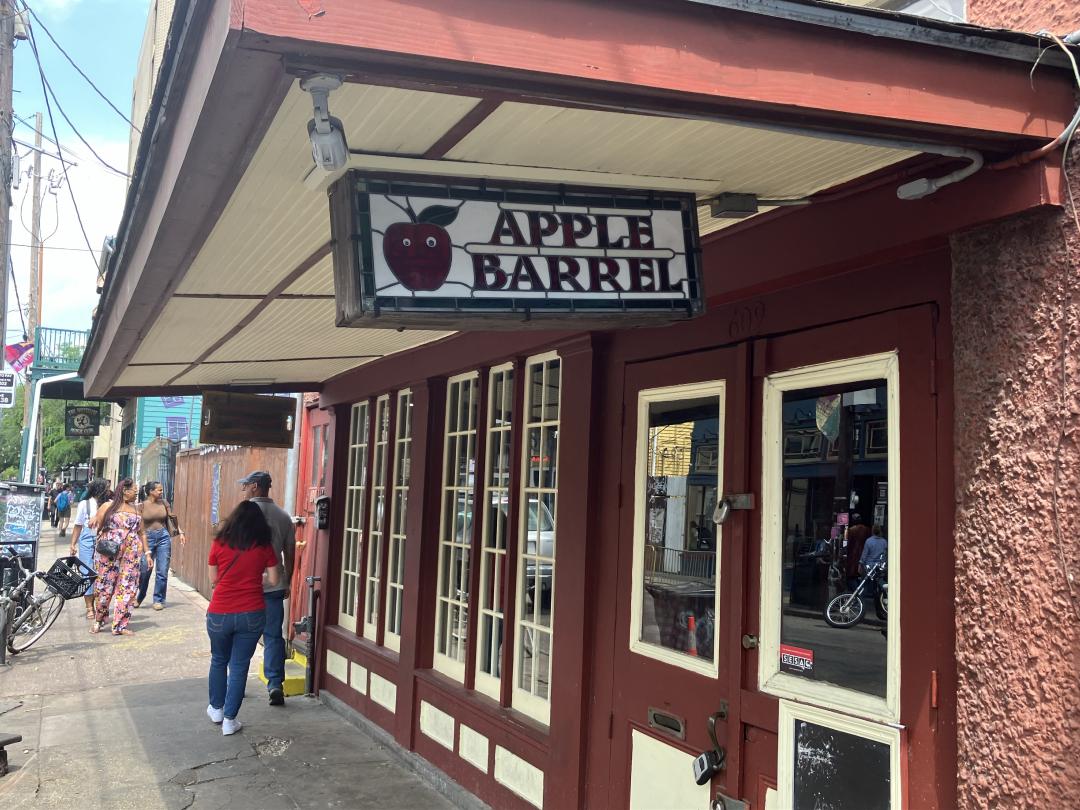
    <summary type="html"><![CDATA[<p><strong><em>Since the 1970s, Frenchmen has been home to a smorgasbord of music venues that have birthed, incubated, and showcased various facets of the local music scene. We’ve asked hundreds of musicians about their favorite spots on Frenchmen Street over the years (with an emphasis on the “musical incubator” aspect) and it’s surprising how many of them lead with somewhere that wasn’t a venue at all. It wasn’t even a place where people particularly <i>played</i>. It was just regular ol’ sidewalk bench.</em></strong></p><img src="https://mail.neworleanshistorical.org/files/fullsize/cedab97a2ade244b1a07636f9a59c8dc.jpg" alt="The former site of The Bench." /><br/><p><p class="p1">One of the things that makes Frenchmen Street such a unique cultural corridor—one that boasts a notably outsized impact for its two-and-a-half block length—is the sheer density of venues packed into the tiny strip.  <p class="p1">In the late ‘90s, Frenchmen Street was still—according to longtime Frenchmen resident and Snug Harbor music programmer Jason Patterson—just <i>“a couple of popular clubs, a couple of popular restaurants, some daytime retail.”</i> That is, a smattering of individual establishments that didn’t share a collective identity as a cultural corridor. <p class="p1">The turn of the millennium saw a major shift: the Spotted Cat opened, DBA opened, and—what with Snug Harbor, Cafe Brasil, and Dream Palace/Cafe Istanbul already in operation and going strong—there was suddenly <i>“this synergy of live music clubs happening,”</i> as Patterson described. <i>“Things kind of snowballed, and outlets that wouldn’t have thought about doing live music started doing live music.” </i> <p class="p1">Among these unlikely outfits was the Apple Barrel, described by Patterson as <i>“very small, like a walk-in closet.”</i> When Liz Montoya and Doug Hopper took over in the late ‘90s, they started booking live music. The Apple Barrel became known primarily as a blues bar, thanks to frequent performances by local legend Coco Robicheaux. <p class="p1"><i>“What was such a beautiful thing about [the Frenchmen scene],”</i> Patterson noted, <i>“was that it actually stayed local for a long period of time.” </i> <p class="p1">And a great microcosm for this intense sense of local-ness was the bench on the sidewalk outside the Apple Barrel. <p class="p1">In the <a href="https://frenchmennotes.com/?p=2110">words of drummer Tom Chute</a>, <i>“There was always a bench in front of the Apple Barrel. When one would get old and break down, they would replace it with a new one. You’d have people sitting on the bench together talking. Talking about the news of the day. You could always find somebody hanging out.” </i> <p class="p1">The Bench was homebase to a core group of musicians and colorful characters who became known as “The Royal Benchmen of Frenchmen.” The Benchmen included such local luminaries as Robicheaux, Uncle Lionel, Doc Love, Kenny Holiday, and Mike Sklar, to name a few. <p class="p1"><i>“I remember sitting with Coco in front of the Apple Barrel on the bench,”</i> <a href="https://frenchmennotes.com/?p=3178">says singer-songwriter Lynn Drury</a>, <i>“and he would give me all this great advice…” </i> <p class="p1">It was a place where the next generation of musicians felt comfortable hanging out, learning from their musical elders, and asking questions.  <p class="p1"><i>“I just want to talk about what a cultural, anthropological institution that [bench] really was,”</i> says Monty Banks, pianist. <i>”It was the only chance I’d ever seen where I could hang for long times in a comfortable social environment and just hear stories, ask questions about New Orleans music. Music in general. It was really the best place to learn. Really, really experienced people would be up there, but you felt like everybody was kind of on an even playing field.” </i> <p class="p1">To Monty, The Bench symbolized the kind of musical golden era he never thought he’d see, akin to New York in Charlie Parker’s day or the big swing bands of World War Two.  <p class="p1">To Tom, it was a microcosm of Frenchmen Street itself: <p class="p1"><i>“You felt a bit like [Frenchmen] was a clubhouse, the whole street. Or that it was an array of clubhouses, and that you had a membership to every one of them. That was the vibe I always got. The bench was representational of that.”</i> <p class="p1">But 2013, and another change in Barrel ownership, saw the Bench’s removal from the sidewalk, a sad day for many.<i> “In the old days, the bartenders who worked there were always really good about keeping the homeless people from taking over the bench,”</i> explained one musician. <i>“When the place switched over, they got all new bartenders and the new bartenders just weren’t aware that that was part of the job.” </i> <p class="p1">This wasn’t the only factor contributing to the end of the Bench-era, though: after a good run catering to mostly local audiences, Frenchmen was changing again. According to our old friend Jason Patterson, the years 2012 to 2015 saw a shift on Frenchmen, from <i>“90% locals to 90% tourists.”</i> So by the time the Bench was removed, the sun was already setting on the version of Frenchmen where neighbors milled around on benches, talking about the art they were creating and sharing the news of the day. <p class="p1">The Apple Barrel is still a hub for live blues (albeit for different types of audiences) but the Bench has passed on from a place where locals tell stories to a place locals tell stories about.</p><p><em><strong><a href="https://mail.neworleanshistorical.org/items/show/1714">For more view the original article</a></strong></em></p>]]></summary>
    <published>2023-09-30T18:15:59+00:00</published>
    <updated>2026-07-15T16:20:24+00:00</updated>
    <link rel="alternate" type="text/html" href="https://mail.neworleanshistorical.org/items/show/1714"/>
    <id>https://mail.neworleanshistorical.org/items/show/1714</id>
    <author>
      <name>Laura DeFazio &amp;#32;&amp;amp;&amp;#32;Hannah Kreiger-Benson</name>
    </author>
  </entry>
  <entry>
    <title type="html"><![CDATA[936 St. Peter Street: A Cottage Industry in the Quarter]]></title>
    <summary type="html"><![CDATA[<img src="https://mail.neworleanshistorical.org/files/fullsize/08fa4c36ca36d0771716b7095fd824fc.jpg" alt="Goat skulls found from the privy at 936 St. Peter Street" /><br/><p>In 2014, the University of New Orleans was invited to conduct archaeological testing at 936 St. Peter Street while the property was undergoing renovations. Below the surface layer, archaeologists discovered the opening of a privy shaft. The privy was brick-lined with a wood-lined base. </p><p>The privy deposit appeared to represent a single, rapid deposition, probably within the time frame of the 1860s. This rapid deposition likely happened at the time of a clean-out and renovation of the rear building, when the use of this privy was abandoned due perhaps to shifting use of the outbuilding. The privy fill contained a significant quantity of typical domestic debris from the mid-nineteenth century: ceramic tablewares, including whiteware, ironstone, and porcelain; chamber pots; glass bottles; and smoking pipes. </p><p>What stood out most during the excavation of the privy was the abundance of animal remains, especially the number of elements from skulls. When a rough count was taken of the entire assemblage, the privy feature was found to contain a total of 147 Caprine (goat or sheep) skulls. </p><p>So, what could explain the heavy presence of goat and/or sheep skulls in the privy feature at 936 St. Peter Street? There are, of course, a number of cuisines in which brains are a delicacy, and dishes, particularly stews, in which goat heads play a prominent role, especially in African and Caribbean cultures. However, certain features of this assemblage taken together with other artifacts from the privy suggest that the faunal assemblage recovered from the privy at 936 St. Peter Street is representative of more than just urban diets. </p><p>An analysis of the butchery marks found on faunal material can indicate differences in patterns of faunal utilization. Analysts recorded the number of cuts, chops, fractures, shears, and saw marks present on each bone to determine if there were differences in butchery methods between different species. Most of the bones that were present were utilized as typical food sources and were from the postcranial skeleton. Some of these bones were either sawn or shorn (as with a sharp cleaver), marks that are typically made by a butcher or someone familiar with animal slaughter. However, an inordinate number of the butchery marks present on Caprine remains were indicative of cracking into the skulls to retrieve the brains inside, as evidenced by shearing and chop marks across the back of the skulls. </p><p>It is likely that the abundance of goat skulls and their associated butchery patterns represent the production waste from household-level tanning and hide processing, probably for use in fine leather work. Historical documents and ethnohistorical observations note the use of animal brains in the process of hide tanning, particularly when making buckskin. </p><p>The sheer quantity of goat skulls in relation to other skeletal elements point to the likelihood that the goat brains were being put to a use in manufacturing rather than being consumed. Some of the other artifacts from the privy also support the connection of the assemblage to leatherwork. An abundance of cuprous metal straight pins, some occurring in clumps corroded together, were found within the privy fill along with thimbles, buttons, and hook and eye fasteners. While these items are not atypical finds at urban sites, their abundance is suggestive. Likewise, household production is suggested by some other artifacts in the assemblage, including knives, folded strap-metal, and a lace bobbin, all of which may be associated with hide production and its associated activities. </p><p>The growth of industrialization and urbanization in the late-eighteenth century had far reaching impacts on developing cities. Urban centers, like New Orleans, rapidly became crowded and dirty. Modes of production were centered around the household with production typically taking place within household lots or near the residences of employers. But as the city continued to expand during the nineteenth century, concerns over sanitation and urban waste disposal resulted in the segregation of nuisance industries, such as slaughterhouses and tanneries, to the outskirts of town. Still, small-scale manufacturing persisted, with household-level production only loosely regulated, despite the potential health issues it could generate. </p><p>This historical shift from cottage to commercial industry resulting from urban growth provides a lens through which we may interpret the archaeological assemblage at 936 St. Peter Street. This property was a very small urban lot in what had come to be a distinctly residential area by this time, and it is not hard to imagine the foul mess that the work of splitting hundreds of animal skulls and extracting the brains would incur in a residential yard . The noisome byproduct, and likely the complaints from neighboring tenants, may explain the rapid deposition of the privy contents and the renovation of the outbuilding in the 1860s. Perhaps the landlord at 936 St. Peter and/or their neighbors were no longer willing to tolerate a back yard covered in blood and Caprine effluvia. Rather than cleaning out privy contents from this period, the landlord or new residents instead built a completely new outbuilding and privy altogether, burying the putrid cranial decay until archaeological excavations uncovered it a century and a half later.</p><p><em><strong><a href="https://mail.neworleanshistorical.org/items/show/1712">For more (including 11 images) view the original article</a></strong></em></p>]]></summary>
    <published>2023-04-25T17:45:31+00:00</published>
    <updated>2026-08-24T16:58:09+00:00</updated>
    <link rel="alternate" type="text/html" href="https://mail.neworleanshistorical.org/items/show/1712"/>
    <id>https://mail.neworleanshistorical.org/items/show/1712</id>
    <author>
      <name>Helen Bouzon, J. Ryan Kennedy, D. Ryan Gray,&amp;#32;&amp;amp;&amp;#32;Elizabeth Williams</name>
    </author>
  </entry>
  <entry>
    <title type="html"><![CDATA[Locust Grove Cemeteries No. 1 and 2 and Thomy Lafon School<br />
]]></title>
    <summary type="html"><![CDATA[<img src="https://mail.neworleanshistorical.org/files/fullsize/5631b25de2370f8d7400d0793c4747b0.jpg" alt="The newly constructed Main Building at Thomy Lafon school in early April 1927" /><br/><p><span style="font-weight: 400;">Today the blocks bound by Magnolia, Seventh, Freret, and Sixth streets appear to be a vacant greenspace. However, for nearly a century, these two blocks housed the Thomy Lafon School complex. Originally built in 1906, the property operated as a school throughout the twentieth century until 2005, when it was damaged by Hurricane Katrina. The main school building was demolished in August 2011. Archaeologists monitored this process and discovered that the two blocks once occupied by this school had an even longer history as the site of two nineteenth century cemeteries called Locust Grove Cemeteries Nos. 1 and 2.</span>
<span style="font-weight: 400;">The Locust Grove Cemeteries No. 1 and No. 2. were established between  1865-1879 for the city’s indigent residents. By this period, there were several cemeteries in this vicinity including Lafayette Cemeteries Nos. 1 and 2 and St Joseph Cemeteries Nos. 1 and 2. The Lafayette cemeteries  were municipal, ostensibly reserved for residents of what was then the city’s  Fourth District, while the St. Joseph Cemeteries only interred bodies for a fee. Lafayette Cemetery No 2. had recently  been overwhelmed with burials after the devastating Yellow Fever outbreak in 1853, and was ordered to be closed for burials outside of the Fourth District. Atypically, and possibly part of Reconstruction Era policies, a plot of land was reserved in Lafayette Cemetery No. 2 in which to bury Black residents from the Fourth District who could pay. Black residents whose families could not pay would be buried in the new cemetery, called Locust Grove. </span>
<span style="font-weight: 400;">The first Locust Grove Cemetery was opened in 1865. In March 1877, the city opened Locust Grove Cemetery No. 2. In 1878, yet another Yellow Fever epidemic overwhelmed the city;  the conditions of the cemeteries began deteriorating, and the citizens and officials of New Orleans began to take notice. Many individuals reported grim encounters and gave details of piled up bodies, exposed corpses, and multiple bodies shoved into one grave. In January 1880, only 27 years after the first and 3 years after the second, </span><i><span style="font-weight: 400;">The Daily Picayune</span></i><span style="font-weight: 400;"> reported that the  Locust Grove Cemeteries were closed, covered with soil, and sown with grass seed. In the years after its closing the land was used as a dumping ground.</span>
<span style="font-weight: 400;">Within only a couple of decades, a school for Black students was constructed near the former Locust Grove Cemeteries. This school was named in remembrance of the late Thomy Lafon, a Black philanthropist in New Orleans. The first building accommodated 500 students. Soon after, the school was burned down in conjunction with the Race Riot of 1900 sparked by the </span><a href="https://neworleanshistorical.org/items/show/1451"><span style="font-weight: 400;">murder of Robert Charles</span></a><span style="font-weight: 400;">. </span>
<span style="font-weight: 400;">The African American residents of New Orleans began petitioning for the school to be rebuilt. Plans were underway by March 1905 and the second Thomy Lafon School was ready by the 1906-1907 school year. This time, the City Council selected the site of the former Locust Grove Cemeteries to build the second school. A playground was built in the summer of 1915 and it became the  first playground in the U.S. established for African American children. In 1922, Thomy Lafon School had 30 classrooms and 2,515 students enrolled, making it the largest African American elementary school in the United States. </span>
<span style="font-weight: 400;">This layered site contains some of the best and worst aspects of New Orleans’ history. When looking at New Orleans’ rich history of cemetery use and funerary activities, there are some unique themes that can be uncovered. Setting certain spaces aside for the dead, classifying people after death based on wealth or race, and deciding who should be buried where are all cultural patterns that reflect and can often be predicted by one’s status while alive. As we see in Locust Cemeteries, the ways someone’s body was handled after death was contingent on emerging politics, like those shifting across New Orleans’ Reconstruction-era  landscape. The mistreatment and mishandling of the human remains of New Orleans’ poor and Black residents is unfortunately  seen repeatedly in archaeological sites like Locust Grove Cemetery. </span>
<span style="font-weight: 400;">When analyzing this space through the context of the Thomy Lafon School, similar themes echo. A large part of Louisiana’s past consists of inequality and prejudice towards African American residents from slavery to segregation. The transfer of a polluted, indigent burial ground into a school for Black children reflects broader patterns  of systematic racism. Even so, Thomy Lafon School, established as a successful Black school during the era of </span><a href="https://neworleanshistorical.org/items/show/320"><span style="font-weight: 400;">separate but equal</span></a><span style="font-weight: 400;">, represented the city’s Black excellence and resistance to racism. The school’s perseverance and success over the years highlights the theme of progress and advancement for the African American community in New Orleans throughout the twentieth century. </span></p><p><em><strong><a href="https://mail.neworleanshistorical.org/items/show/1710">For more (including 5 images) view the original article</a></strong></em></p>]]></summary>
    <published>2023-04-10T18:09:26+00:00</published>
    <updated>2026-07-15T16:20:24+00:00</updated>
    <link rel="alternate" type="text/html" href="https://mail.neworleanshistorical.org/items/show/1710"/>
    <id>https://mail.neworleanshistorical.org/items/show/1710</id>
    <author>
      <name>By Macie Michalik, edited by Elizabeth Williams</name>
    </author>
  </entry>
  <entry>
    <title type="html"><![CDATA[Charity Hospital Cemetery No. 2]]></title>
    <summary type="html"><![CDATA[<img src="https://mail.neworleanshistorical.org/files/fullsize/9a2c32b4ad2d3e933aee1e7e8d359a00.jpg" alt="Canal Boulevard, prior to excavation" /><br/><p>By some estimates, nearly 50,000 burials lie beneath Canal Boulevard, originally Charity Hospital Cemetery No. 2. Almost forgotten since Canal Boulevard's addition to the city's roadways in 1937, road crews rediscovered the cemetery when they added a south-bound lane to Canal Boulevard in the 1980s. They called University of New Orleans to quickly protect the remaining burials with by exhuming approximately 157 burials that would have been damaged by the road expansion had they been left <i>in situ</i>. The land that bound Charity Hospital Cemetery No. 2 was sold to the New Orlean Land Company in 11909, eventually to build Canal Boulevard, completed by 1937. Artifacts collected strewn across the site indicate the land was briefly used or repurposed as a de facto dumping ground; nearly all the bottles collected from above the burials all had scars and manufacture marks that date to the early-twentieth century. Part of the reason that these cemeteries were so clustered together was that the high-ground afforded by the relict distributary system was relatively narrow. Once infrastructure had improved to the point of drainage large tracts of land by the turn of hte twentieth century, private real estate companies were pouncing on the ability to secure profit from previously undevelopable tracts of swamp land like those areas between Metairie Ridge and the south shore of Lake Pontchartrain. The city again modified its underground streetscape along Canal Boulevard in the early 2000s by planning an extension to the Canal Street streetcar. New Orleans Regional Transit Authority (RTA) consulted with a private Cultural Resource Management, Earth Search, Inc. and Louisiana State University's (LSU) Forensic Anthropology and Computer Enhancement Services (FACES) to mitigate the damage by exhuming and processing the burials and human remains from Charity Hospital Cemetery No. 2 that might have been disturbed during the course of this work.</p><p><i>Modified 8/24/2026</i></p><p><em><strong><a href="https://mail.neworleanshistorical.org/items/show/1709">For more (including 5 images) view the original article</a></strong></em></p>]]></summary>
    <published>2023-03-22T21:05:25+00:00</published>
    <updated>2026-08-24T20:30:03+00:00</updated>
    <link rel="alternate" type="text/html" href="https://mail.neworleanshistorical.org/items/show/1709"/>
    <id>https://mail.neworleanshistorical.org/items/show/1709</id>
    <author>
      <name>By Elizabeth Williams and Ethan Ranck, edited by D. Ryan Gray, Charlotte Willcox, and Elizabeth Williams</name>
    </author>
  </entry>
  <entry>
    <title type="html"><![CDATA[The Gex Pottery Site at the Lafitte Housing Project<br />
]]></title>
    <summary type="html"><![CDATA[<img src="https://mail.neworleanshistorical.org/files/fullsize/0d30a8cfe1cf317d35a111a6a928ca39.jpg" alt=" Photograph of the archaeological excavations that located Lucien Gex’ Pottery. " /><br/><p>In 2009-2010, archaeologists from ESI excavated the remains of a pottery from one of the blocks during the Lafitte Housing Complex renovation along what used to have been the Carondelet “Old Basin” Canal. Archival research links the pottery at City Square 281 to Lucien M. Gex from 1890-1891, enumerated as 253 Carondelet Walk, the walking path that paralleled the shipping canal. Further research unravels that this pottery was likely a salvage venture, stemming from another failed pottery, Porcelain Works, two blocks away. Advertised in 1883 as Porcelain Works, this original pottery purported to manufacture Limoges porcelain manufactured with American clay. However, newspaper articles indicate that Porcelain Works failed after only a year, and then burned to the ground in 1885. The remnants of pottery at the second site, 253 Carondelet Walk, includes hand-worked clay, biscuit ware, irregularly fired pottery sherds, and kiln furniture with a spatial distribution that suggests the site was an active site of pottery production. By 1900, the United States Census enumerates Lucien M. Gex and his family in Bay St. Louis, Mississippi, leaving his pottery venture behind. </p><p><em><strong><a href="https://mail.neworleanshistorical.org/items/show/1708">For more (including 5 images) view the original article</a></strong></em></p>]]></summary>
    <published>2023-03-22T18:00:39+00:00</published>
    <updated>2026-08-24T17:21:07+00:00</updated>
    <link rel="alternate" type="text/html" href="https://mail.neworleanshistorical.org/items/show/1708"/>
    <id>https://mail.neworleanshistorical.org/items/show/1708</id>
    <author>
      <name>By Elizabeth Williams</name>
    </author>
  </entry>
  <entry>
    <title type="html"><![CDATA[Charity Hospital Cemetery No. 1 and Hurricane Katrina Memorial<br />
]]></title>
    <summary type="html"><![CDATA[<img src="https://mail.neworleanshistorical.org/files/fullsize/0f33c47cb1bf6bd904d8dfaba952be10.jpg" alt=" Katrina Memorial Fence erected prior to the unveiling of Katrina Memorial.
" /><br/><p>Charity Hospital was an iconic institution in the history of New Orleans, and at the time of its closure in 2015, one of the longest lasting public institutions in the United States. Both Charity Hospital and its cemeteries are indelibly linked to the changed landscape of the city after Hurricane Katrina. Originally traced to the colonial period and operated by various charitable initiatives, the first Charity hospital was placed in the Vieux Carré in 1736. In the period from 1747-1815, the hospital moved to Toulouse Street and Rampart, then to Conti and Basin streets near today’s Lady Guadalupe Church, and finally to Baronne Street and University Place. </p><p>In 1834, it moved one last time to its present-day location, soon to be operated by the Sisters of Charity, and was run as a medical school operated by the State of Louisiana until its closure in 2015. Charity Hospital continued to see patients during its function as a medical school, and included 1000 beds by 1850. To accommodate the need for burial space, especially for the indigent population of New Orleans that the hospital treated, Charity Hospital secured two tracts of land — Charity Hospital Cemetery No.1 in 1847 on the riverside of Bayou Metairie, and Charity Hospital Cemetery No. 2 in 1849 on the lakeside of Bayou Metairie, just adjacent to Cypress Grove Cemetery. </p><p>The effects of stormwaters from the levee breaches caused by Hurricane Katrina in 2005 damaged the interior of the hospital. After almost a decade of debate about what to do with the building, the state finally began construction on a new facility called the University Medical Center (UMC). The closure of <a href="https://neworleanshistorical.org/items/show/1438">Charity Hospital</a> after Hurricane Katrina’s aftermath caused much public outcry. Among many reasons was that its closure caused a rupture to its legacy of treating the area’s marginalized populations. </p><p>While Charity Hospital remained shuttered during the first years of the recovery effort, Charity Hospital Cemetery No. 1 became the site for the Hurricane Katrina Memorial. This memorial serves as the final resting place to the 86 people who died during the storm whose bodies remained unclaimed or unidentified, as well as a memorial dedicated to the 1,100 people who died in and around New Orleans due to the effects and after effects of the storm. The money to construct the memorial was provided by the Federal Emergency Management Agency (FEMA), with donations of up to $100,000 from the Funeral Service Foundation, part of the National Funeral Directors Association. This Association created the momentum for the creation of the monument and the final burial of the unclaimed bodies by the third anniversary of Hurricane Katrina, August 29, 2008. The monument consists of mausoleums arranged in a spiral, using the shape of the hurricane to create a “meditative labyrinth…[and a] healing space for reflection,” to quote a portion of the words inscribed on the monument. </p><p>Archaeological monitoring was required at Charity Hospital No. 1 during the construction of the memorial. Although the majority of the memorial was designed to be above ground, surface grading and excavation of select postholes for stabilization required oversight. Earth Search, Inc. monitored construction for the memorial in 2008, and in the process fragments from three individuals were exhumed, and examined. The remains, combined with remains from Charity Hospital Cemetery No. 2 were finally reinterred in one of the mausoleums in 2021.</p><p><em><strong><a href="https://mail.neworleanshistorical.org/items/show/1706">For more (including 4 images) view the original article</a></strong></em></p>]]></summary>
    <published>2023-03-13T20:16:36+00:00</published>
    <updated>2026-07-15T16:20:24+00:00</updated>
    <link rel="alternate" type="text/html" href="https://mail.neworleanshistorical.org/items/show/1706"/>
    <id>https://mail.neworleanshistorical.org/items/show/1706</id>
    <author>
      <name>By Elizabeth Williams</name>
    </author>
  </entry>
  <entry>
    <title type="html"><![CDATA[626 Bourbon Street<br />
]]></title>
    <summary type="html"><![CDATA[<img src="https://mail.neworleanshistorical.org/files/fullsize/c921315614fac60bb6205c3ce473c481.jpg" alt="Detail from the New Orleans Notarial Archives Plan Book Plan" /><br/><p>In 2017, Dr. D. Ryan Gray led students and volunteers from University of New Orleans to excavate a portion of a private residence in the French Quarter located at 626 Bourbon Street. The team excavated a series of test units and shovel tests in the historical footprint of the modern property’s backyard and ground floor. Artifacts dated to the antebellum and included crucibles - ceramic vessels used in metalworking. The exact reason that they were used in this household is unknown, but newspaper records suggest that in the antebellum, crucibles were used for blacksmithing, gold prospecting, experimentation, counterfeiting, and theft. </p><p><em><strong><a href="https://mail.neworleanshistorical.org/items/show/1705">For more (including 7 images) view the original article</a></strong></em></p>]]></summary>
    <published>2023-03-07T21:23:54+00:00</published>
    <updated>2026-08-24T16:30:28+00:00</updated>
    <link rel="alternate" type="text/html" href="https://mail.neworleanshistorical.org/items/show/1705"/>
    <id>https://mail.neworleanshistorical.org/items/show/1705</id>
    <author>
      <name>By Elizabeth Williams</name>
    </author>
  </entry>
</feed>